Tuesday, February 10, 2015

WILLY'S FACE LIFT - INSTALLMENT 11

Primed and ready. 
There isn't a lot to report today.  I sanded the remaining two sides and washed them with trisodium phosphate, then primed them.  There's lots of grey.  There is a TCT (Tin Can Tourist - largest and oldest vintage trailer club in US) saying - "Friends don't let friends pull white boxes."  I wonder if that applies to grey. (Yes, those of you who are FaceBook friends already heard that one. It isn't any better the second time. :D)  
Close up of Willy's siding


I did think of one thing that I should share with novices like me who don't have a flat skin trailer. I bought a small detail sander to get in all of the groves.  It has been very useful but not for what I originally intended.  If your trailer skin is like the picture to the left, you might as well plan on sanding it by hand.  At least if you want a descent sand job.

After the primer was dry all the way around I did the masking so I can start painting in the morning. We're going to do the white first.  When I was sanding, I noticed how badly the lower front panels were pitted from rocks, and road hazards. I also noticed that the pattern didn't match the rest of Willy. It has obviously been replaced once. I bought a sheet of diamond plate to see what it would look like. It is harder, heavier and a lot more expensive ($80 for a 2x4 sheet) but we think it will avoid future repairs and give Willy some protection.  I'll mount it after the painting is done and take some pictures then.  It is low and behind the battery box and propane tanks, and I actually think it looks rather nice. Regardless, it's better than badly dinged siding.


Monday, February 9, 2015

WILLY'S FACE LIFT - INSTALLMENT 10

It hasn't been a particularly interesting few days for readers, but it has been exciting for us.  Actually it has been remove silicone and sand, sand, sand, sand and sand.  There are, however, some important and/or interesting things I want to share with those who, like us, are total novices and wanting to redo their own trailer.

Along the lower back of Willy we found about four screws. It took us some time to figure out why they were there.   Someone had evidently taken off the bottom panel of siding and re-attached it. When they did so they didn't get enough metal into the grove of the panel above. Result - the lower panel can be easily pulled out.  You can guess how the previous person addressed the problem - silicone and screws.

Repaired area
Our problem was that we didn't have enough material to both move the panel up to properly fit into the panel above and still have enough to secure it at the bottom.  The best way to deal with the problem would have been to put a new panel on the back. The problem with that would be finding a matching panel - Willy is 30 years old.  A secondary problem is that our lease is up soon and we do not have the luxury of letting the project sit while we try to find a piece of matching panel. I solved the problem by cutting narrow strips of aluminum and fitting them into the track of the upper panel. The strips were backed with butyl tape and then screwed into the lower panel and wood behind. I used Tap sealer along the edge just to make sure I had a good clean water tight edge.  I don't know how kosher this is, but I think it was the best solution and assured us that we had original siding.  You will notice that our siding is not flat and would be extremely hard to match, or even come close.  The picture to the right show the back of Willy after everything had been sanded and washed with Trisodium Phosphate.  Even when you know where the repair is located, it is not particularly noticeable.  

We are going to use an industrial implement enamel. This is commonly referred to as tractor paint. Many people have successfully applied tractor paint with a foam roller. We plan to attempt to replicate their success.  One thing you need to understand about this type of enamel is that there is a lot of chemistry to be considered.  We went to a PPG automotive paint store. The young man there knows his products very well and consequently was able to give us some excellent guidance. A strong recommendation: go to a paint store that knows the paint you need very well.  I can not imagine what we might have done had we not gone to the PPG store.  We decided to use a hardener. We have a 10 hour pot time (number of hours before the paint begins to harden), so we will only be mixing in the hardener by the pint.  The hardener makes the paint more durable. It also keeps the paint from re-activating if we put a second coat over it, or decide to repaint at some future time.
Sanded, washed with TSP and ready for primer 

We decided that having a primer was worth the time and expense. Technically tractor paint doesn't need a primer because it is put directly on bare metal. However, the fellow at PPG agreed that a primer would be beneficial in case the paint gets chipped by rocks, etc.  The process is four steps: (1) make sure that all grease, oil, adhesive residue, etc., is removed.  (2) sand, sand and sand again. (3) Wipe and then wash with trisodium phosphate. (4) I used Rustoleum primer.
Willy after priming. Repair spot almost unnoticeable
I had time to do a couple of other projects while I was waiting for things to dry.  I refurbished the step-handle. I did it in chrome.  I also reinforced the second fender skirt with fiberglass. I should have taken a picture to show you what I did.  We think that we can find a fender skirt that would fit, but I had already started the salvage process on the originals and it is going well, so we are not going to buy any new skirts until these can't be used any longer.  I backed the entire skirt with fiberglass focusing on areas around the screw holes.

I did not attempt to prime more than two sides of the trailer in a day - the back and left side today. Tomorrow, after the primer is sufficiently dry, I will sand and prime the right and front. Once all four sides are primed I'll go over it with a prep sponge and mask for painting the white.

The weather is supposed to be good on Wednesday, so I'm hoping that we'll be able to finish priming and at least get the white done.


Saturday, February 7, 2015

WILLY'S FACE LIFT - INSTALLMENT 9

It was a good day but most of the time was spent on preparing for painting. Yesterday afternoon,after Pamela got finished at college, we went to the PPG auto paint store I had visited earlier.  We found that we could get an exact match to the truck. We were all excited but there were two problems: (1) you must spray paint and (2) it costs $268 for 2 quarts.

We ended up going through their book of industrial implement paints (known as tractor paint) and getting a pretty good match to the truck. It was still $74/gal but the fellow there figured we'd probably not use more than a gallon of each color. In the end he threw in a quart of black to do the pinstripe. I was told by several people who know paints and pinstripe that we shouldn't use a pinstripe because it doesn't last well.  It's going to be a tedious job, but I re-did the lettering on Willy last year, so I figured I could handle it.

This morning we had breakfast with good friends, Cherry and Carl Berges, picked up painting supplies at Lowe's and headed toward the garage.

Guess what Pamela started doing?  You've read the other blogs. Yes, she continued to work on removing silicone.  She's getting a good clean surface for us to paint, but it's taking a lot of work. She brought some acetone today.  It didn't take take it off alone, but it evidently did help.

Felt's Locks in Evansville made us keys for Willy's original lock, so I removed the ugly deadbolt. I filled the cavity left in the door frame with bondo. It took me three tries to repair the 2 inch hole it left in the door skin.  What finally worked was putting the fiberglass material on the plastic mixing board, mixing the fiberglass resin with the hardener, coating the material, and then picking up the soaked material and applying it to the door. I'm going to fill the door cavity with expanding foam before I patch the inside.

After I worked on the door I started sanding. The entire body must be sanded and then washed with trisodium phosphate to help the new paint bond better.  Just as a trial run I prepared the right rear corner up to the dinette window. I sprayed the area that is to be painted white with a primer. It isn't absolutely necessary but there are a lot of places where there is bare metal and if that would get chipped somehow it would rust.

I purposely used a light grey primer because Pamela had been looking over my shoulder last might when I was working on pictures of Willy. It looked like more of an aluminum or chrome on the computer. For a short while we toyed with changing from white in the middle to a chrome or aluminum grey. I used some touch up spray from Pamela's Chasta - which is very close to what we're going to paint Willy - so we could get an idea.  Actually we rather like the chrome, but we decided to stay with the original White. We don't know what it might take to get the chrome color we want.  You can see the chrome against the burgandy in the picture below.

Pamela - guess what  - finished up the silicone removal while I sanded the fiberglass on the door, sanded the rest of the right side, and washed it down with trisodium phosphate. We're ready to continue priming.  I'm hoping that we'll be able to get some of the painting done this weekend.

It is slow, but everything we do is new to us, and we want to do it right.

Willy sits ready for primer and paint.  


Thursday, February 5, 2015

Ninety-two Days, Twelve Hours, Seventeen Minutes and Counting

Lake McDonald, 1/27/2015
Lake McDonald is clear and cold today. Last year it was frozen over by now. Sprague Creek - our campground - down by the snow covered peaks in the distance in the picture to the right, is undoubted buried in snow. It's winter at Glacier National Park and though it is not technically closed, the only people there will be the year-round staff and those  capable of getting there and going there for winter sports. We take snow cleats with us in the summer. You can imagine what it must be like now. 

We all have those events that are of such importance to our lives that we almost instinctively know how soon it is going to happen. While Pamela and I have a lot of adventures between now and the start our annual tour of duty at Glacier National Park - a great cruise and diving in the Bahamas for starters - we can't help but look forward to 'going home'.


At the front gate
It is funny. Last year I was very excited. I had never been to Glacier and the idea of working for the National Park Service as a volunteer was almost more than I could handle. Pamela just watched amused knowing that I hadn't seen the half of it. By the end of our tour of duty, at the end of July, Glacier was home. I didn't know how Sprague Creek was going to survive the rest of the year without our loving oversight. Maybe I didn't want to think about how it was quite capable of surviving without us. Now the time is drawing near to return. Okay, so 92 days is a quarter of a year, but I'm getting ready to pack. 
Arriving at Sprague Creek with Willy
Looking into Sprague Creek CG in May 2014
From Madisonville, KY to Sprague Creek Camp Ground is 2,008 miles. Last year we made the trip in two and a half days. No I didn't speed. I never go over 65 pulling Willy. We just drove for sixteen or more hours a day.  Pilot and Flying J have an agreement with Good Sam trailer club and we have one of their cards.  We would pull into a Pilot or Flying J between 11 and 12 at night, ask if we could park, climb into Willy and sleep until about 6 in the morning, and start the process over. But we were anxious. The park had actually opened Sprague Creek early.  Pamela couldn't leave until after graduation, but I was waiting for her with the engine running.  Even then one of the rangers had to take care of the campground for us for 5 days. 

Set up and ready for work 
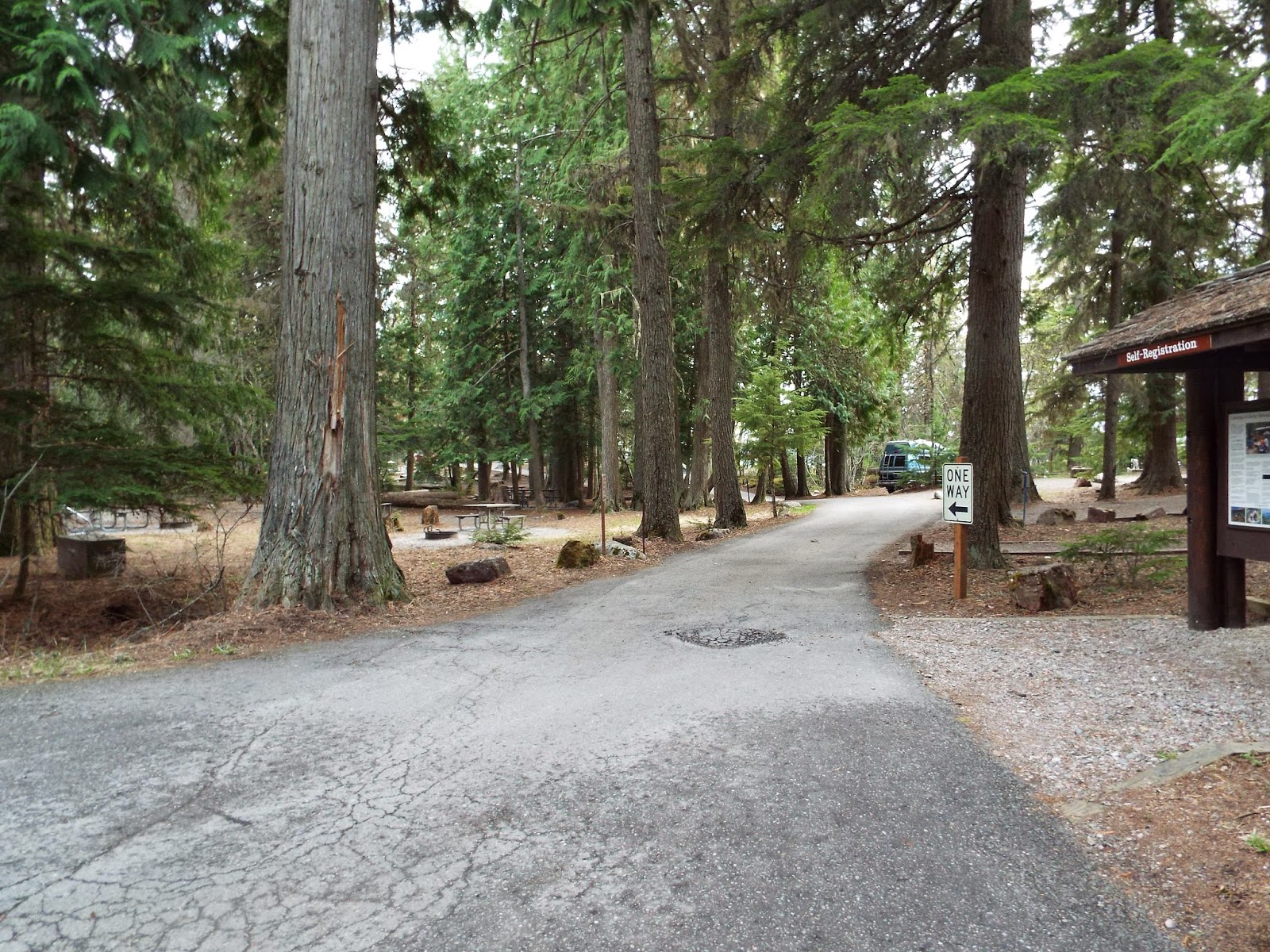
When you arrive in western Montana you are struck by the reality of "Big Sky" country. I don't know why, but everything seems bigger and more real.  The mountains are massive and both intimidating and beckoning at the same time.  The deafening rush of the Flathead River Middle Fork didn't hold a candle to the rush I was experiencing as we cross the bridge and entered Glacier National Park. From the gate to Sprague Creek is about ten miles. We are the only trailer permitted in Sprague Creek. About 95% of all campers who use Sprague Creek camp in tents, some just hammocks and a few truck campers. 

Within a week of our arrival we would be 90% full every night, and before Memorial Day we were at 100% capacity daily - often by noon. Most of the campgrounds at Glacier are first-come-first-serve. Sprague Creek is the only campground that has campsites actually on a lake. Others have sites overlooking a lake, but not where you can walk to the back of your campsite and go fishing. We had a game the campers played each morning starting about 6am. I called it 'Ring-Around-the-Campground'.  By looking at the campsite pole marker you can tell to what date the campers has paid. That doesn't mean that they are leaving that day. They have until noon to pay for the next day. So those who wanted spots, especially spots on the lake, would literally drive around and around the loop watching for signs of campers striking camp. If you want a place at Sprague Creek, or actually to get a good place almost anywhere, you need to plan your arrival for morning. I know that isn't easy. Some people will take a less desirable spot at one of the large campgrounds, pay for one night, and then be at Sprague Creek early the next morning. 
First trip up to Avalanche Lake

Reason to smile - she's HOME! 
Avalanche Creek
Pamela (L) had plenty of reason to be grinning. She was finally home again. We did our first morning rounds, did our work and headed to Avalanche Lake.  I think I've told you before that one of our jobs is to help visitors pick trails that meet their experience and abilities and what they want to see.  The teacher comes out of Pamela when we're working with visitors and she's been known to tell them that they're only allowed to go home after they've done Avalanche Lake Trail.  Avalanche Lake was actually where we encountered our first Grizzly bear. She or he was beautiful and just a bit over 100 yards from us. We were separated by the narrow end of a small lake but there was a log jam which the bear could have easily crossed. 

Crossing a snow field to Hidden Lake
Hidden lake 
Mountain Goats at Hidden Lake Pass
In mid-May you can sit at Avalanche lake and hear three or four avalanches every hour. You don't see them, but you do hear them. Avalanche Lake is ringed by Bearhat Mountain, the Little Matterhorn, and Mount Brown. The Continental Divide runs right along the top of the mountains just 1.73 miles due east.  Well, 1.73 miles east and almost 5,000 feet up!  Also northeast of Avalanche Lake is Hidden Lake. It is about 2,500 feet higher than Avalanche on the other side of Bearhat Mountain.  While it is only 3.17 miles as the crow flies, to get there you must follow the Going-to-the-Sun Road to Logan Pass, where the road crosses the Continental Divide - almost 19 miles - and then hike up the Hidden Lake Trail to Hidden Lake Pass.  The trail to Hidden Lake Pass wasn't open until mid-July because of snow. Even then the snow fields were still about 5 feet thick. To go down to Hidden Lake you need a special pass, good snow climbing gear and a lot of experience.  Since we didn't have any of those, we never made it all the way to Hidden Lake. Even in the picture above right ("Crossing a snow field") there is a 700 foot drop to the left.  Hidden Lake Pass is about 800 feet above the lake. While we were at Hidden Lake Pass we had some up-close-and-personal encounters with Mountain Goats.  There were some very narrow spots on the trail. When we encountered Mountain Goats coming the other way, all we could do was stand up close to the mountain and let them go by. They walked over our feet but never threatened us -- and they're big enough to do so if they wanted.  The picture of the goats is right at the Hidden Lake Pass and right on the Continental Divide. As I mentioned, the pass is 800 feet above the lake. Where the goats are standing it is 800 feet straight down. The kids were butting heads and playing king-of-the-mountain. They are amazing animals. 

We had great adventures and experiences from first light of morning until we went to bed. We hiked trails where the snow was 5 feet deep in July. We traversed trails inches from a thousand foot drop, and cycled up a road that wound its way up to the Continental Divide almost a mile and a half above sea-level and kayaked a lake so remote that it took us 55 minutes to travel the last 6 miles in a 4x4 truck. I got to go scuba diving in a lake carved by a glacier and fed by water from a glacier and snow fields.  We had campers from every state except Mississippi and Rhode Island. We had visitors from 27 different countries - young people going around the world, and a couple my age (late 60s) who were riding bicycles from the Atlantic Ocean to Alaska. Some of these people keep in touch with us. A young couple from New York ended up moving to Anchorage and invited us to visit. (1)  I could go on and on but I can't tell our story without telling about some of the most important people we met . . . . the full-time park rangers and or colleagues. 
Unsung heroes

The life of a full-time ranger with the National Park Service is not easy.  Because they are almost always among the first budgets cut, they live on very little and provide the American people with a service beyond value. They love their country and they love the national parks. They literally give their lives and are among America's unsung heroes.  The National Park Service consider volunteers employees.  We are treated with great respect and make some very strong and lasting friendships. About 50% of the staff at Glacier National Park are volunteers and I understand that is common in most national parks. Some times the NPS and the Rangers are so grateful for our help that it is almost embarrassing. But the truth of the matter is all of us are extremely honored to be selected and allowed to serve along side these highly trained park rangers.  
West side CGHs at our Sunday morning meeting.

At the same time I must sing the praises of my fellow volunteers who dedicate themselves to the parks and the people who visit them. Some of the people in this picture have been at Glacier for over 15 seasons. Some of them might actually work at more than one national park in a year. The lady at the front right travels by herself from Panama City, FL and takes care of a large remote campground by herself.  I can not tell you what a privilege it is to work with a group like this.  I can not express how proud I am to be associated with such wonderful people. 

Mt. Oberlin from Going-to-the-Sun Road 
When you are privileged to spend this much time living and working in the wilderness you become so appreciative of the experiences and want to share them.  We can show pictures and tell stories, but you, the reader, will not truly understand until you experience it for yourself.  I don't mean that you have to become volunteers for the NPS - although that might be in some of your futures (2) - but almost all of you can either come and visit us at Glacier (3) or spend some time in one of our many national parks. 

Pamela and I traveled almost 12,000 miles in 2014. We camped in wilderness areas for 124 days.  I love to share stories and pictures of our time at Glacier or any of our great adventures because each time I get to share this with someone I get to relive it. BUT I don't want people just to live the adventures vicariously through us. You can live your own adventures.  All of the pull outs at Glacier and other national parks are handicap accessible, and there is a magnificent trail at Glacier that is handicap accessible from which I took that magnificent picture "Avalanche Creek" above.  I can't tell you how much I enjoy sharing our adventures. It keeps the adrenaline pumping and helps me get through to the next adventure. But most of all I want our adventures to get you, the reader, out into our nation's marvelous wilderness to see and experience for yourself.  Then I know you will show up at the gate of one of our national parks, national forests, or state parks saying "I'm home!"  

===== Footnotes =====
(1) A young couple were camping on one of our lakeside sites. On the evening before they were to leave for a back-country adventure the young man realized that he had not been fishing. He took his fishing rod and went to the lake at the back of his campsite. He cast three times. The third time he thought he was snagged. It turned out to be a 10# lake trout. They knocked at our door late that night. They offered us the trout because they didn't have anyplace to keep it. We put the trout in our freezer (Willy actually has a small freezer) and cooked it for them when they returned from their back-country trip. Pamela and the young lady have kept in contact ever since. They were from New York but  fell in love with the western mountain wilderness. They ended up in Alaska and have invited us to visit them. 

(2) We had the opportunity to meet the brother of a Kentucky friend and his wife. They are from Oregon. They came with our Kentucky friends to visit us.  They are avid recumbent cyclist. We took them up the Going-to-the-Sun Road the day before it opened to automobile traffic. We could only go up about 12-15 miles because of snow cleaning but they had a great time. It wasn't until they started down that they realized how steep the road actually is. At the bottom they said "if we had known it was that steep we'd have never tried it."  They loved the wilderness and expressed wishing that they had time to be volunteers. As it turns out she is a physician between jobs and they're taking the time to be volunteers.  I got a referral call the other day from the head ranger at a Colorado national park. This could be you too! You never know.  

(3) While we love all of our time at Glacier, we must admit that May is cold, June is rain and snow, but July is beautiful.  There's a very true saying . . . . in Glacier there are two seasons - July and winter. The Going-to-the-Sun Road didn't open until July 2nd. (it has been later) because of snow and was closed Sept 9th because of snow. We had a snow storm on June 17th. which left some snow on us at 3,500 ft. and dumped 30" of snow on the Continental Divide just above us.  Sooooo, if you want to come visit us at Glacier, we recommend July.  If you want to actually spend time with us personally, we recommend early July. We'll take you to the 4th of July parade at Polebridge (population 15). It is an experience you'll always remember.  


RYUHIKO - 06

RYUHIKO -06-20150205


The storm disappeared leaving Ryuhiko and Moru standing looking up into a cold rain. They stood motionless and speechless for a long time. Finally Ryuhiko transformed into his human form, walked slowly to the bag of clothes, still lying under a nearby tree, took out a piece of material and wrapped a fundoshi around his waist. The cold rain felt like needles hitting his bare skin. He pulled out one of the robes and was putting it on when he turned to Moru, who had yet to move.

“What did he mean about my father, brother and sister?” Shinmasa's voice was soft and low. It was the voice of a man who had just gone to hell and back and wasn't sure if he had survived.

“What?” said Moru shaking her head as though she was just becoming conscious. “What did you say?”

“What did he mean about my father, brother and sister and the other dragons?” Shinmasa repeated a little bit stronger. He walked to where Moru was still standing staring after the disappeared Lefu. He took her by the shoulders and turn her to face him. “What did he mean? What haven't you told me?”

“Lefu Sefefo is my brother,” Moru turned her head away. Almost as though talking to herself, “he is so different. He is so full of pain and anger and hatred.”

“What did you fail to tell me? Why is he so intent upon making me suffer?”

“You are the dragon prince. That's why you are called Ryuhiko, . . .”

“I know what my dragon name means, but why?” Shinmasa interrupted. He squeezed Moru's shoulders and again turned her face toward him. “What haven't you told me?” His voice was now strong and insistent.

“Your father was the Dragon King,” Moru's head dropped as though the weight of the memory was too great to hold it up. “His name was Ryutada. He was our champion along with two of his children, your sister, Haruko, and brother, Ryutake. Any time that Lefu would try to hurt people or destroy something, your Father would stop him.” Moru raised her head and looked into Shimasa's eyes. “When he would rise up to face Lefu he was a blinding brilliance.”

The two sat down under a tree as Moru continued her story.

“Lefu created a horrible, malevolent creature he called Babe Kgwebo. It was like a cross between a plague and the anthropomorphism of pure terror, but Lefu loved Babe Kgwebo. I wasn't there, but my sister, Phoofo, the animal spirit, saw your Father destroy Babe Kgwebo. She said that Babe Kgwebo got too near to your Father. Your Father put his paw on Babe Kgwebo's chest and sent a beam of light straight through him. Lefu was so incensed that he went on a rampage starting wars, feeding hatred and prejudice, and violent storms wherever he went. It was all that your Father, brother and sister could do to contain him.”

“One day shortly after you were born Lefu caused a great storm at sea around an oil platform that had been poorly capped. He liked to use that type of situation. Greed was the reason for the well being poorly capped, and when people found out they would be angry and want revenge. It always played into Lefu's hands that way. Your Father, Haruko and Ryutake went to protect the platform. But the greed, selfishness and lack of caring that surrounded the platform made Lefu stronger and stronger. The oil gushed to the surface like the welling up of centuries of oppression and anger. The derrick caught on fire and began to buckle. Men were trying to escape the flames by jumping to their death in the oily sea. The three dragons were trying to save the men but there was no trust or faith. The doomed men died believing in the very ones who caused their death. Little by little Ryutada, Haruko and Ryutake were pushed under the oil by the weight of the oil rig and all the evil that went with it. They drowned trying to save the humans. The human news media reported that a bad storm had damaged an oil platform. It never mentioned the death and the millions of gallons of oil that poured into the sea.” Moru dropped her head and cried. It seemed to Shinmasa that the branches of all the trees around them sagged as though burdened with a great, unseen weight.

Shinmasa put his arm around the sobbing woman. She might have been a powerful spirit, but right then she was as vulnerable and fragile as a small child. The forest around her was sharing her grief. It took some time before Shinmasa could bring himself to ask her the next question. He just sat and held Moru as she cried.

“What did he mean about the others?”

“They're all gone. All the dragons are dead except maybe three or four others whom Mahotsukai Ryunake hid.”

All gone?!”

Your Mother's name is Ryu 'Me,” Moru looked up at Shinmasa. “She was the last of the Dragon Mothers - women who could give birth to kawizate dragons. Lefu found and destroyed all of the other Dragon Mothers. Mahotsukai Ryunake gathered the other surviving babies and hid them around the world and then took away your Mother's memory of who she was so she could not be discovered by Lefu or his henchmen. He did not, however, take away her belief in dragons. That is what helps make you powerful. Mahotsukai Ryunake is out right now trying to find the others without Lefu knowing.”

Are my other brothers and sisters dragons?”

No. Just you.” Moru smiled. “Your Mother is a great woman. For many ages she carried and gave birth to kawizate dragons. A few years before the birth of your oldest sister, your Mother fell in love with a mortal - your earthly Father. He was a good man and cared deeply for your Mother. Your Mother gave up being a Dragon Mother and immortality for him. He never knew. It was a decision I don't think she'll ever regret. But my Mother, Me Tlhaho, was worried about Lefu and asked your Mother to carry one last kawizate dragon. You.”

Shinmasa sat trying to digest everything he had just heard. It was hard enough to learn that you're a dragon, but even harder to learn that you're a dragon prince who is the target of a spirit who possesses all the hatred and evil in the world. Then, if you get past that, you find that you might be the last dragon and it is going to be up to you to stop this super-powered evil spirit to save the world. No pressure.

Moru had stopped crying and was pressed tightly against his chest. They just sat.

Thabeng arrived a few hours later. She made another rather unorthodox entrance. Shinmasa really liked Moru's younger sister. He had assumed, since mountains are so majestic and at times stern looking, that Thabeng would be big, powerful, stately and a bit on the serious side. To the contrary Thabeng was more of a female version of Peter Pan, or perhaps even better, the typical comedy movie stereotype of the blonde female cheerleader. Shinmasa knew that there was no way she was as scatter-brained as she presented. This had to be her 'I'm off the clock' behavior.

Oh, I have the greatest place for you, Ryuhiko. It is near the peak of a mountain that rises about 9,000 feet. It is right at the top of a cirque that was created by a glacier and there's even a lovely lake in the middle of the cirque. It is so remote that even I haven't been there before, but it is gorgeous. You'll love it.” Thabeng paused a moment and did a little dance, then picked right back up as though she'd never stopped. “And I made a large area for when . . .”

Moru interrupted. “Why don't you show us instead of tell us?”

That's a great idea,” Thabeng giggled. “That's why she's my big sister,” she said to Shinmasa. Then turning back to Moru, “It should be exactly 47.29 miles northwest of this spot.”

Could it be 47.3?” teased Moru.

Nope,” Thabeng evidently didn't joke about that sort of thing. “47.3 would put you on the western side of the ridge and you'd miss it completely.”

In that case, lead the way sister,” Moru laughed.

Shinmasa took off the robe he was wearing and was standing there in his fundoshi. He transformed into Ryuhiko leaving only the cloth of the fundoshi lying on the ground. Moru picked up the cloth and robe, stuffed them into a bag, and climbed onto Ryuhiko's back.

Thabeng led them exactly 47.29 miles northwest. As they approached Ryuhiko noticed a dark spot high on the cliff above the cirque lake. Thabeng led them straight to it.

Landing in a cavernous area in the side of the mountain, Thabeng took on her human form and danced around the entrance to the lair. She was so excited about her creation that it as all that Shinmasa and Moru could do to keep up with her chatter. The entrance to the lair could not be seen from the lake below, which made it virtually invisible. Just inside the lair was a large room. To one side was an area filled with human amenities, but the most of the room was created for a dragon.

As Thabeng danced around the lair chattering happily, Moru took hold of Shinmasa's hand. With a gentle squeeze she said “This is where it begins. This is where you will learn to be a dragon.”

I know,” Shinmasa replied looking back toward the east where they had encountered Lefu. It was late afternoon and the setting sun reflected like a red glow off the mountain tops. He thought of the old sailors' saying 'red sails at night, sailor's delight'. The view was breathtaking and he hoped the red sky was a good omen. “I know,” he said squeezing Moru's hand tightly. 


Wednesday, February 4, 2015

VEGETARIANS SURPRISE

At this point in my blogging career I can be fairly sure that most of my readers know that I am a vegetarian.  Using the method of throwing out the extremes and averaging the remaining figures, it appears that vegetarians represent 15-20% of the US population.  That does not include vegans. Most people do not know the difference between a vegetarian and a vegan.  A vegan will not eat anything that comes from an animal - no butter, milk, cheese, etc.  There are two types of vegetarians.  There are those who are vegetarian for nutritional reason and those who are vegetarian for spiritual/religious reasons. Some of those who are vegetarians for nutritional reason will eat fish because of its nutritional values. The spiritual/religious vegetarians cover a broad spectrum. This group does not eat "sentient beings".  I'm sure you've already guessed that the definition of "sentient being" is problematic. So the behavior of this group of vegetarians covers a wide spectrum from those who will eat some seafood because they define it as non-sentient to those who literally sweep the ground ahead of themselves with a broom to avoid stepping on an insect. I fall somewhere in the middle. I avoid killing insects but at times I feel I have no choice. I don't get involved in the definition game, so I just don't eat any seafood.

Now one would most likely conclude that vegetarians are a rather innocuous group.  Most carnivores probably say "hurrah for vegetarians. That's more meat for me." A lot of people like to make fun of us, but it's generally unoffensive and good natured, so we either laugh, ignore it or hand it right back. Vegetarians seem like the perfect conservationists.  It makes sense since we don't want to kill any animal and want to preserve life.  But what if it turned out that the vegetarian actually might contribute to a potential environmental crisis?

A great number of sources say that vegetarianism is growing in the US. As I said, I used the throw out the extremes and average the rest to arrive at the number of vegetarians in the US.  I found the low of  2.6% to a high of 38%. Those are the extremes. I admit to not liking Gallop Polls. They take a small sample, almost never distributed across the country, and try to generalize the results to the entire US.  They came up with the 2.6%. You can not take a sample of 1,014 adults and generalize the results to 316,000,000 people spread out over 3,626,328 square miles!!!  Obviously it went out with the absurd. The study claiming 38% added three group together, again putting it in the realm of the extreme.  I believe that the resulting average is a bit low - 16.5% - but I can live with that. I can live with that especially since that isn't really important. The point is that this number is growing and appears to be growing rapidly.

So what kind of environmental crisis could the growth of vegetarianism cause?  As the numbers increase the demand for meat decreases. What is the potential long-term impact on the feed lots? What might be the long-term impact on natural wildlife?  Obviously this isn't going to happen overnight, but is there any sense in waiting until we have a problem? We have eliminated predatory animals across much of the United States. By eliminating the natural predators, deer and other animals are not only growing in numbers even with hunting but could be facing a crisis - starvation, etc. - if human hunting for food were to decrease.  We have also removed a great deal of natural feeding grounds along with the predatory animals, so we have thrown natural balance totally out of whack.

Red lines indicate food corridor prior to Interstate 
Before I-164 was built less than a quarter mile from my home I had deer, fox and a host of other animals on my property. The deer and the fox are totally gone. I own the right-of-way of an old trolley line that has food and shelter for a number of animals. The interstate cut this resource off for the animals, confining them to a small strip of land along the Ohio River that floods almost every year.

Obviously I am not a hunter and I don't agree with stalking and killing another living creature, but I don't condemn those who do hunt, especially those who hunt only what they are going to eat. There is little doubt that the human animal started as a gatherer and moved into being a hunter-gatherer. Our physiology confirms that we are omnivores. But at some point we started moving from hunting for food to hunting for pleasure and began to over hunt and exterminate entire species of animals.  I purposely do not use the term "sport" because my experience, although lacking any statistical backing, is that most "sport hunters" eat what they kill. They may enjoy the hunt but that's no worse that a farmer who enjoys tilling the soil. Would that mean the gardener or small subsistence farmer is a "sport farmer"? It seems that "sport" has almost become an economic/tax law term; viz. if you don't need to hunt to eat, then you are hunting because you want to hunt instead of buy your meat and that makes it a sport. I know quite a number of hunters who abhor trophy hunting and killing without reason, or what I am calling "pleasure" hunting. Often time these "sports hunters" are far, far more environmentalists and conservationists than non-hunters. Nevertheless, because of the human animal's historic lack of conservation and uncontrolled killing of predatory animals, we have become dependent upon hunters to control animal populations.  That is sad.

Here are some ideas to think about.  Even as a vegetarian who is a vegetarian because I do not want to kill other living creatures, I would much prefer that, if you feel compelled to eat meat, you hunt and eat what you kill. If you can't do that, many hunters would be happy to share or you can buy locally raised animals. In other words, avoid feed lot animals which flood the market place with meat filled with chemicals. And being so packed into an area that you spend your entire life standing up, has to count as cruelty. Because you are raising an animal to kill for food doesn't mean that you have to be cruel to it. Ending feed lots would not only create a better balance of supply and demand but it would be much healthier for the carnivore.

http://opossumsocietyus.org/faq-opossum/
Hunting groups have a great influence upon what is killed. I would suggest that it is to everyone's best interest that we stop killing animals that are considered a nuisance or just not necessary. We may not have figured out the purpose of the mosquito, but most of us can realize that every other creature on this planet has a purpose, and by destroying them we are destroying ourselves or the lives of our progeny. Take, for example, the opossum. It may seem like a useless animal to some people, but it is one of nature's garbage collectors like the vulture. Scavengers play an important part in a healthy world and the control of disease.

The care and maintenance of our wilderness is an important means of creating a win-win situation for all creatures.  We need not only to permit the return of the predators to their natural habitat but provide for sufficient wilderness so that they do not conflict with humans. This means not destroying any more of our wilderness. Wilderness is not a renewable resource. Thankfully, if carefully done, predators can be reintroduced. There have been several very successful projects of this sort. This permits the return of the natural balance of nature.  It doesn't mean the end of hunting. We could actually expand our protected areas so that there is a fringe along the wilderness that would permit hunting. This would not only help protect the predatory animals by keeping them even farther away from human development but would provide the hunter with abundant game.

Last, but not least, we would do well to copy a project that Pamela and I saw on several occasions in the west.  Earth bridges are built across highways and interstates.  Sometimes tunnel like areas are created along known animal trails, but the bridge seems to work best because there is no sense of being confined so the animals can cross the wide grassy areas almost without awareness of the highway. This permits the animals to move along natural migration corridors and to reach important food resources.

Perhaps the vegetarian really isn't going to cause an environmental crisis, at least not in the US and not in our life-times. Nevertheless the consideration of such a scenario gives us plenty of food for thought.  To protect our magnificent land and preserve its bounty as well as its beauty for generations to come, we need to be proactive.  We need to find the common point with others who might not totally think as we do and work to protect our children's birthright.

One last vegetarian cartoon . . . .


Monday, February 2, 2015

WILLY'S FACE LIFT - INSTALLMENT 8

This was a very productive day but not one of the more exciting.  As I told you in the last installment, we decided that all of the edging needed to come off. That meant that I had to remove the seam molding on the roof.  That's a bit scary, but I've become accustomed to scary.  Everything new major task is scary - taking out windows, cutting water lines, opening seams and removing wood, taking off air conditions and opening the roof seam. I can't say that I'm immune to scary, but I can say that it no longer keeps me awake the night before.

I was a bit surprised today to find that the molding along the roof-line didn't go over the edge - didn't cover the edge - but the metal from the roof was folded over the side and was tacked down by this molding.  I like our way better.  Our new molding will be one unbroken piece that will seal down over the edge where the roof and the side of the trailer meet.  I know the trailer purist are probably having hissy fits about now, but I am so happy with our choice of edging even if it was designed for a pole-barn. It will take about 3 times more butyl tape to make a secure seal, but when done there is no gaping and a far superior edge.  Yes, the screws will show, but everyone knows that the screws are there. Besides Air Stream made screws and rivets a part of an icon.  In any case, besides providing more protection it is also going to be a lot cheaper.  The vintage trailer molding we ordered costs $2.47/foot. The molding we are using costs us <0.50/foot.  We've saved over $200.

Roof edge after old molding was been removed 
I should have know that there had to be a problem removing this molding. Everything else like this has gone flawlessly.  There were about six screws that just wouldn't come out. It took me most of an afternoon to get them off. It also took a lot of time to clean off the old adhesive. Fortunately there was only about five feet where they had smeared it with silicone. The first picture is of the roof before cleaning with Goo Gone and a putty knife.  The second is after the cleaning. The dark lines are the staples that are currently all that's holding the roof on. The old screw holes are rather obvious. The will be filled. Goo Gone is great stuff.
Roof edge after a cleaning with Goo Gone

New wood on back curve
Perhaps my proudest moment came when I was ready to leave and decide that I didn't really like the idea of putting foam in to a gap where the roof bends. There's no weight or pressure on the area so expandable foam is a good filling, but I really wanted wood to give greater structural integrity. I decided that I'd give it a go. I made a pattern and cut two curved pieces out of 1x6 treated wood. They fit perfectly. I have to admit that I'm exceptionally pleased. Here's a picture of the pretty new wood before I close and screw down the side skin.

This means that the next step is to find any more areas that need to be repaired and start sanding for painting.  It would be nice if we could get it painted by the first of next week.  Like I said, we're getting accustomed to scary - so we are actually looking forward to doing the painting.

I hope my next installment with have a picture Willy ready to be painted. Then all that will be left will be to put on the molding, seal the roof, and re-install the air conditioner.