I have been remiss in my posting to this blog. I could blame it on feeling that no one really reads it or cares, but that's just an excuse. If even one person reads what I share, then I'm happy and hope that they take something away that they didn't have before - a piece of knowledge or a sense of wonder at what we have on this earth. (Actually after I wrote that sentence I learned that there have been several hundred visits to my site. Happy!)
As an attempt at making amends I'm going to share some of what I experienced since my last post. I spent from early May to the end of July as a volunteer for the National Park Service at Glacier National Park in Montana. I have Pamela Smith to thank for that. We met in December of 2013. We bought a vintage trailer in January 2014 that we named Willy. Willy is a sixteen foot 1985 Fleetwood Wilderness. He's a work in progress but we've made a lot of progress and are proud of him.
In 2014 alone Pamela and I travelled 12,000 miles together, camped in the wilderness for over 120 days, rode our bicycles almost 300 miles, trekked almost 500 miles, kayaked over 30 miles and went scuba diving in the icy glacier waters of Lake McDonald, GNP, Montana as well as the warm waters of Panama Beach, FL. and quarries of western Kentucky.
We spent our time at Glacier working as camp ground hosts for a small 25 site campground about 11 miles into the wilderness. People see the word "park" and forget that it is really wilderness and should be respected as such. While we are treated like park employees, it is embarrassing to call what we do "work". Trailers and large campers are not permitted at Sprague Creek. Over 95% of our campers sleep in tents or hammocks strung between trees. Our job was to help them know how to live safely in the wilderness, find appropriate trails and activities, and respect the wildlife. It was great fun. We did "work" an average of 9.5 hours a day, 7 days a week, but we had more than ample time for fun. We would open a gate and check on the campers early in the morning. By noon the campground was either full or we had things under control. From then until evening we could often play. In the evening we worked until about 9:30 and then retired early.

This is a picture of the view from our campsite. It was our inspiration each morning. I went scuba diving in this lake. It is 500 feet deep. Carved by a glacier it is fed by glaciers and melting snow. I waited until July 5th. to go diving - allowing the water to get as warm as it was going to get. Even then the water was only 40 degrees at the surface. Thanks to Tammy Storm and Larry Babcock of Aquatech Diving in Evansville, IN. I had a safe and enjoyable dive. Larry got me outfitted with the correct diving gear and Tammy taught me how to dive in high altitude and cold water.
It should also be noted that every drop of water that falls as snow or rain in Glacier has a direct effect on the water across continental North America. Glacier water is the original source for three systems. All of the water that flows down the west side of the Continental Divide goes into the Pacific Ocean somewhere along the Pacific coast. The water on the east side of the Continental Divide either goes north into Hudson Bay, and therefore effects everything in eastern North America as it makes it way to the Atlantic Ocean, or south to the Gulf of Mexico via the Missouri and Mississippi Rivers. This area is so sensitive that hundreds of scientist constantly monitor our waters and the lakes are carefully protected.

A picture of me as we trekked along the Avalanche Lake trail. In May at Avalanche Lake one could hear 2-3 avalanches every hour. Generally you could not see them. They were in the mountains far above us. Avalanche lake is only about 3,500 ft elevation. But it is a magnificent place.
Pamela had a lot to smile about in this picture. This was one of the first days we were back in her beloved Glacier and we were out trekking the wilderness. Nothing makes her happier. Yes, that's snow in May even at only 3,500 feet elevation. We had a snow storm on June 17th that dropped 30" of snow on the Continental Divide above us. At the end of July, just before we left, we were still trekking over snow fields that were 5 feet deep. It is said that Glacier has only two seasons - July and Winter.
The mountains of Glacier are actually the lowest in the Rocky Mountains, but they're high enough to be magnificent. We lived at 3,200 ft. and played at 6-7,000 ft. There are only about 1/2 dozen peaks above 10,000 feet in Glacier, but look at the next picture and tell me they aren't magnificent!
The Going-to-the-Sun Road was closed because of snow until July 2nd. but we were able to hike or bicycle the road up to where they were clearing snow . . . about 2 miles from the Continental Divide. Above is a picture that I captioned "The view from where we were forced to turn around". The reason we had to turn around was an avalanche that had buried the road. The road goes from 3,200 feet to 6,600 feet in 14 miles. Pretty steep. We rode up the road on our bikes about once a week until it opened to car traffic. The road had to be closed down again on September 9th because of snow. Like I said, . . . two season . . . . July and Winter.

This was our first Grizzly bear. He was just a bit over 100 yards from us with a small lake between us. He looked at us a couple of times, but didn't seem interested. We met another one on the east side of park and were much closer. The bears at Glacier have not experienced human food and we work hard to keep it that way. One of our main jobs was educating people about camping and hiking in bear country. Even though there was evidence that a deer had been killed (probably by Mountain Lion) within 50 yards of Willy, we never had problems with bears or mountain lions in the campground. The Mule deer, however, would wander through the camp each day.
Here is a Black Bear play-pen. These two were high up in the top of a tree. Mom was about half way down the tree taking a nap.
After our 'tour-of-duty' was over we enjoyed some time camping and hiking on the east side of the park. It is very difference. The west side is lucious forest like the rest of the Pacific Northwest. The east side is rather stark and open, by comparison, like the great plains which come right up to the mountains. Above is Iceberg Lake, about ten miles into the wilderness. It has icebergs in it the year around. We waded in the water but our feet started going numb in less than a minute.
We made the trip to Glacier in 2 and a half days because they opened our campground early and we were rushing to get there. (Relax, I didn't drive fast with a vintage trailer in tow. We just drove for 14-16 hours each day.) We took two weeks coming home visiting 5 National Parks/Forests and camping at three of them. Above we are camped at about 8,200 ft in Rocky Mountain National Park. Even though we had spent 10 weeks working and playing at high elevations, this was higher and took some adjusting.
Here I am at 11,900 feet. We hiked up about another 2-300 feet along a narrow ridge until we saw a thunderstorm coming. Standing on a narrow ridge at 12,000+ feet with nothing higher than you isn't a good idea in a thunderstorm. We were about 4 miles from the truck and scurried back. Up here we got to enjoy the tundra. The tundra, despite is appearance, is quite delicate. A misplaced foot-fall can wipe out plant life that will take decades to replace.
From what we understand about 1/2 of all the workers in our nation's National Park Service are volunteers. That is certainly true at Glacier. This is our group of campground hosts who work on the west side of the Continental Divide. Most of us are retired. Within a week of this picture one of these couples were dropped by boat into the most remote spot in the Glacier wilderness. From there they hiked further into the wilderness for three days to small lakes where they counted Loons. They were totally on their own.
This is Avalanche Creek. One of our favorites. We told all visitors that they weren't allowed to go home until they had hike Avalanche Lake trail along this creek. Unfortunately the number one cause of death at Glacier is drowning. Despite what we tell visitors they get too close and end up falling in. If you fall in, you are dead. The man with whom I went scuba diving at Glacier has the job of retrieving the bodies.
Here's a picture of Pamela riding up the Going-to-the-Sun Road. At this point we're about 10 miles from our starting point at the Avalanche campground (3,200 ft) and at an elevation of 5,200 feet. Around the corner just ahead there is a 1,400 vertical drop! You don't want to miss that curve!
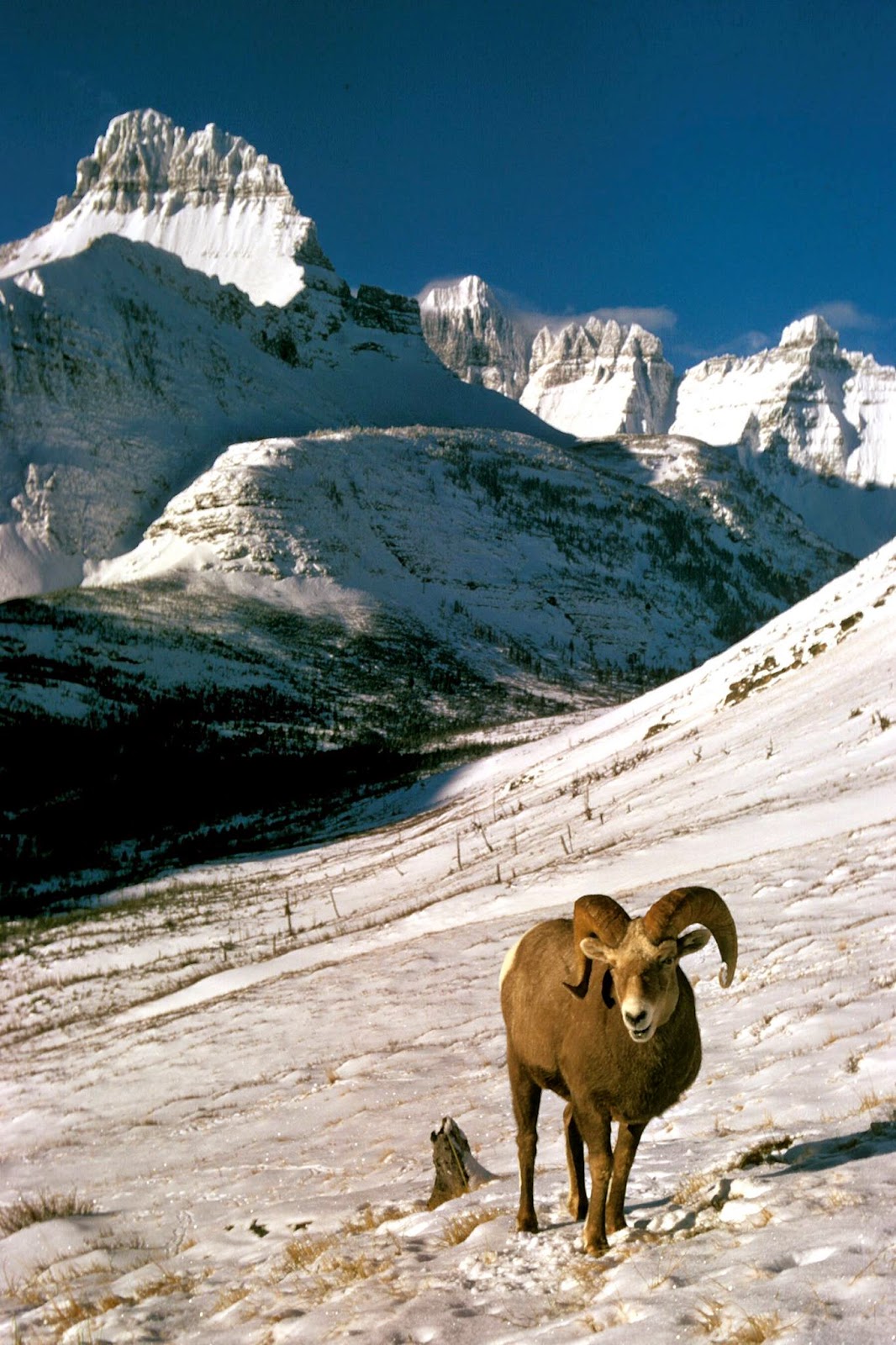
We crossed paths with Great Horn sheep, Mountain goats, Mule deer and many other animals. On one occasion we met some Mountain goats on a narrow, snow-covered trail with an 800 foot drop to the side. It didn't bother them. We pressed ourselves up against the mountain and they walked over our feet. It was definitely up-close-and-personal!
This is a picture on the east side of the park with our friend, Judy, from Cincinnati. She was one of two women who made the trip to Glacier and tended a campground alone. The other was our good friend, Jane, from Panama Beach. We had a great visit with Jane at St. Andrew State Park in Panama City in October. She too is a diver. In the picture above we're on a guided trek. The ranger was extremely knowledgeable and has two books published. We are taking a break after about 5 miles out and a 2,000 foot climb. The two of them had me take over 100 pictures of wildflowers and plants. Pamela is planning to do a field guide for Glacier wildflowers.

This bear was actually closer than the picture shows. We were going along the Going-to-the-Sun Road when we saw this bear running toward us at full speed. Despite our efforts, we can't get most visitors to spend $30 for bear-spray for their own protection. There were a number of visitors on the road but Pamela and I were the only two with bear-spray. We were suddenly everyone's best friends. The bear stopped running a hundred yards or so from us. All Glacier employees must attend "bear school". We were no exception and so we applied what we learned. But bears all have their own personalities and this one wasn't going to be put off. He kept walking toward us. The road is only 16 feet wide. The bear walked along on one side while we stood on the other with all of the visitors behind us. He ambled off down the road and everyone was happy. The visitors all had a great bear story to tell when they got home. Employees are asked to report any bear sightings. Pamela and I turned in 15 reports (some of them reporting as many as 4 bears) in 10 weeks. Glacier is definitely bear country.
There are not words that I can type or say, sounds that I can make or any means of communication that will express the feelings of wonder, awe, love and excitement I felt every moment I spent at Glacier and in the high Rockies. This is a marvelous part of the paradise which has been entrusted to us to care for and turn over to our children unblemished. If you have not been to Glacier or the Rockies, it is a must do trip for you. Even if you can't bike, hike, kayak or camp, your National Park Service has made sure that you can enjoy these marvelous places up close with many handicapped assessible areas. It is an experience that will leave you wanting to start sing "America the Beautiful".
P.S. I feel compelled to add that without your help . . . without your raising your voice and vote to stop greedy developers and companies who don't care about environment or wilderness but only the bottom line and stockholder profits . . . without your involvement this too will pass. And wilderness is NOT a renewable resource. Once it's gone. It's gone. Join Sierra Club, National Wildlife Federation or one of the great organizations who work everyday to protect this country for you and your posterity.