Thursday, November 5, 2015

Looking out the window

Looking out my bedroom window
I sit and look out the window. Funny. It hasn't been that long ago that I would have been shaken with guilt for spending my time on such a frivolous activity.  Actually, it is hard to admit but there was the day when the last thing I would think to do would be to look outside.  Those days seem so long ago but, as I look back at the computer, I realize that for so many people, such a tremendously high percentage of the population, that is current reality. That makes me sad and so I again turn to the window.

Out there is where I know real life.  It sounds corny but it's true. I had always liked the outdoors as a kid. I was the youngest member of a group of Explorer Scouts that were known for seeking out the most outlandish, wild adventures allowable. Well, sometimes we used the 'receiving-forgiveness-is-sometimes-easier-than-obtaining-permission' approach, but not too often.

One November in the late 1950s we decided to take a canoe trip down the French Creek. French Creek flows into the Allegheny and that becomes the Ohio River at Pittsburgh.  The thing is that we lived in the foothills of the Allegheny Mountains in northwestern Pennsylvania.  It can start snowing there in October and often does. But we were determined. David Smith, the group leader and my next door neighbor, had a canoe known as 'the tipsy orange crate.' Only a few of us rode with David because it was so easy to flip. One of the boys hounded David for over an hour to let him ride in the tipsy orange crate. Finally David gave in. I switched places with the boy. Shortly we hit some fast moving water made worse by wind and snow and the next thing we knew David and the boy were in the water. We all made our way to a spot along the bank and built a large roaring fire. It was snowing hard by this time. We created a human wind-break as the two wet adventurers stripped down to their skivvies and dried by the fire. Once they were fairly dry I again took my place with David and we made our way the remaining miles to where the trucks were waiting to pick us up.
Covered bridge across French Creek in western Pennsylvania
I had always loved being out in the woods or in the water. I took my children camping. When we lived in McKean, PA we bought 40 acres of hilly woods. It was our get-away place and we camped there whenever we could.  My children seemed to enjoy being out there. That was before the days of cell phones, so we were alone. Come to think of it, that was also the time of life when we lived on five acres. We had two horses in the barn, a quarter of an acre in garden and four hives of bees. We canned 1,000 quarts a year. The well in the barn froze every winter so I had to take water to the horses in 5 gallon containers on a toboggan. I had a well beaten path from house to barn. One evening I was late getting home. When I got out of the car I could hear my wife screaming. She had tried to help out and take the water to the horses. She fell off the path. She was only 5 feet tall and the snow was so deep she couldn't get out. The average snowfall in that area was 110" of snow by January 1.  But we thrived.

When had I closed myself off to the out-of-doors?  When had I given up really living?  I'm not going to bore you by attempting to answer those questions. Actually I'm not sure they're worth the effort because somehow I found my way back.

 Goofy 40 mile back-to-back. Cinderella's castle just before dawn
18 miles down. 22 miles to go.
The closest I can come to identifying a starting point for my new life was when my Grandson was looking for someone to do a Disney 5k with him. His Mother was running the Walt Disney World Marathon so she couldn't do it. His Father was facing knee surgery and his sister was at college. That left Grandpa who was, at that time, walking with a cane because of arthritis. It took me five months to be able to "run". My first 5k race was the day before my 63rd birthday.  The next January I ran the Walt Disney World 1/2 Marathon. Before I was done with road racing I had done the WDW Goofy (a 40 mile back-to-back race) three times. Then I discovered trails and the ultra-marathon (runs of >40 miles) became my passion. I ran on beaches, in mountains and across deserts. I was back in nature. My life was renewed.  My life was saved.

I was getting ready for my last WDW Goofy when I met Pamela.  Before she starts thinking she caused me to give up the Goofy, let it be known that I gave them up because of the cost.  It was costing $600 plus room, board and transportation to do the Goofy.  Pamela and I met because of our mutual love for running. Then we discovered our other mutual loves - all centered around nature and being out of doors.  We spent most of that January hiking and camping around western Kentucky.
Pamela hiking at Penyrile State Park

Camping in Willy at Land-Between-the-Lakes, KY
Primitive camping - nothing but a place to park.
I'm sure our families thought us nuts when we bought Willy together after knowing each other only a month. But the kids all agree that we are like the proverbial 'two peas in a pod.'  You have to admit that you must be really compatible to be pretty much attached at the hip and live in 128 square feet for 90 days without even an argument. In that first year we not only worked at Glacier National Park from the first of May to the end of July but we traveled 11,700 miles, camped 134 nights in 17 states, visited 10 national parks/forests, cycled 300 miles, hiked 450 miles, kayaked 20 miles and went scuba diving in a glacier lake where the surface temperature was only 40 degrees on July 5th. Life doesn't get much better, but it did.

In my last blog I quoted Henry David Thoreau. I realized that, just as he feared and worked to avoid, I had come dangerously close to coming to the end of life without having lived.  When I was traveling alone and doing the ultra runs I had a pop-up trailer. On the side, written in Irish, was my motto "Don't stop living before you die." It was written in Irish because that made people ask me "what does that say?" I loved to translate it for them.

My first trip to St. Andrew State Park in Panama City, FL I had my pop-up. I parked it so close to the water that my pull-out bed literally hung out over the water. I could lay in my bed and watched alligators cruise the lagoon. When I went back with Pamela she had just started snorkeling and was so engrossed in following a giant sea turtle that she didn't realize that she was going right out to sea. I had to grab one of her fins to stop her. Pamela fell in love with all of the sea creatures along the jetty. I encountered an enormous Goliath Grouper in a sunken ship and six Barracuda each as big as me. What marvels of life on planet Earth! What treasures!  We would walk or bike along the edge of the fragile dunes admiring and taking pictures of the plants. In the evening we would watch the sun go down in the placid lagoon then lay in our bed in Willy with the lights out listening to the sounds of life around us. And we were a part of that life. We had torn down the wall which homo sapiens have built around ourselves that makes nature something strange, foreign and threatening.

There is current research which believes that it has discovered that DNA has memory or carries memory. Perhaps we had somehow triggered a primordial memory that allowed us to return to being one with nature like our hunter-gatherer ancestors. People generally think of the hunter-gatherer as being poor and struggling, but that's only because we think we have to have so many possessions. Marshall Sahlins calls them the original affluent society.(1) They were rich in the treasures of nature around them. Each day we spend away from our sad, burdened, depressed, troubled modern society and in the midst of nature we realize how rich we really are. We are connected to all around us and we know our oneness.

Lake McDonald at sunset.  We live at the foot of the first mountain on the right.
Our campsite at Glacier National Park is only yards from the beautiful Lake McDonald.  From the very first evening we were there Pamela would go to a spot on the lake each evening and 'wait for the pink', the beautiful sunset.  We would sit and talk about the day and the wonders around us. We would share our thankfulness for being privileged to spend our days in the wilderness and the sense of oneness we felt with all around us. This was not a foreign, scary place. This was home and we soon knew that. I would refer you to my blog "The journey home" (2) where I share the experience of returning to Glacier.  Hiking trails and climbing mountains in the middle of 150,000 square miles of wilderness makes you aware that you are not the master of this planet but a part of its complex being. You understand your oneness with the animals, plants and land around you. You begin to see your place in the order of nature, where you really stand in the food chain, and how your footsteps on the mountain leave the earth changed forever.

As long as there have been philosophers there has been the ongoing debate on whether there is meaning to life and if so, what is it.  I'm not going to pit my puny intellect against the great philosophers of our age or any other age, so let me simply state observation and opinion. I believe that life has the potential to have meaning but we must give it that meaning.  In my thinking the jury is still out on whether there is any innate meaning to human life. Like other animals we are born because we are conceived and what happens in and/or to our lives is dependent upon a host of variables, most beyond our control. I won't argue that one can not give their life meaning without thinking about it, but I am of the opinion that most of us will not have one of those experiences in life that natural draws us into a meaningful life. If we have a meaningful life it will be because we determine that we want our lives to have meaning. We must determine the definition of meaning since philosophy can't actually agree upon a definition of meaningful. In their defense, it is an almost impossible definition therefore we must be the ones to decide. I strongly believe that experiencing a meaningful life is much less likely and much more difficult to achieve in our modern world where we are encapsulated in a stainless steel shell designed to protect us from reality and the world around us. If you notice people whom you would have to say lead meaningful lives, they have exposed themselves to reality, to the true nature of the world.

Nature is not other. Looking out the window it is easy to see nature as "out there" but that is not true. We are a part of nature - good, bad or neutral. I look out the window at the trees and the plants. We have a symbiotic relationship. We provide them with carbon dioxide and they provide us with oxygen. It is when we forget that we are totally dependent upon everything else in nature that we fail to have a meaningful life and we become the invasive monsters we are today. Our ancestors knew that they were a part of everything around them. The ocean, mountains, prairie and desert were their source of life.  They never had to think about environmental management or renewable living. They were part of the nature.

Looking out the window I see the trees and watch the dogs race around the yard and enjoying the openness. I am reminded of the nature I love and of which I am so joyfully a part.  The sunlight shimmering through the almost leafless oaks create an ever changing pattern of light that lifts my spirit.  The earth is preparing itself for its winter rest, and watching I know that we are one.
"There is pleasure in the pathless woods, there is rapture in the lonely shore, there is society where none intrudes, by the deep sea, and music in its roar; I love not man the less, but Nature more."               Lord Byron 


FOOTNOTE: 

(1)  Sahlins, Marshall. (1972) The original affluent society.  http://www.eco-action.org/dt/affluent.html. This essay is one of his best known and seems to have been published circa 1972. 
(2)  Vance, Russell (2015) Our Journey Home.  http://oldconservationist.blogspot.com/ 2015/10/our-journey-home.html


Tuesday, November 3, 2015

Walden Pond Full-Timers

It is already after 9am. Pamela had a meeting in Versailles, KY., a small eastern Kentucky town about 11 miles away. I stopped at a grocery store on the way home to pick up a couple of things I need for dinner tonight. The dogs are happy to hear me return. It is still quite chilly outside so only Atilla-the-Honey stays out very long. In fact, she's still sitting outside seemingly enjoying herself. Teddy, the elder of the three at 14 years old, is lying near the space heater. I had turned it on because it was only 54 inside. It's already up to 64, probably because I'm seasoning a new piece of cast iron cookware and the oven is on. It stinks, but it's worth the smell as well as the effort. Cubby, our 11 year old, has found one of the dog beds and is sleeping. He can always find the softest available spot.
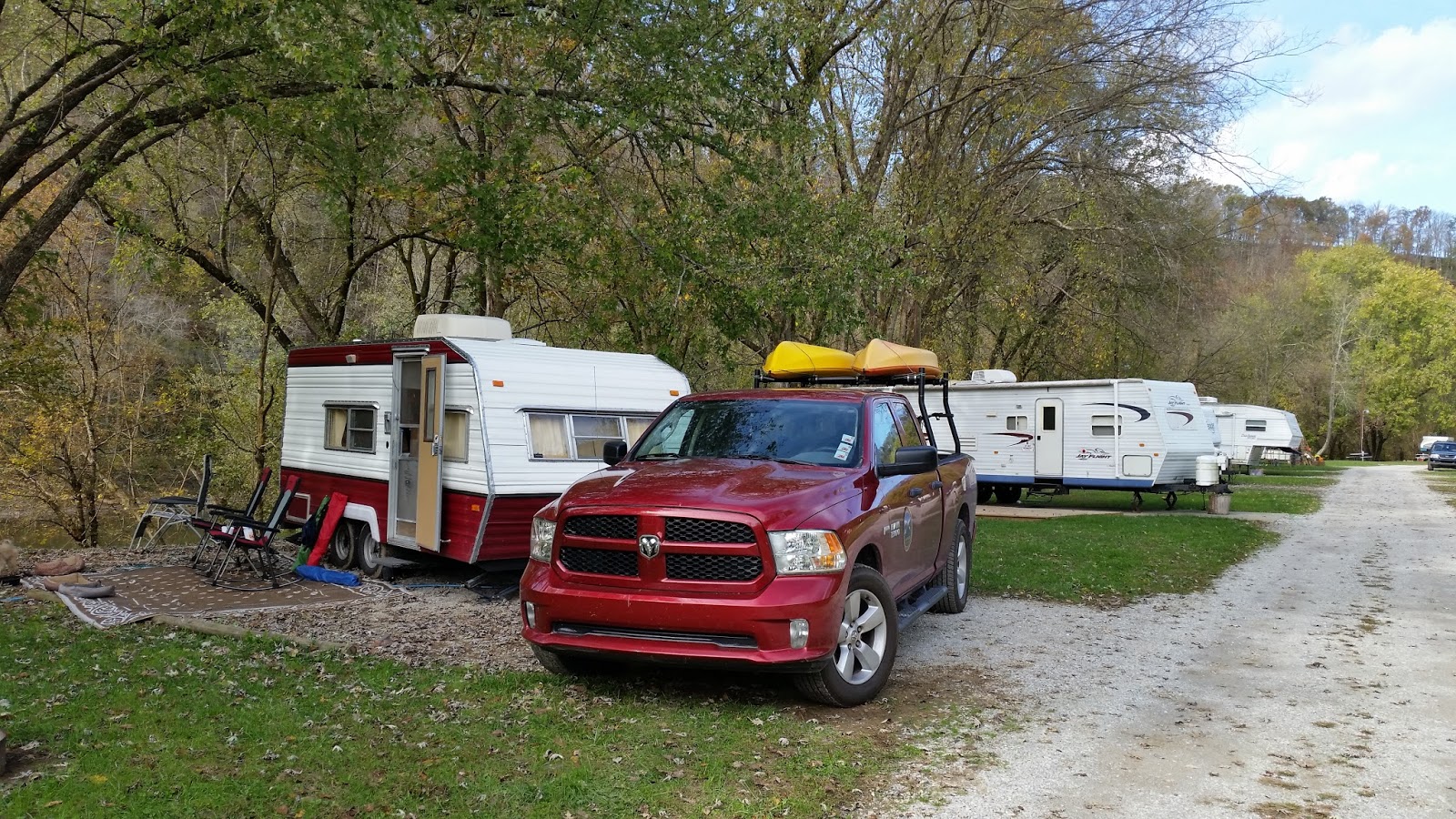
Camped at Camping-on-the-Kentucky, Versailles, KY
A family campground right on the Kentucky River. 

A lot of people wonder about the life of those of us who are called full-timers. Pamela and I aren't official full-timers yet but will be in 183 days. Right now we're as close as anyone can be without being worthy of the title. We spend about 140 days a year living in our 16 foot, 35 year old trailer we call “Willy”. There are actually sub-groups among the full-timers. Most people hear the word “full-timer” and assume that we travel from RV park to RV park which are like small trailer cities. We are a part of the sub-set who rarely stay in RV parks and prefer the out-of-the-way campgrounds, either in woods, desert or on the beach, that are relatively secluded and not mini-towns. In the past year we spent one night in an RV park when we were driven off the roads of western Kansas by thunderstorms and tornadoes. We spent 2 nights in an RV park when we were trying to take my grandson to see Rocky Mt National Park and all of the park campgrounds were full. This sub-group is as likely to be boon-docking (camping where there is no electricity or water) as they are to be in a campground (usually a state park or privately owned) with utilities. We are a self-sufficient group capable of stopping and camping absolutely anywhere. When we are going a distance, such as our 2004 mile trip to Glacier, we pull into Flying J/Pilot truck stops late at night, climb into Willy and sleep, and get on the road early the next morning.
Willy at Sprague Creek where we live and work as
volunteers for the National Park Service for 4-5
months a year starting in May. 

You will find that this subgroup that I am calling “Walden Pond Full-timers” are frequently found doing volunteer work at state and federal parks, like we do at Glacier National Park, because we have that love of nature and a Thoreau-Walden Pond mentality; viz simplicity and close to nature. Some have found small private campgrounds in remote areas where they can live in anything from woods near a town to wilderness areas, deserts and beaches. Pamela and I are making a list of such potential places to stay. It is great fun and an adventure in itself to seek out and try small out of the way campgrounds. This past summer we helped a couple from Arizona who are also Walden Ponders. As a thank you they gave us directions to their secret spot on the rim of the Grand Canyon where you can camp with absolutely no one around and right on the edge of the canyon!

We are currently camped at a small family owned camp ground that will go on that list and we'll share with others. It is right on the Kentucky River. If you visit my FaceBook site – Old Conservationist – I've posted pictures. It is beautiful. It is the type of place we seek. You have to remember, such places are generally well off the beaten path. This place – Camp-on-the-Kentucky – is at least three miles from the nearest thru road and 11 miles south of Versailles, KY. Camp-on-the-Kentucky, like so many of the places we find, is down a small, narrow road which requires a good tow-vehicle and plenty of confidence and skill. The picture of the sign showing a steep incline for 2,000 feet doesn't tell the whole story. At the bottom of the incline is the Kentucky River. You'd better have a plan and some good brakes.

Pamela and I have been building up to being full-time Walden Pond Full-timers for two years. Making sure that you have the right trailer and the right tow-vehicle is most important. We love vintage trailers so we opted for a 1980 Fleetwood Wilderness that is 16 feet long. I wouldn't even look at anything that didn't have a double axle. That is for safety and stability. It also helps if you blow a tire when you're so far into the wilderness that it takes a tow-truck a day to get to you. As I said, we call our trailer “Willy”. Most Walden Ponders and full-timers name their units. They are not only your home but your survival. Willy has a full bathroom. That was something on which Pamela insisted. Our bed is slightly wider than a single, but we're comfortable. We have a dinette and my kitchen has a three-burner Magic Chef gas stove with nice oven and double sink. I'm the cook in the family and I love my little kitchen. I like my little Magic Chef much better than the fancy Jen-Air we have in
My kitchen in Willy. There are overhead cabinets that didn't
get in the picture. 
Evansville. Willy is fairly well insulated. We have been able to keep the inside temperature a comfortable 64-65 when it is snowing outside with just a space heater. We do have a good furnace but we've only used it two or three times. Actually the one time we used it was just because we were boon-docking and there was no 120V for the space heater. We could probably get it warmer inside but both of us are quite comfortable in the mid-60s. I spent the winter months of 2014 and 2015, while Pamela had to teach, restoring Willy. He will always be a work in progress but we have the inside pretty much as we like. I opened up all of the seams on the outside, removed any bad wood, and redid the entire outside. That included removing, cleaning and refitting all the windows along with removing and replacing all the roof vents and utility connections.We have our wilderness trailer. It is only 128 square feet, but we're comfortable in it and we can take it almost anywhere.
Mighty Moe and Willy at Guntersville Lake, Alabama
The great thing about Willy's size is that we can put him almost anywhere.

Our tow vehicle, which has been dubbed 'Mighty Moe', is a 2013 Ram 1500 4x4 with the large Hemi engine. It can tow up to 11,700 pounds. Willy only weighs in at <3,000 pounds fully loaded. Having such a powerful tow vehicle for a light trailer proved its worth the first season we had Willy at Glacier National Park in far northwestern Montana. We were heading back to the mid-west and spent the night at a very primitive campground in the Lewis and Clark National Forest in southwest Montana – e.g. Pit toilets and hand pump your water. The undergrowth pulled one of our brake wires. Because of the size of our tow-vehicle we crossed the Continental Divide three times and didn't notice that we didn't have brakes until Pamela noticed the wire dangling as we backed into a campsite. In fact we had actually safely taken Willy into the very remote and steep Teton National Forest area to camp without brakes because our tow-vehicle was bigger than needed. I would never recommend light and/or cheap for a tow-vehicle. Remember, you get what you pay for. A hefty tow-vehicle with a big engine, good tow package, etc., will more than pay for itself if you go full-time.

View from our campsite at Gros Ventre, Grand Teton
National Forest. 
We had just finished our 2014 tour of duty at Glacier National Park and were going to visit some other park areas on the way back to Evansville. One of our destinations was the Teton-Yellowstone parks. We knew that finding a campground was not going to be easy and a NPS Ranger friend had told us about Gros Ventre in the Grand Teton National Forest. As expected there were no openings in the National Park campgrounds. We headed into the wilderness, traveling over 20 miles on gravel roads, to the Gros Ventre campground. It is inhabited mostly by fishermen who are there for the lake which was created by the great Gros Ventre landslide. When we got there it was actually full but the host said that a manager had just quit and his site was empty. If we paid $25/night, as opposed to the normal $5/night in a national forest, we could have water and electricity. We took it. We sat on a small bluff just above the main campground with a panoramic view of the lake, slide and Grand Teton mountains about 25 miles away. If you have the Walden Ponder personality it pays to be flexible and adventuresome.

We like living in a trailer versus recreational vehicle. This is 100% a matter of preference. We know full-timers who live in trailers and recreation vehicles of all descriptions. We don't like the slide outs because they are always a potential source of problems which you don't want if you are in remote and primitive areas. Many of the slide outs also make it impossible to use the trailer unless you open them. That precludes stopping and sleeping at truck stops and national forest pull offs. We prefer the trailer for two reasons – (1) you don't have to buy a toad (small vehicle that you tow behind the RV) when you pull a trailer and (2) if something happens to your tow-vehicle you're not without a place to live. We knew full-timers whose RV engine had to be repaired. They had to rent a place to live and a car to drive until it was fixed.
Cozy Campground, Bridger-Teton
National Forest, Wyoming
Cozy Campground
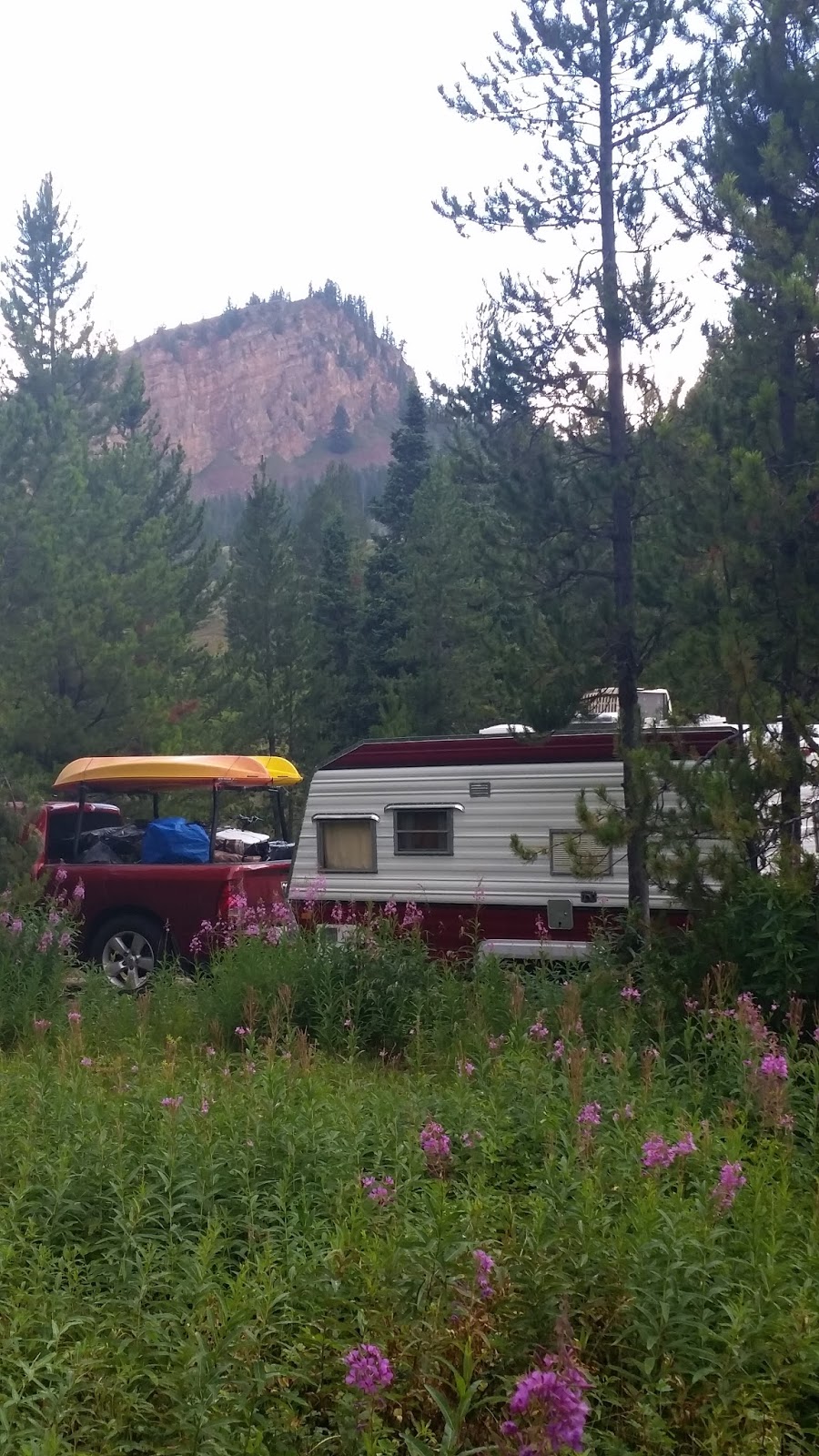
Being a Walden Pond Full-timer is almost a calling as well as a life-style. John Muir once said, "the mountains are calling and I must go." We also love the sea shore, rivers and desert. Nature calls Pamela and me and, as a result, we have camped from Florida to Montana. We really enjoy a concert but if we had to make a choice we'd elect to sit quietly and listen to birds, the surf, or a brook and all the sounds around us in the wilderness. We love to go to art shows but if we were forced to choose, we know that there is no greater artist than Mother Nature. (Apologies to a dear friend who is a great artist.) Great cities have so many things to do and see, but as much as we might like to see and do those things there is no doubt in our minds that living close to nature is where we want to be.  We avoid interstate highways. We want to see the land. There is no right direction or right place or proper way to go. When we were talking about what we wanted to do between the time we left Glacier and had to be back for Pamela's school we came up with one plan, made five changes to that plan, and didn't follow any of them. Had we followed a plan we would have missed camping in the wild flower meadow at Cozy Campground, a lovely primitive campground along a gorgeous stream in Bridger-Teton National Forest.  There was no electricity.  There was a pump well a short distance from us. No security lights. When the sun went down the stars came out in all their brilliance.  
“I went to the woods because I wished to live deliberately, to front only the essential facts of life, and see if I could not learn what it had to teach, and not, when I came to die, discover that I had not lived. I did not wish to live what was not life, living is so dear; nor did I wish to practise resignation, unless it was quite necessary. I wanted to live deep and suck out all the marrow of life, to live so sturdily and Spartan-like as to put to rout all that was not life, to cut a broad swath and shave close, to drive life into a corner, and reduce it to its lowest terms.”    
                                                                                                      Henry David Thoreau, Walden

Having returned to Evansville before finishing this blog, I had just backed Willy into his long-term spot.  A neighbor about my age was out walking his dog. He stopped.  "I was surprised to see you are still here," he said.  I told him that Pamela was going to have surgery and we would probably stay in Evansville until after the first of the year. "That's a long time for you guys to stick around here." He was being sympathetic. He knows of our love of the outdoors. "You guys sure know how to live," he said almost over his shoulder as he waved and walked away.  I stopped and thought about what he had said. He's right. 


Friday, October 23, 2015

Our Journey Home

On the journey.   Photo by Beth Ritchason. (1) 
Would you accept the premise that life is a journey?  Philosophers ask all sorts of questions about people and life.  One philosopher, Loyal Rue, confronts his intro to philosophy students with the question "what is a human being for?"  I can really get into that one but, as he admits, it is a bit unfair and "an unphilosophical thing to do".  They also ask is there meaning to life.  This question is fraught with problems, pitfalls and barriers, despite our very simplistic inherentism which, Rue points out, "may be the most commonly held metaphysical attitude in human history."(2) Of course that does not in any way validate inherentism.

But before I get off onto such a philosophical discussion let's get back to my original question - would you accept the premise that life is a journey?  If it is, I've had a hell of a trip and haven't any idea what it means, if it means anything.  I think my trip has been easier than most peoples', harder than that of some, but definitely filled with lots of joy, sorrow, excitement and time to ponder.  I am more willing to accept that it is a journey, which can be altered at any point, than a goal-oriented activity. What would my goal be? To arrive as slowly as possible at the point of death?  As a child I remember people saying "getting there is half the fun."  Now, seven decades later, I would venture to disagree with them.  I think that "getting there", whatever that means, is all the fun.

My concern - switching from philosophy to sociology - is that homo sapiens have gone from being participants in nature to being an invasive species that is destroying the very nature which sustains them. Actually that sounds more like a parasite, doesn't it?  There are two types of parasites: (a) those that feed off their host and ultimately kill the host, and (b) those that try to feed off the host without killing it.  Obviously the latter is the more advance. In the first case the host dies and therefore the parasite dies. In the second case they both still die, but the parasite lives longer. Which are we?

But again, I'm tempted into regression.  Might one say that I am easily distracted?  Not really. These questions and issues are just ones of great interest to me even if they aren't the focus of this particular blog. It is hard not to include a discussion of them as a preamble. It would be appropriate but they are blogs and books unto themselves.

Recently we took a 10 day camping trip which started at Brown County State Park in south-central Indiana, to Raccoon Lake State Recreation Area in central Indiana, and ending at Guntersville Lake, Alabama, a TVA project that damned the Tennessee River to create this magnificent lake. We had a wonderful time with family and friends, rode our bikes and kayaked, and enjoyed life in Willy, our 35 year old 16 foot camper trailer which is our home for much of the year. Despite the mid-western humidity, the weather was outstanding. This trip was Pamela's fall break.  Pamela is a college biology professor.  All such trips are now rehearsal for full-timing which begins when Pamela retires next spring. Right now, however, it is most definitely a part of the journey.

Pamela and my journeys intersected at our love for nature. At our meeting Pamela was a trekker, cyclist and kayaking enthusiast who had a long history as a triathlete. I was a trail and ultra-marathon (>40 miles) runner and scuba diver who thrived on trail adventures in the most remote environments. Pamela sparked my love of trekking, cycling and kayaking. We had both concluded that to apply the term "civilization" to cities and populated areas was incredulous because "civilization" implies a superiority which we firmly believe homo sapiens have not really attained.  Don't misunderstand me. There are many spectacular and amazing things in our cities.  That, however, has two problems: (1) it does not necessarily follow that these spectacular and amazing things are and/or makes us superior to the rest of nature, and (2) they came at an appalling cost to the nature of which we are a part.  To achieve this "high level of culture, science, industry and government"(3) we have squandered countless resources and put ourselves and our short time on this planet ahead of all other life and the long-term welfare of everything that supports our fragile existence.

Our journey together brought us to more carefully explore the world around us.  That, in turn, led us to live and work in the wilderness while playing and exploring in  natural areas wherever we go from Bahama reefs to the most remote of the northern Rocky Mountains. That point of realization, maybe enlightenment, definitely understanding led us to do our best to be good citizens of planet earth  - not the best citizens of a state or an ideology or political unit but of the community of nature to which we owe our existence and our continued survival.

Our journey took us into a world which we both had loved and admired from afar but only realized as our true home in the past 3+ years.  Pamela and I love our house in Evansville, IN.  It is way too big and still needs a lot of work, but we enjoy it. Nevertheless, it is when we are living in Willy (our 35 year old 16 foot camper trailer) in the wilderness or in the woods away from what is called "civilization", that we feel the strongest, most alive and definitely most free.  Right now we spend about 120 days a year in Willy.  Starting May 2016 we anticipate that we will be spending 245 days or more living in Willy while returning to Evansville twice a year as a base-camp for visiting our combined 7 children, their spouses and 8 grandchildren.

After our first 90 consecutive days in Glacier National Park in the wilds of northwestern Montana we felt like we were being ripped away when we had to return to "civilization".  Some vital part of our being was still there in the wilderness or perhaps some part of our primeval being that remembers 'when' had been awakened so that we were more aware of our true home.  It didn't matter.  Over the next nine months before we would return we were continuously aware of our longing to be back. Short trips in Willy to parks and forests would lift our spirits. Just going out and sitting in Willy seemed to help.  Willy was like a mnemonic. He had become a symbol of the freedom and new life we had discovered.

Laugh if you will, but everyone goes back to nature. Unless you just stepped off the last star-freighter from Mars your roots go back to hunter-gatherers and farmers. It is very sad indeed that so much of our species has been corrupted by what Dr. Yusal Noah Harari calls "fictitious" reality (4) and has forgotten from whence it came. There is even new research that believes it has discovered evidence that we have memory in our DNA. There appears to be some very fundamental reason and, perhaps, even science for the old saying "you may be able to take the boy out of the country but you can't take the country out of the boy."  Could Pamela and I be evidence?

This year (2015) we made the 2004 mile trip from Evansville, Indiana to Glacier in three days despite not being able to travel faster than 65 miles per hour and having to hole up in western Kansas because the rain was blowing us off the road and there were tornadoes both in front and behind us. We were almost giddy the last hour as familiar landmarks began to appear and mountains could be named. I can still remember coming down the hill toward the turn under the railroad tracks.  The old passage under the railroad is very narrow and opens into the little tourist village of West Glacier - a commercial part of what had been the town of Belmont when the park was founded. Since it was still the first of May, the village was closed. It wouldn't open until Memorial Day. But we knew that when we crossed the bridge over the Middle Fork of the Flathead River we were home. This was "our Glacier". We are shamelessly possessive and protective. It didn't matter if the Ranger at the gate recognized us or just the employee sticker on our window, their broad smile and welcome made it official . . . we were home.  We were anxious to see our new friends, Terry and Beth Ritchason, whom we had recruited to take an assignment at Apgar Campground, so we stopped by to see them before we started the last 11 miles of the Going-to-the-Sun Road and turned into Sprague Creek Campground where we would live and work until we were forced to leave so that Pamela could get back in time for school in August. Everything was ready for us.  We backed Willy into his spot, hooked him up, and hugging each other said "we're home".
Home. Sprague Creek is at the foot of the first mountain on the right.
Why should this feel so much like home?   It is indeed beautiful, but there are many beautiful places in the world, and many people call some of the least pretty places on the globe home.

To address this question I Googled "attributes of a home". I wasn't surprised to find a list of web sites that all contained lists of "attributes". What did surprise me was that all those lists contained things like monthly payment, type of home, number of levels, minimum number of bedrooms, minimum number of bathrooms, whether the payment included property taxes and insurance, and other indoor amenities.  Am I the only one who is still naive enough to define the attributes of a home as a place where there is fellowship, love, compassion, a sense of belonging, a sense of security, etc.?  When did we become so jaded?

Almost at the top of Mt Oberlin (5)
Pamela and my journey had led us away from everything that blinds one to reality.  Because of our love for plants, animals, mountains, rivers, lakes, oceans and all places wild our journey had driven us away from all that contradicts nature. Because of our love for trekking, running, biking, and kayaking our journey had led us far enough away from the toxicity of civilization that we were able to do what so few modern people get the opportunity to do; viz. really know what it is to be alive. We have stood within yards of Grizzly bears and within feet of Black bears (not on purpose). We lay on the ground and took pictures of plants in the alpine tundra struggling for survival at >12,000 feet elevation. Two to three times a week we ride our bikes up the Going-to-the-Sun Road when it was closed to cars which goes from 3,100 ft to 6,800 ft in 12 miles. We go scuba diving in a glacial lake. We kayak a lake that is 7.5 miles long in one of the most remote areas of the park where it takes our 4-wheel drive truck 55 minutes to travel the last 6 miles, and raft through Class IV white water. We have purposely stepped between an annoyed bear and some really dumb visitors. We patrol high back-country trails to keep visitors from getting the animals we love into trouble. We found stromatolites at 7,500 ft., and took pictures of wildlife and lichen high up a mountainside. We climb mountains and stand on top of the world. We know we were alive and want so much for others to share the feeling.

Stromatolites - formed on the ocean floor - we found at
7,500 feet up a mountain. 
If you haven't already, I know you are going to be asking why I feel I can say that living in civilization is not real or that it is not a true reality compared to living a Thoreau-like existence in nature. That is a valid question and I respect it.  I also think that I can answer it relatively briefly.

Back in September 2015 I posted a note about Dr. Yusal Noah Harari. He had given a TED talk on July 24, 2015.  Dr. Harari is an Israeli historian who concluded that homo sapiens went from an insignificant mammal in east Africa to the dominant mammal on the globe because we were able to achieve cooperation among the masses.  He pointed out that this was accomplished by piggy backing what he calls 'fictitious' reality onto objective reality. He went on to very convincingly demonstrate that everything from religion to law, finance to politics is based upon a 'reality' created by someone or some group to control the masses and gain the cooperation.  Let's use money as an example. I don't know that I can do as well as Dr. Harari, but here goes. People give up much of their lives and many actually give their lives for money. What is it?  A piece of paper.  You don't see many Mountain Lions trading their deer carcass for a piece of paper.  But that paper is backed by real gold! Great. Have you seen the gold that "backs" your paper? Actually, in modern times, have you seen the paper? What makes that gold worth your life?  Someone told you that it is worth it. But if someone were to change the "reality" of gold, it could sit on your table and shine as you die of starvation.  Harari calls this fictitious reality because it is a story that we have told ourselves for so long that we now actually believe it.

Pamela and I had never thought about fictitious reality versus objective reality before.  We had frequently questioned the very things that Dr. Harari point out as being fictitious reality, but that was as far as we had gone. Nevertheless our journey took us to a place where we were free to see. We were unfettered by the proponents of the fictitious reality that shame us, or in some cases threaten us, if we doubt. Nature is not fictional reality.  A bear doesn't make up some abstract or fictitious rules to get you to stay away from his huckleberry patch or to get you to give him your huckleberries. You have a fairly good idea if the pack of wolves that just caught your scent is thinking that you'd make a good addition to their lunch menu. The law of gravity is rather objective and you soon learn what you must do to keep from falling off the mountain. Survival skills are not abstract. No one came up with them to control a group of people or to establish themselves as important or supreme.

Now, as a result of our journey together and the discoveries it has afforded us, Pamela and I have become seekers.  Seekers are those who have discovered life and are on a quest to see what all life has for them.  Seekers don't have agendas or goals. We're not looking for anything specific but everything in general. It is a journey . . . a journey into the unknown . . . a journey into life.

Giving in to the reality that life is a journey and not trying to restrict or direct that journey based upon abstract or fictitious goals has opened up a world for me that is beyond my wildest expectation.  When I think of how to express the marvel of life's journey when you make the journey unencumbered by fictitious reality, I think of any one of a number of treks I have made through the wilderness. You have no idea what is around the corner but that's why you keep following the path around the next corner.  It isn't about where you end up. It's about getting there.

I am convinced that our true nature does not lie within the confines of abstracts and fictitious reality we call "civilization" but that creature of nature that we discover when we free ourselves and return to that relationship with the rest of nature that we enjoyed before we embraced the fiction and made our true nature "other".

I wish you all the greatest of journeys.  May you be seekers of the highest degree.

Still on the journey. Still looking for what's around the corner.
Picture by Beth Ritchason 

FOOTNOTES:

(1) Beth Ritchason is a professional photographer and good friend. She and her husband, Terry, volunteer at Glacier. They are vintage trailer, bicycle, kayak and all-around outdoor enthusiasts.
(2) Rue, Loyal (2011) Nature is enough: religious naturalism and the meaning of life.  Albany, NY., State University of New York Press.    (ISBN  978-1-4384-3799-6)
(3) http://dictionary.reference.com/browse/civilization
(4) Dr. Yusal Noah Harari, professor of history at Hebrew University, Jerusalem. TED Talk 7/24/2015.
(5) This picture of Pamela was taken when she was <200 feet from the summit of Mt Oberlin. She was climbing despite the fact that both of her knees were bone-on-bone and she is awaiting replacement surgery. She is driven by the journey and will tell you it's worth the effort.


Tuesday, September 22, 2015

Boy on the Mountain

Kieran on Mt Oberlin trail
Trail patrol is one of those marvelous “jobs” which make you embarrassed to call it work. Yes, you must go to training and study everything from wildlife management to law enforcement procedures to search and rescue. But that's enjoyable as well as educational in itself.

Trail patrol is no more dangerous than regular hiking so I took my grandson, Kieran, with me one day so he could experience the wilderness from a trail that isn't even on an official park map. We started up the climber's trail that leads to the summit of Mt Oberlin. Mt. Oberlin is one of the easier mountains in Glacier National Park to climb but that still doesn't make it easy unless you are an experienced climber. I had been up Mt Oberlin a couple of times in the weeks prior so I knew that we could go quite a way up the mountain before it would be too dangerous for Kieran.


It was a lovely day for climbing. It was a lovely day to do anything outside. It was a bit warmer than usual. The temperature was in the mid 60s. The reason they have us patrolling a climber's trail that isn't on the park map is that much of it goes through closures. Closures are areas that are legally closed to people either because the area is a sensitive wildlife habitat or there is fragile vegetation. The side of the mountain we were climbing was covered with very fragile sub-alpine vegetation with numerous large meadows. Somehow visitors who are not climbers get on this trail, see the official trail they want on the other side of a large meadow and want to cut across. My job is to keep this from happening in my best Ranger Friendly manner.

We had not gone half a mile up the mountain and were going through a narrow rocky pass between two of the large meadows when the trail was blocked by a large mountain goat billy. Kieran and I had talked about how we are supposed to act when we encounter wildlife. He could even quote the rule that one is supposed to stay 100 yards from bears, moose and mountain lions and 25 yards from all other wildlife. We were no way near 25 yards away. More like 25 feet. We moved back and the goat moved with us. He never acted aggressive. He walked with he head high. If he were being aggressive he would have held his head lower so he could use his horns. But he was displaying a behavior that, according to goat expert Douglas Chadwick(1), is often seen when an older billy is establishing his dominance with a newcomer. Dr. Chadwick tells the story of how, while doing his research in Glacier National Park, the goats had let him actually stay among them and a billy had displayed this same behavior as though to say “you can be here but I'm the boss.” That is what this billy was doing to us. We finally stopped and stood still as the big billy practically stepped on our feet as he passed us. It was an exciting encounter for both of us. I have been very close to many mountain goats but this was the first time that I had observed this behavior.

A short distance up the trail we came to a water tank. It sat where it was out of sight of the visitor center in the mountain pass below. I told Kieran that a friend and fellow volunteer had helped build the tank and move it to this spot. People don't stop to think about how a visitor's center in a mountain pass twenty miles from the nearest village gets water. The tank had to be lifted up the mountain by helicopter and then reassembled. It was strenuous and dangerous work. Not three weeks after Kieran's first time up the mountain we would encounter a small group of hikers descending at this very point. Not twenty yards further up the mountain after encountering those hikers I would respond to a radio call from Glacier dispatch that a climber had fallen on Mt. Oberlin. It was my day off but I was on the mountain already well ahead of other rescuers. I notified dispatch of my presence and said that I would locate the climber and stay with them until the rescue crew could get there. Pamela, Kieran and I would spend an hour climbing as quickly as possible to over 7,000 feet but finding no injured climber. It turned out that she had walked out with the group we had met by the water tower
and left without telling anyone she was safe. It was somewhat fortuitous because it put me at a much higher elevation than I would have been at our original pace. That's when I spotted the forest fire that had just started. When I first saw it, it looked like a ribbon of campfire smoke coming up from the trees. Within minutes there were clouds of smoke billowing upwards. I was among the first, if not the first, to report it. It eventually burned over 4,000 acres. But that's another story I'll share some day.

Kieran was anxious to hike through snow. Under normal circumstances there would still have been plenty of snow. Normally there would still be 4-5 feet of snow at this altitude in late
July but this was an unusually dry and warm year. Like good mountain trekkers we had cleats hanging from our backpacks just in case and Kieran was anxious to get to use them. Little more than a hundred yards up the mountain from the water tank Kieran got his first snow and faced his first ford across a fast moving mountain stream.

Before us was a beautiful stream cascading down the mountain. To our left was steep outcropping of rock over which the stream flowed in a plethora of miniature falls. It flowed through a field of snow making the water icy cold. To our right the stream dropped off at a steep angle down a hundred feet or more to the meadow below. Kieran was faced with the task of crossing this without getting any wetter than necessary.

When Kieran was preparing for his 30 days visit with us in the wilderness his Mother had asked about what he needed. At the top of the list was a pair of good hiking boots. It is impossible to emphasize enough the importance of good footwear. At first Kieran thought my gaiters were a bit funny. By the third or fourth major hike he was wearing my shorter summer gaiters while I wore my high winter gaiters. Kieran had arrived at Glacier with a good pair of boots. They were very good for comfort and safety. They were not as water resistant as my Keens, but kudos for Mom and a good choice.

It was as he was carefully picking his way across the snowfield and fording the stream that Kieran became aware of one of the most important pieces of the trekker's equipment – trail poles. For several years I have been a trail runner doing ultras (50-100 mile runs or races) through extreme environments and dreaming of doing one really classic extreme ultra before my running days were over. In my pictures of people doing the famous Mont Blanc 150km ultra one will notice that they all use poles even though they are running. Even for the youngest trekker or trail runner poles are important for balance and safety. I had given Kieran some instruction on using his poles, which I was sure he had ignored, but here he proved that he had indeed been listening. He did a great job of traversing the stream and getting to the other side with dry feet.

Lunch-time view
We climbed another 50-60 feet in elevation up some steep and slippery rock faces to a large and broad meadow. It was a great place to have lunch. We had a marvelous view of the valley almost 4,000 feet below. We also had plenty of space between us and any creatures that we might attract with our food. There was no way they could sneak up on us. 

Kieran was getting tired.  We had climbed the better part of 1,000 feet in elevation from the Visitor's Center at Logan Pass. Kieran had not been with us more than a couple of days.  He was using muscles that he probably didn't even use in karate or at least in a different way. He was over 6,500 feet higher than his home in Alabama.  I was very proud of him for having climbed to over 7,000 feet but I knew that he had to be feeling the effects of altitude.  

Altitude sickness is very real and can be frightening.  It is not uncommon for some people to start noticing it at elevations of 6-7,000 feet. Actually the body is dealing with it at a much lower elevation but one doesn't become conscious of it until higher altitudes. Many of our campers at Sprague Creek - only 3200 feet elevation and the lowest point in the Rocky Mountains - would complain of difficulty sleeping and tiring easily. They were dealing with altitude.  Visitors to Denver will notice the altitude and Denver is about 2,000 feet below Kieran's highest point on this day.  Pamela and I had never had any altitude problems until we were at Rocky Mountain National Park where we were camped at 8,500 feet and hiking at 12,000 feet. At night, when we were trying to sleep, we would feel like we were having trouble breathing. And we had already spent 90 days in the Rocky Mountains at 3,200-7,000 feet. 

I let Kieran pick a goal for our climb. He picked a point some 40-50 feet elevation beyond where we had lunch and about another few tenths of a mile. He was being a trooper but he was ready to go back. 

We started down the mountain about one or two o'clock.  We were at the waterfall when we saw a group of people standing on a ledge looking down into the McDonald Creek Valley. It was a marvelous spot with a magnificent view. The problem was that they had to have traversed almost 100 yards of fragile sub-alpine vegetation to get there. There was a small gully that ran down to the ledge, but there was no way that at least a dozen people went that far without tromping through the vegetation. A long-term trampling study that had been conducted in this very area found that it takes well over 50 years for this sub-alpine vegetation to recover from such abuse. As we drew near I called to the people on the ledge. I wasn't going to trample the vegetation to get to them. Besides my voice is very resonant.  Some people might say I have a loud mouth, but I prefer resonant.  In any case the group was very responsive and returned to the trail. 

Using my best Ranger Friendly voice and approach I explained why I had called them back from the ledge. I pointed out the fragile vegetation that had been damaged and asked them to please remain on the trail. It wasn't until the person in front said "I'm the tour guide" that I noticed the name badges. Opps!  But if the leader was a trained guide she should have known that they were going through a closure area and she should have known better than tromp across such fragile vegetation. Nevertheless I tried to give her a chance to recover, although it wasn't easy. This is one of the reasons that those of us who patrol these trail are here. 

As they moved on up the mountain we heard the embarrassed guide saying “now watch out for vegetation on the trail.” Kieran looked back at the group and then at me. He had a smerk on his face that belied one ready to explode with laughter. Within moments that's what happened. “Watch out for vegetation on the trail?” He doubled over in laughter. Even today, if he sees a picture of Mt. Oberlin, or almost any mountain trail. He says in the most serious voice he can muster, “watch out for vegetation on the trail.”


We continued down to the Visitor Center at Logan Pass where we caught a shuttle down the beautiful Going-to-the-Sun Road to Sprague Creek Campground and home. It was a good day and great hike. 

It it generally hard to know what a twelve year old boy really thinks about an experience. You only get an idea from what their parents tell you they say when they get home. Kieran is a very high-tech child. If he doesn't end up an aero-space engineer like his father I'll miss my guess. Nevertheless, we live in hope that spending 30 days without computers or television but hiking through mountains and kayaking high wilderness lakes will instill an appreciation and love for the nature of which we are all an integral part.  


Friday, September 18, 2015

Simply Green - China and Napkins

Our breakfast table.
I would guess that I'm as lazy as the next person, but I must admit that I miss the days before everything was disposable.  When I was growing up and asked for a napkin I didn't get a piece of paper. I got a piece of cloth 18 inches by 18 inches that was generally folded in half three times forming a rectangle. It was made either from cotton or linen, depending upon whether or not there was company. I don't know when we transitioned from cloth to paper, but when Pamela and I first started going together we realized that we both preferred cloth napkins and made the conscious decision to spoil ourselves with the luxury of the traditional gentility. The time to wash them is negligible and using cloth as opposed to paper is actually much cheaper.  Even our simple breakfast table is set with cloth.

Many years ago when my late wife, Diana, was alive and we had four small children at home, we did a great deal of canning. We bought some jars at an auction. My mother-in-law saw the jars and started chiding us for using them. "They are worth a great deal of money," she scolded, to which I replied, "not unless they have food in them."  What's the use of having something nice if you don't use it? 
Our every day table setting. Pretty, fun to use, easy to
maintain, and in the end result a lot cheaper than plastic
or paper 
Pamela and I also realized that we both prefer to have our meals on china, or at least not plastic or paper. When we brought our two households together we found that we were blessed with several lovely table settings.  One set, which is more earthy, is what we use every day. There are three more formal sets which we enjoy using to be a bit more gentile - like when Pam's son and his wife and my daughter and her husband shared a meal with us.  
Pamela's favorite of our "formal" table setting. Still pretty,
fun, and ultimately costs less. 

Some people call that 'putting on the Ritz' or 'putting on airs'. Since we do it for our own pleasure and don't really care what anyone else thinks of it, we call it enjoying nice things with which we have been blessed.  Believe it or not we have the same table habits the four months of the year we have been living in Willy, our 16 ft 35 year old camper and next year we expect that to be 7-8 months. We may be outdoors people and prefer to be in the woods many miles from so-called civilization, but that doesn't mean that we stop liking cloth napkins and china.  In fact, we even use the proper wine glasses when we're in the wilderness. 

What all this is leading to is that we realized that what we like and what we found to be financially beneficial is also simply green. If you really enjoy setting a "fancy" table for a special occasion, then why not enjoy having the nice tableware and napkins everyday. You can enjoy that special feeling and be good to the the environment at the same time.  If you don't really like setting a "fancy" table, you might want to at least consider the ease, money saving, and environmentally friendly qualities of using cloth napkins and some other tableware other than plastic and paper.

Here are some numbers.  I wasn't able to identify the individual paper product, so these numbers relate to the manufacture of all paper products.  39 gallons of water is required to make 1 pound of paper! (That one blew my mind.) 93% of paper products come from trees. Every tree produces enough oxygen for 3 people to breathe.  Another surprising fact for me is that pulp and paper is the third largest industrial polluter of air, water and soil.  Your paper plates and other household paper products can not be recycled because they are contaminated with food residue, so unless you compost, your paper products go straight to the landfill where paper produces methane gas as it rots. Methane gas is 25 times more toxic than CO2.   


How about cost?  How much is it going to cost us to give up paper products.  If you buy a case of paper towels at Sam's Club you can get them as cheaply as $0.96/roll.  Even then you're probably looking at $52/year.  Cloth napkins at Sam's Club cost $0.53/each. That's $6.36 a dozen. I can't remember the last time I threw a cloth napkin away but even if I had to replace a dozen a year I'm still paying only 12.23% of the cost of paper.  

You can buy 186 paper plates for only $17.48 at Sam's. I could not find the average number of paper plates used per year, so let's say you'll buy at least one package -- right?   One of our expensive china setting now costs $189/place setting.  We didn't pay anyways near that, but let's use that as a comparison. Highest cost for china. Lowest cost for paper. We've had this particular setting for 47 years. That means that it has cost us $4.02/setting/year for that china, and the cost goes down each year. For six people it costs $24.12 to use that china 3 times day if we like.  My china cost will go down while the paper cost will go up.  And if you really want to see a savings, compare paper to a set of 6 Corell plates for 31.98.  In two years your cost will be $15.99 for Corell compared to $34.96 in paper. 

Conclusion.  Using things like cloth napkins and china, corell or some other non-plastic or non-paper product is not only much better for the environment but is going to save you money.  

AGAIN, BEING GREEN SAVES YOU MONEY and SAVES THE ENVIRONMENT. ANOTHER WIN-WIN SITUATION. 


Reference: 

http://www.theworldcounts.com/stories/Paper-Waste-Facts
www.gao.gov/assets/670/667773.pdf
http://www2.epa.gov/sites/production/files/signpost/index.html
www.walmart.com
www.samsclub.com


Tuesday, September 15, 2015

Simply Green - Introduction


     To say that something is “green” or something that one does is “green” denotes an item, product or action that is environmentally friendly and therefore good for nature. There are many people who put a lot of effort into being green, while there are some who really don't care. I would suspect that, if you have continued reading to this point, you are most likely closer to the former than the latter. If you tend toward the 'don't care' group but are willing to continue reading this blog, kudos to you.

Have you ever found yourself a bit overwhelmed by all of the ideas, programs, and campaigns that want to tell you how to be green? There are a lot of people who think that being green requires a 'signed-in-blood' commitment, significant time and a substantial monetary outlay. That's really not true. Let's use the example of putting an aluminum can in recycling instead of throwing it away. So often we environmentalists get caught up in telling people the damage an act does instead of showing the tremendous benefit and savings of not doing some acts. That's true of the aluminum can. “I'm just one person,” or "it's just one can," you might say. That's very true, but you are one of 350 million people just in this country. According to the Keep America Beautiful website (www.kab.org) if you recycle one can you have saved enough energy to run your television for three hours. KAB also wrote that The amount of energy saved just from recycling cans in 2010 is equal to the energy equivalent of 17 million barrels of crude oil, or nearly two days of all U.S. oil imports.” Wow! Think about recycling your next 24-can case of soda! That's a lot of punch for almost no effort. Hopefully “Simply Green” can help some people get past the 'it takes too much' roadblock to being green or greener. To others it might be just some more ideas, but that's good too.

The idea of Simply Green is that being green doesn't require a tremendous amount of special energy, extra time or participation in campaigns or programs. Being green is more about our life-style and how we think. Based upon that premise Simply Green is going to be a series of blogs that share minor adjustments in life-style or habits that can make a big difference to the environment. These ideas will take no extra time, or at worst a few minutes of your time. They will not inhibit your modern life-style and they will frequently save you money. If you are willing to save those aluminum cans and take them by a recycling plant, you will actually get money. Doesn't that sound like a win-win situation? You can make a positive impact upon the environment with minimal effort and no ill effects.

If you like the idea – or at least are willing to check out the first blog – let's get started. The first Simply Green idea I'd like to share is the newspaper. There is no categorical ranking or symbolism involved with this choice. I picked it because it is something that I just encountered two days ago.

I was standing in line at a Schnuck's Grocery store on Sunday morning around 7 am. The lady ahead of me plopped down a gigantic pile of newsprint. The top banner read “New York Times”. No one picked it up with one hand. It was massive. My first thought was 'how many trees did that take?' I remembered having seen some statistics about newspapers so I went looking. The New York Times prints an average of 1,217,201 newspapers every Sunday. This printing takes an average of 63,000 trees. That works out to be >19 trees for every newspaper. You can do something simply green by reading your newspaper on-line. Staying with the example of the New York times, the NY Times has an impressive digital program. The hard-copy Sunday Edition costs $5.00 in New York and $6.00 elsewhere. To get the New York Times on-line for an entire week costs $3.75/wk for for web and smartphone access, $5/wk for web and a tablet and $8.75/wk for all digital access. Obviously you can read the New York Times for an entire week for little more than the cost of a single Sunday hard-copy issue. Of course there is the down side . . . you are using electricity which may use coal. From what I understand it is really almost impossible to determine how much energy is really used for us to spend time on the internet, but here are some number of which we need to be aware. According to Michael Bluejays Saving Electricity website a lap top, modem, and router for an hour takes 15-45 watts. According to the US Energy Information Administration it takes 0.00052 short tons or 1.05 pounds of coal to generate 1kw/h (1000 watts) or 0.0168 ounces for 1 watt hour. That means that if you spend an hour reading the New York Times on-line you are using up to 0.756 oz of coal. But, we can argue, all of that energy might not be coal generated. Fair enough, but then there's the student who pointed out to the professor that when you download something from the internet you can't just take into consideration your own computer. There are other computers – servers – that must be considered. In other words, we can't really say how much coal we might cause to be burned but it is probably going to be measured in ounces. We do know that if we do not buy the hard-copy we are truly effecting the number of trees cut down to make paper. It is a small but significant act that can save >19 trees a week, if you read the New York Times, and save you money. That sounds like a win-win situation to me.  

One other issue probably needs to be addressed in this first offering. I have heard people say that they are fearful of doing things like not buying a newspapers because it will put companies out of business and people out of work.  This is not new. When the automobile was invented and people started using cars instead of carriages there was an outcry on behalf of the carriage industry and livery stables. What happened?  New industries emerged to which these could transition. Soon you had automobile plants employing the carriage makers, automobile repair shops and a new industry - the service station. This pattern has repeated itself over and over throughout human history. Sadly the newspaper will most likely be a thing of the past by the next generation, but the newspaper companies themselves are leading the way in developing replacement industries. Thus The New York Times On-line. They're being pro-active and we can use that to our benefit as well as the environments.