Tuesday, December 15, 2015

I see smoke


The first of each May Pamela and I head toward Glacier National Park tucked away in the far northwestern corner of Montana.  It is like going home for us so it is a time of anticipation and excitement. Our first glimpse of the Rocky Mountains as we approach Denver starts us singing Rocky Mountain High and Oh, Montana.  The excitement really starts building as we turn north at Missoula, Montana and start up US 93.  When we get to the south end of Flathead Lake we usually turn off onto a secondary road that goes up the east side of the lake and intersects US 2 just east of Columbia Falls. Columbia Falls is our closest larger town about 45 miles from where we live in the park. It has almost 3,600 people.  Once on US 2 it is hard to contain our excitement. This is the last leg of our annual 2,004 mile migration.  Now it's just Hungry Horse, Coram, West Glacier and then we're home.

Last May (2015) we were as excited as ever but we were also a bit concerned. It was warmer than usual and many of the lower mountains were already losing their snow. Things didn't look like May in Montana and that had us worried. After checking in with old friends and colleagues we learned from those who live at Glacier year round that it had been a very mild winter with little snow. The Big Drift was still 80 feet deep, but it's always 80 feet deep.

We have certain things that we do as soon upon arrival as possible. We'd do them all on the same day but that would be impossible. We always go to Polebridge, hike to Avalanche Lake and listen to the avalanches, and ride our bikes as far up the Going-to-the-Sun road as the snow removal crews will allow.

Robert fire of 2003 directly across from where we live.
The heat was so intense that you could not stand it
a mile away across the lake. 
Over the winter we had made some new friends through Tin Can Tourist - a vintage trailer club - whom we ended up talking into taking a post as hosts at Apgar Campground.  We included them in our ritualistic activity.  We were anxious to make the 2.5 mile hike up to Avalanche Lake. We told our friends, Terry and Beth, how there would be snow starting about 2/3 the way to the lake and you could sit at the lake and hear the thunderous sound of two or three avalanches every hour. I had on my high winter gaiters. We got to the lake. No snow except high up the mountains. No sounds of avalanches. There just hadn't been enough snow and it hadn't been cold enough. That was the beginning of our worries.

The weather situation seemed to go from bad to worse. We could make the trip all the way to Logan Pass by June 6th.  Normally May and June are wet and on the cold side. We have been known to have as much as 30 inches of snow in the pass in late June. This year it rained only two days in May and three days in June. The Going-to-the-Sun Road, which had not been cleared of snow until July 2nd the year before, was open by mid-June.  I saw bare earth on mountains where I'd never seen the ground before.  Streams that are normally swollen and thunderous to the point that you can't stand next to them and talk were little more than trickles and McDonald Lake was so low that there were beaches where there had never been beaches before.

I saw Mountain Goats panting and looking for patches of snow to get cool. We had one bear in the campground this year. It was a young bear that wandered through a picnic area and down an access stairway to the lake. He saw people to his right so he went left. He appeared to be dragging as he walked along the water looking for a place away from people to lay in the water. I was following him from a short distance so I could protect his privacy. When he did start back up the mountain he came to a fallen tree. Normally a bear his size would hop over such a tree. He climbed up one side, paused and jumped off the other side. The heat was almost more than he could tolerate.

By the end of June I must admit that I was beyond worry.  I was frightened every time a camper insisted upon having a campfire when the wind was blowing. Most places around us had fire bans. In fact we were the only place in the northwest US and Canada that didn't have a fire ban.  By June there were countless fires in almost every state and province west and north of us. We would actually have days where the smoke from a fire(s) in another state reduced our visibility.  I never did figure out why Glacier didn't ban fires. Even the campers and visitors were surprised that we were permitting fires.
Robert Fire, Glacier National Park, 2003. 
I know I should not have been so fearful, but there were extenuating circumstances. Forest fires are not only natural but they are natures way of cleaning house and enriching life. Not only is fire good for the soil but there are actually trees which depend upon forest fires to germinate. Forest fires are a part of the cycle of life.  Why then was I fearful?  Because government agencies are playing with nature. In truth all of the agencies involved mean well and have the forest's best interest at heart. The problem is that much of the damage has been done by previous generations and none of them can agree on how to deal with fires around developed areas. At that point buildings become more important than the preservation of nature. The National Park Service insists that, to comply with the mandates of the Wilderness Act of 1964, fallen wood must be left where it falls. That's fine if you permit natural fires. When you avoid fires and have gone for decades longer than the normal cycle of fires, you get an accumulation of flammables on the ground that makes a fire many times hotter than normal. That can cause trees that are capable of surviving a normal fire to burn and die. The heat can cause combustion across fire breaks. And studies have been shown that it takes much longer for a forest to recover from an excessively hot fire. In short, it is a disastrous situation. But the fire management debate between agencies isn't the purpose of this story. I only share it because we were living and working eleven miles into a tinder box with only one road out. But worse than that I was worried about what a major fire would do to the park we love.

Reynold's Creek Fire just minutes after I reported it to dispatch.
July 21st was our day off.  Pamela had decided that she was tired of not being able to go on hikes and climb mountains because of her bone-on-bone arthritis in both knees. She decided that this day she was going to climb Mt Oberlin.  It was a beautiful day.  Much warmer than normal, but we were growing accustomed to that after almost three months.  Even though it was our day off we ended up being involved in finding a fallen climber and we were standing at about 7,500 feet on the side of Mt Oberlin.  I was on the radio with a ranger about a mile or so down the mountain. That's when we saw the smoke.

It appeared like a thin grey line rising from the valley floor several thousand feet below us. That shouldn't be there was my first thought.  I asked the ranger below me if he could see the smoke. He couldn't see it as well as we could but he saw enough. "Call it in!"

Reynold's Creek fire burning eastward down the St Mary Valley
It was a sickening feeling and I had trouble getting the words out as I keyed the radio. By the time I had reported the smoke to dispatch it had gone from a fine ribbon to a thick band of smoke rising. I knew the area. There was a back-country campsite, known as Reynold's Creek, right about where the smoke was rising. Within minutes the valley below us was filled with smoke. Glacier had a major forest fire. By the time we got off the mountain hundreds of visitors were stranded in the high mountain pass while many hundreds more were be evacuated from campgrounds and hotels in the St Mary valley down which the fire was roaring.

When the fire was finally out over 4,000 acres - over 6.25 square miles - of forest was burned. They had actively fought the fire because of the number of campgrounds, hotels and other buildings and dwellings in the fire's path. It had been contained naturally by the mountains on each side.

Throughout the summer it seemed that the west was burning. Smoke poured into western Montana from Oregon, Washington, Idaho and Canada.  There were times that it was so hazy that it appeared like smog.

Four and a half months after this fire the west is still burning. Today 9.8 million acres have burned. 9.8 million acres is 15,312 square miles and is the equivalent of burning all of the States of Massachusetts, Connecticut, Rhode Island and some of New Hampshire.  It is the worst fire year in recorded history.

We can deny reality and scientific fact.  We can pretend it isn't happening or that we can't do anything about it because it is just some deity who's really pissed at us. Regardless, if we don't try to do something it is only going to get worse. You can't drink oil and there are no nutrients in coal. If you don't want to burn or starve or drown I would suggest that we not only hold our government to the COP21 agreement but insist upon doing better.  FEEL THE HEAT.


Monday, December 14, 2015

Friendship

Great friends and colleagues, Terry and Beth, with Pamela
and me at Northern Lights Saloon, Polebridge, MT
after a day in the back-country.
I wouldn't quite call myself a Trekkie but I do really like Star Trek. I especially like the fourth movie. At the beginning of the movie Spock's Mother asks him why he needed to return to Earth. He explained that it was because he had to testify. She said "oh, because they're your friends." To which he replied, "because I was there."  After time traveling back to the late 20th. century to find Hump Backed Whales to save the world, having their alien space craft break down, having a crew member end up in a primitive 20th century hospital, and whalers almost killing one of their whales, they return to Earth where they are to face a court martial for something they did in movie episode III.  During their adventure Spock finds himself agreeing with Bones that they needed to stay and take extraordinary risks to save Pavlov. Of course the court realizes that this motley crew had saved the Earth, so charges were dropped and everyone was happy except the Klingon ambassador. As Spock's Vulcan Father is saying goodbye he says, in good Vulcan manner, "As I recall I opposed your enlistment in Star Fleet. I may have been mistaken. Your comrades are good people." Spock didn't blink "They are my friends," he said.

My blog entitled "our journey home" made quite a hit and, at least for me, raised lots of philosophical questions which I feel somehow compelled to address.  Maybe being a seeker makes one a wee bit of a philosopher. Perhaps I should apologize for that.  I'm sure that, if there is some type of life beyond human death where the deceased can look back on those of us still here, my college philosophy professor is enjoying a good laugh at the idea of me being a philosopher. I could always make him laugh.  He was a man of my parents age who had become a Jesuit priest, taught philosophy, fell in love, and left orders to become a faculty colleague of my parents. He was great as a friend as well as a teacher. He told one class that we would be guaranteed an "A" if we could demonstrate an opposite to love. I got the "A" but it wasn't because I demonstrated an opposite to love. To the contrary, I became convinced that love does not have an opposite. He laughed hysterically when he found me reading Paul Tillich.  No matter how mundane our conversations they always seemed, in retrospect, to dip frequently into very complex and meaningful areas of life.

I took a few moments to sit down and make a list of the issues and ideas, the questions and the potential hypotheses, that my journey blog raised.  At this point there are at least eight and the list is growing.  Now being the rather analytic type, I figure that the proper approach would be to finish the list, organize it, research and prep and then start writing.  Unfortunately, or perhaps thankfully, I'm not an obsessive analytic, so I'm not going to do that. I figured that since I'm within seven months of having survived on this planet for seven full decades I need to write in my own order or preference if I want to share what I think is most important before my time is up. No reason to spend time talking about the definition of nature, participant, reality, etc., if I never get to talk about why they are important.

I ended up in bed with a cold the night I posted the Journey blog. I was so sick that it was two days before I saw how many people had read it.  I completed the blog while I was waiting for Pamela to get out of a meeting at the college system main office in Versailles, KY.  and posted it that night when we got home. On the steps going up to our room was a package which turned out to be homemade jam from friends in Washington.  Our friend, who sent the jam, had done everything from picking the fruit to filling the jars. It was not only delicious but we were honored that she would share something which represented significant time and effort with us. We met Bill and Susan when they visited Glacier to meet Bill's brother and sister-in-law, Warren and Michelle. Warren and Michelle are good friends from Hopkinsville, KY, about 90 miles south of home-base, who were coming to Glacier to visit us. Bill and Susan love the outdoors, are avid bicyclist and had just become hooked on trailering, which is what brought us together with Warren and Michelle.

The next morning, as I lay sick in bed, Pamela spoke to the good friends who were supposed to have stopped by to visit on their way home from a local Asian food market. Aseem and Plabita are another couple with whom Pamela was friends before I came along. Aseem is a physics professor. Pamela and Plabita were talking excitedly because Plabita finally received her green card so she can get her PT license.

It was just a short while later that Pamela was on the phone with Cherry.  Cherry is the head of the college library and her husband, Carl, is a professional artist. Many of you have seen the picture I posted of his painting that I bought Pamela for her birthday. It brings our Berges collection up to two. Cherry was excited about a book of poetry she was reading and ended up reading poetry to us over the phone. We had Facebook conversations with a friend who is a traveler and was somewhere in Turkey.  We always have to check his Facebook posts to see where he's living.  We dipped (is that term still around?) into the lives of other friends who were sharing great moments with their family. Then Pamela turned to me and said "we certainly have many wonderful friends."  What an understatement!

Pamela's statement seemed so obvious but it hit me that this was the next segment of the journey that deserves consideration.  So you can either credit or blame Pamela for this blog.

From time to time I have visualized the journey as a pinball machine. As the ball starts its journey from the top of the incline to the small opening between the flippers at the bottom, it bumps into objects, called bumpers, which send it in a different direction and, in some case, may actually catapult the ball. As I think about my own journey I can identify those experiences and individuals which acted as my pinball bumpers. Friends can be such bumpers propelling you in totally unplanned and unexpected direction.

But first we must define "friend".  I'm sure you're not surprised that I got 277 million results when I Goggled "friend definition".  I went through two pages and found so little variation that I stopped. The  Google definition, which was of course first, was "a person whom one knows and with whom one has a bond of mutual affection, typically exclusive of sexual or family relations."  (Google) One look at this one and I knew that I was going to have some problems. The majority of them noted that a friend is not usually a member of one's family. I would definitely have to take exception to that. My late wife, Diana, and for the past two years, Pamela, are both people whom I would have to call "best friends." Right now it is Pamela who patiently sits and listens as I proof read my blogs out loud.  But until we determine what constitutes a friend I guess I can't get into that argument.

Dictionary.reference.com defined friend as "a person attached to another by feelings of affection or personal regard."  I was struck by the word 'attached'.  Merriam-Webster's first definition was "a person who you like and enjoy being with". Poor grammar for a grammatical tool but I like the idea. At first I thought the Urbandictionary.com definition was really bad. It used a psychological diagnostic term as a derogatory term. I really get upset with that. It used poor grammar and no punctuation.  But it grew on me. "... people who are aware of how retarded you are and still manage to be seen in public with you. people who make you laugh till you pee your pants. people who cry for you when one of your special items disappear. when you dont (sic) have enough money to get a (sic) ice cream, they chip in. knows all of your internet passwords. who would never make you cry just to be mean." 

I don't know about you, but the true dictionary-type definitions all left me a bit cold.  The Urban Dictionary definition seems to be a bit more of an example than a definition but in some ways was more helpful. Maybe that's because I can relate to it.

You have to admit that it takes something - not sure yet what that might be - to be seen, nevertheless associated, with a 69 year old man who has a pony tail, a yellow-diamond earring, a dragon tattoo on his arm and a a Goofy on his leg. Besides that he's an unabashed tree-huger, vegetarian, conservationist who would rather be climbing a mountain, kayaking, white-water rafting, cycling, scuba diving or living in the wilderness rather than be confined to "civilization".  Left, right, or dead center, most people are going to have something to say about such a man which may or may not be complimentary.

The Urban Dictionary definition seems to be saying that a defining quality of a friend is one who likes you regardless of your strangeness.  Regardless of our strangeness?  I can't help but think of a psychology professor that my Mother had (she was a grad-student when I was a teenager) who insisted upon, at some point, asking his classes who among them thought they were normal. My Mother always raised her hand just to torment him. I'm very glad that we don't have to try to define 'normal'. Since I'm not proposing a doctoral dissertation, can we save time and agree that we all have our quirks?

Can we conclude without massive evidence or extensive time going through the steps of logic, that at least one of the attributes of a friend is, in a word, acceptance?   I have people whom I consider good friends and whom I like very much but they consider roughing it to be staying in a three-star hotel instead of a five star hotel.  I have people whom I consider good friends and whom I like who are spiritually polar opposites to me.  I accept their differences. In fact, I can not think of any of our friends who do not have some difference.  So, we must then ask, are we friends because we are accepting or are we accepting because we are friends?  Dang it! I'm making this tougher than I meant.

Should we focus on the "feelings of affection or personal regard"?  I really hate to consider this one because it then forces me to ask what causes the feelings of affection. Why are we drawn to affection for another person?  Over the years I have had many situations where I had an un-explainable affection toward another person - usually a patient - which was not necessarily returned nor would I call them a friend. An example is the non-verbal man who was sent to my special secured unit from the State Hospital. He would steal any food or drink left unattended and hit without apparent provocation. It took almost a year of hard work to train him but mostly train the staff. I knew his personal history and I had an affection for him despite the fact that he'd hit me with all his might if I got in his way . . . which I unfortunately had to do frequently. It would seem then that affection might be a part of friendship, but it is not unique to friendship and isn't that which makes a friend.

We can also see from simple observation that there are levels of friendship. I have people whom I like but I do not know well, we share a common interest but not to the point that we keep in contact to talk about it, and I have no driving desire to tell them about life experiences and events. Perhaps we should call such people acquaintances . . . the most basic level of friendship. On the other extreme there are those, like a mate, with whom you share everything and have a driving desire to talk and spend time with them especially when there is a special life experience.

To save time and my poor brain, let's take a short-cut. The one thing we can say about all of the definitions is what they are lacking, viz. none of them says why there is personal attachment, etc. There seems to be a missing ingredient.  Perhaps I'm really asking for a cause of friendship rather than a definition of friendship. Be that as it may, let's push on.

I'm really going to go out on philosophical thin ice here and propose that the missing ingredient is the realization that friendship begins at a point where our journeys collide. I'm going to propose that some factor(s) in that collision creates friendship.  Quantum mechanics shows how a particle collision results in (1) one or both of the particles going off in different directions, (2) the creation of one or more different particles while one or more of the particles that collided disintegrate, and (3) they may both become a part of something new. Can we take a page out of quantum theory and apply it to friendship?


Obviously in Possibility 1 I am assuming that no human encounter leaves us proceeding directly on the same course as before. Since there is nothing in the physical world that can come physically close without being effected by the gravitational pull of one another I can see no reason to assume that we can come physically and emotionally close to another human being without some course change even if that course change is to avoid the encounter. If nothing else, we are constantly learning. When we stop learning we are dead.  We are going to take some data from the most casual and meaningless encounter with another human being which means that our being has been effected and our course is changed.  What then happens when the encounter is something more than mundane and uneventful? That takes us to Possibility 2.  But it doesn't explain what happened in that event, the encounter, the collision of life's journeys that created friendship.

What I fear is the more we dig the more questions arise and fewer answers we will have. I'm already seeing this happening. It is easy to identify those things which attract us; viz. common interest, values and history.  It may be impossible to identify that which turns those attractants into the glue which creates a life-long bond of friendship. Is it chemical or psychological?

While all of our friendships are very special and very dear to us, we can look at a few that practically define the question.  We have friends whom we met on-line. By the time that we finally met face-to-face we hugged and talked as though we had been dear friends our entire lives. That level of friendship has endured.  At the same time we have friends whom we met one day and by the time we parted company one would have thought we were life-long friends. That level of friendship has likewise endured.  Both of those friends (couples) share multiple common interests and values, but we have many acquaintances with whom we share common interests and values but do not have the deep abiding friendship.  And to make things really confused, there is a man whom we would call a good friend whose kind words or advice are a treasure to us and I've never met him.  We follow each other literally around the world on Facebook.

Perhaps what I'm trying to do is like trying to find an opposite to love. It isn't going to happen. It might be that we must be content with being able to identify attributes of a friend and be satisfied with knowing that somehow our life journeys collided in such a way as to create this relationship we call friendship.


Étant précède essence


For seven decades I have been told what I am. In my first years I was told that I was a child. By the time I was comfortable with that I  was suddenly a young man and expected to act differently than when I was a child. Years later it seemed that I was what I did.  Something didn't seem right. I really wanted to rebel - and from time to time I attempted to do so - but I didn't really know from what or against what I was rebelling.  It wasn't that I didn't like being a husband, a father and a psychotherapist. Actually I truly enjoyed each of those life roles very much, and I don't want anyone to think that I would ever have given them up.  I enjoyed them and they did give my life meaning nevertheless something was still wrong. They were my essence.  But I didn't really know my being.
Étant précède essence - being precedes essence.

I have to admit that the struggle would often drive me to depression.  I guess, according to Jean-Paul Sartre that is to be expected when one runs head first into the absurd. But often I found myself banging my head against it. As Sartre said "life begins on the other side of despair."

Pool on Little Missouri River into which I walked
at the end of running the Eagle Rock Loop
Although it may be called another manifestation of essence, my first valid glimpse at 'being' was when I finished the Eagle Rock Loop and walked full clothed into a pool on the Little Missouri River. I had just run the 43 mile loop alone - a triangle that went north up the Little Missouri River, cut across three mountains and returned by a second river that intersected the Little Missouri near Albert Pike Recreation Area. There were times when I had to search for the trail. The temperature hit 93 degrees even under the heavy forest canopy. Then I ran out of water because one of the water sources upon which I was relying had dried up. I had to use my emergency purifier and take water out of a puddle.  Standing in the waist-deep pool I looked around. The sun was just getting low in the sky casting long shadows. I remember thinking "I'm alive" - not in the sense of 'oh, boy, I just did that and I didn't die' but in the sense of being aware of being alive, feeling alive. It is a feeling that words can not adequately describe. I had that sense that this was me. I was really getting to see myself.

Sadly I returned to essence shortly but I wanted to know the feeling of being again.  Had I really experienced being or was it just adrenaline pumping me up to get through a long hard run? Yes, it could have been an adrenaline rush but I've had adrenaline rushes and this was different. It was as if something primeval had surfaced from my very core.  Had I really experienced being or was it just fantasy?  I needed to know and I was almost addicted to repeating that experience like a scientist wanting to replicate an experiment to demonstrate its validity. For many months after that experience I did frequent long solo runs culminating in my run across the Badlands. Every time there was that brief glimpse at being.  The experiences and the moments were very much like those described by Buddhist monks and others who, while meditating, get a brief glimpse of reality unfettered by social expectations, religious dogma and our human baggage. But, like the person meditating, I was unable to carry that experience into the rest of my life. I could remember it, but that isn't as good as living it.

Horse Bridge near where we live at Glacier 
Then there was Glacier . . . Glacier National Park.  I believe that the reason this magnificent park means so much to me and is like my true home is because this is where pure natural wilderness, bearing ageless life wisdom and reality, collided with my craving to experience being.  It was like a rebirth. I'm not a dumb man, but somehow I, like those around me, couldn't see the reality of  Étant précède essence. I had been locked into my essence which was not all that I am. In fact, according to existentialists like Kierkegaard, Heidegger and Sartre the true me is my being, not my essence. If we had time I would pursue the idea that society wants us stay in character; viz. essence.  Perhaps it was being freed of the confining mental myopia from which we, as a species, suffer.  Far from the negating and confining influence of what we call 'civilization' (or society) I was able to capture a sense of being. I was able to throw off the social expectations, being defined by essence, and embrace my being.  Finally I understood the words of Richard Dawkins who wrote “There is something infantile in the presumption that somebody else has a responsibility to give your life meaning and point… The truly adult view, by contrast, is that our life is as meaningful, as full and as wonderful as we choose to make it.”

As full a life . . . .
       As wonderful a life . . . .
               As full and as wonderful as WE CHOOSE to make it!

Étant précède essence!


Tuesday, December 1, 2015

Fictitious reality

I just had a very nice conversation with Lowa Bebee. I would describe her as an indigenous, Native American, First Nation advocate. I have obtained a wealth of information and news since I discovered her on Twitter (1) and I know I can go to her when I have a question.


We were talking about Derek Nepinak, grand chief of the Assembly of Manitoba Chiefs, being disappointed in some media headlines (2) They had missed his point that the oil company wanting to expand across the prairies is just a symptom of a greater disease. Native American tribes in the US are facing similar issues and we are all facing the same deadly disease.

After I said 'good-night' I began thinking. I wonder whether greed is actually not the core problem, as many of us hypothesize, but perhaps it is a manifestation of the problem. I wonder if the problem isn't actually a mind-set based upon what Dr. Yusal Noah Harari(3) calls "fictitious" reality. A fictitious reality is one which has been created for a particular purpose (control people, justify inappropriate action) and has no basis in objective reality. Everything from religion to law fall into this category of reality. Those people who claim that things like increasing the flow of tar sand oil are necessary for our survival may believe what they say but they are obviously claiming a fictitious reality. It is a reality that is created for purpose; viz. to support a specific life-style that just happens to be very destructive to all of nature. The life-style is not only destructive but very greedy and self-centered.


Those of us who fall under the labels environmentalists and conservationists along with the leaders of indigenous peoples like Lowa Bebee and Chief Derek Nepinak find this type of thinking totally foreign. It is incomprehensible. To us it is rather like the line from the movie Star Trek IV where a very confused Spock says "To hunt species to extinction is illogical." To continue to do those things which are killing us even when we know the results of our actions is unfathomable. But it is fictitious reality and is very deeply embedded. The one thing, however, that we must accept because I believe that it is a testable, quantifiable, objective reality is that most public media will not challenge fictitious reality. This is what caused Chief Nepinak some disappointment.

Perhaps we must change our tactics, or at least alter them slightly, to deal with the existence of fictitious reality.


FOOT NOTES.

(1) You can also follow her at http://lowabeebe.com/
(2) http://www.cbc.ca/beta/news/canada/manitoba/first-nations-speak-against-oil-pipeline-expansion-across-prairies-1.3343488 (3) Dr. Yusal Noah Harari, professor of history at Hebrew University, Jerusalem. TED Talk 7/24/2015.


Come Journey with Us

Come journey with us. Join us as we hike trails through the wilderness where you encounter nature the way it was intended and you meet the animals with whom you share this fragile blue ball hurling through space.  Look into the eyes of kiááyo and the face of áwatoyi.  Listen to the warning call of pica as she is forced to go higher and higher looking for a place to live and care for her young.  Look closely at the wildflower that provides food as well as beauty, enjoy the colorful lichen and admire the might trees upon which we so greatly depend.


  Ride with us as we bike remote roads devoid of the annoying noise and choking fumes of motorized vehicles. Peddle silently through forest and meadow, along raging rivers and babbling brooks. Ride with us as we push higher up the mountain, taking time to stop and savor the magnificent view of a land almost totally undisturbed and unmarred by human presence.

Glide on a quiet lake surrounded by mountains whose waters are so pristine they are the cleanest water left on the planet and so quiet that the scenery reflects before you. Dip your paddle into the water and with a gentle push slip into a cove where you can rest as you watch for animals coming to the bank to drink. Feel your oneness with all that is around you. Feel your spirit soar.

Climb a mountain with us and, standing on the top experiencing the exhilaration of physical exertion and achievement, look out over the world and know why you are an environmentalist at heart.  Sense the strength and timelessness of the mountains as you stand in awe of the green and red rock or stramatolites billions of years old. Here you feel safe.  Here you feel peace.

Drop into the depths of an ocean or a lake and explore a world so few have ever seen. Watch creatures who have existed long before any creature roaming the land.  This is the source of all life - water and oxygen. As animals we can go days without food but the time we can go without water is measured in hours and the time without oxygen in seconds.

Come join with us and explore the natural world, our home, to which we have become strangers. Come journey with us and sense the world to which we really belong. It is a journey of exploration that will excite your senses and boggle your mind.  It is a journey of discovery that nature is not a place apart but our true home.  It is a journey that will make you uncomfortable as you look around at what we as a species have done yet a journey that will offer peace and purpose. Come join us on the journey back . . . back to our relationship with the nature around us, with animals and plants, mountains and deserts, streams and oceans, that truly define what we are.
Humanity is lost.  It feels lost. It expresses its lostness in books, movies and songs. Ironically the answer to our lostness, the way back to our true nature, is what is being destroyed in the name of "advancement" and "progress".  We have but to drop our stainless steel shell which protects us from the reality of the world around us and we will renew our lives with nature. We will find who we really are and we will find peace.  We will see what we have forgotten or deserted or forsaken, and we will know true strength.  We will return to our rightful place in the world and know true life.

At any national or state park, forest, wilderness, recreational area, go up to a ranger and simply say "show me the way home."   The journey is magnificent. Arriving home is beyond anyone's ability to describe. Come journey with us.  Come, let's go home.


Tuesday, November 24, 2015

Salt Lamp in the Window

Willy is a welcome sight at the end of an adventure. 
In the heavy canopy forest on the east side of Glacier National Park it gets dark quickly once the sun starts to set. After a long day of adventures in the Montana wilderness, or anywhere else for that matter, there is nothing sweeter than seeing Willy sitting there waiting with three excited dogs and  an 8" foam mattress bed.

It is rather interesting how we came to this point. Pamela and I are both widowed. We met through our love of nature, the wilderness, and outdoor activity. I was an ultra trail runner and Pamela had been a triathlete.  Pamela introduced me to vintage trailers and within a short time we had purchased Willy, fixed him up and were volunteers at Glacier National Park. We have a house in Evansville, Indiana that was purchased thirty years ago when my late wife and I needed room for seven people plus two offices. You can imagine. It is quite large - slightly over 4,000 square feet.  Pamela and I obviously rattle around in such a large house and it is an interesting study in contrast to go from 128 square feet to 4000. But Willy is our home for much of the year and will be even more so when we go totally full-time this spring when Pamela retires.  But I digress.

This morning we had headed off toward the far northwest corner of the park to go kayaking in a remote lake known as Bowman Lake about six miles from the settlement of Polebridge and across the road from the Flathead National Forest.

Waiting for the Fourth of July Parade at Polebridge, MT. 
Oh, I have to take the time to tell you about Polebridge.  Polebridge is a community of 15 residence in an area known as the North Fork. It is at least 35 miles from the tiny village of West Glacier, which is only open from Memorial Day to Labor Day and further from Columbia Falls which is a town of 4,800. When we first knew Polebridge the last 25 miles was dirty road. To the chagrin of the residents of the North Fork some of that has been paved since then. Polebridge is totally off the grid. They get water from wells and electricity from three large solar panels with a diesel generator as backup. There is no telephone, television or internet. The central focus of Polebridge is the Polebridge Mercantile and the Northern Lights Saloon.  The Northern Lights Saloon is a log cabin which was the home that Bill Adair built in 1913. I don't know a lot about his first wife, Jessie but  when she died Bill married Emma who sought the Post Office contract and had the name Polebridge approved. Bill built the mercantile in 1914 which was run by Emma while he went fishing.  Today the mercantile includes a bakery that is so good that almost every seasonal employee at the park goes there immediately upon arrival. They have a Fourth of July parade that draws people from all over northwestern Montana. This past year there were almost 2,500 people there. In 2014 I was privileged to be one of the judges. A piece of plywood was put on a tractor fork lift with folding chairs for each of us and we were lifted above the crowd. Needless to say every entry got some sort of best in category. Most of the people here make their living from the wilderness. For example, one of the parade entries was a mule-team. Each of the mules wore a placard with sayings like "Bray for the wilderness".
Polebridge Mercantile and Northern Lights Saloon. (just beyong vehicles) 
There is a park gate near Polebridge at which point the dirt road splits. The left fork heads further north to the even more remote Kintla Lake with the right fork heading northeast to Bowman Lake. This is where the adventure begins. The next six miles goes from an elevation of 3,600 to a little over 4,100. It is loosely called a road, although I must be careful because the locals were proud that it had been graded. It still took us over 30 minutes in our 4x4. The year before the trip took 50 minutes in a 4x4.

"Road" to Bowman Lake
Bowman Lake is, of course, a glacial lake which is long and narrow. It is 7 miles long but only 2,640 feet wide.  It runs northeast-southwest and is flanked by the Numa Ridge on the north and Cerulean Ridge on the south while Numa Peak (9,003 ft high) above Baby Glacier, Mt. Carter (9,843 ft) above Weasel Collar Glacier, Rainbow Peak (9,891 ft) towering over Rainbow Glacier, and Square Peak (8,777 ft) provide snow covered scenery year around.

We put our kayaks in at the boat launch near the Bowman Campground. The water was like glass and the mountains reflected like a mirror. We didn't know our intentions when we started out, but the far end of the lake seemed to call us. Once we were away from the campground and boat launch it was as though we were the only people on earth. We took our time and lazily made our way to the far end. In the six hours we were on the water we saw only one other boat. That was one of those long, sleek sea-going kayaks. They whizzed past us on the far side of the lake. We hadn't gone more than another couple of miles when they came flying past us going the other way.  To us that seemed like a waste. We would literally stop, kick our feet out on the bow of our kayaks, lean back and just lose ourselves in the beauty around us. Look at the picture and tell me you wouldn't do the same.
Bowman Lake looking from the boat ramp at the southwest end of the lake.

The only reason that we returned when we did was that we knew that the Northern Lights Saloon opened at 4pm.  It only has five table and we wanted one.  When you are taking your time and having so much fun you forget that you really are working.  If you calculate our pace we were doing just under a 26 minute mile. Our kayaks are the small (6'), light weight calm water type that are amazingly easy to get moving. We loaded up and headed down the mountain to Polebridge.

Pamela at our table at Northern Lights Saloon
My back is against the far wall. 
The Northern Lights Saloon is a great restaurant. I'm a vegetarian and in that small 5 table restaurant they had three vegetarian offerings on the menu.  Our meals were delicious and went well with the Moose Drool brown ale which we drank from Ball jars.  Moose Drool is a Montana beer made in Missoula, Montana. We got to know the owner.  They had moved to Polebridge when their children were young. Now their grandchildren spend summers with them and have a hard time each year getting accustomed no television or internet. The power went off a couple of times during dinner, but no one was concerned.  You can't see them in the picture but there are also gas lamps. The couple at the table behind Pamela live near Kintla Lake another 15 miles down the dirt road. They were from Georgia.  Like so many people we meet in Montana, they had come to visit and never went home. There is a saying in the town of Whitefish. On the first day you do the tourist things and on day two you visit the real estate office.
Adair Homestead (1913) now the Northern Lights Saloon. 


After a marvelous day of Kayaking at Bowman Lake culminating with a great dinner at the Northern Lights Saloon we headed home. We had almost a 50 mile drive to get home. Besides about a third of it  being dirt roads, the speed limit was 35 mph most of the time.  By the time we were on the Going-to-the-Sun Road along the east side of Lake McDonald the sun was setting. As we approached Sprague Creek, where we live and work, it was dark. No night lights. No lights from nearby buildings or towns. It was dark . . . . except for our salt lamp in Willy's window welcoming us home.
There is nothing more exciting than an adventure in the wilderness.  Nothing gets your heart pumping and adrenaline surging more than hiking in the glorious mountains, gliding across remote mountain lakes, shooting a Class IV rapids, meeting a wild animal up close and personal or standing on top of a mountain you've just climbed. Nevertheless there is nothing that lifts our spirits more than three tiny dogs so excited to see us. Nothing gives us greater sense of welcome, of warmth and safety than to see the lights of Willy.
Like Pliny the Elder said, "Home is where the heart is." 


Saturday, November 21, 2015

Iceberg Lake

Grinnell Point from Willy's kitchen window
It was one of those beautiful Montana mornings - cool and dry.  There is a local joke that Montana has two seasons - Winter and July.  Granted it was the end of July and we had had 30 inches of snow at 6,000 feet about three weeks earlier. We were now camped at about 5,000 ft in the valley between Mt Grinnell and Mt Henkel near Swiftcurrent Lake.

Willy camped under Grinnell Point
Pamela was outside with the G-3, our three old dogs with whom we share our 16 foot vintage trailer we call Willy. Ranging in age from 9 to 13, one of them is blind and two are deaf.  It is never permissible to turn your dogs loose in a campground but in the wilderness you stay with them at all times lest they become breakfast for some animal further up the food chain.  I was standing at the kitchen sink making coffee. Actually I was spending more of my time starring at Grinnell Point 2,200 feet above us. We had a perfect view from the kitchen window.

We had just finished our three month tour-of-duty as volunteers at Sprague Creek Campground on Glacier National Park's west side.  Now we were taking some time to explore the east side of the park.  The Many Glacier area is very popular and has many outstanding hikes. Don't tell anyone but the first thing we did when we arrived the night before was to head out to Fishcap Lake around sunset in hopes of finding a Moose. You shouldn't really be wandering around the woods after dark but we were almost to the point of desperation to see a Moose at Glacier.

Deer at Fishcap Lake
There are a lot of Moose at Glacier. There was one spot near Sprague Creek I visit frequently where there will be fresh skat (poop!) and all the signs of Moose but no Moose. The only Moose we had sighted were in other parks. We had been told that Fiskcap Lake always has Moose around sunset.  Guess what? No Moose.(1)  But it had been a nice hike and we watched a beautiful deer wading through shallow water.

Fishcap Lake looking southeast at Grinnell Point. 
The mountains on the east side of Glacier are very different from those on the west side. The west side is part of the pacific coast rain forest so the forests are dense with tall trees and a heavy canopy. The tree line seems to go higher on the west side but the reality is that where we live on the west side is the lowest point in the Rocky Mountains. We live at 3,200 feet. We tease the east side staff saying that they really have easier hikes and climbs because we have to start at 3,200 feet and climb to 8-10,000 feet while they start at about 5,000+ feet. The mountains on the east side of the park are very barren. It is much easier to see the thrust (2) from west to east.  It is as though you are looking at the raw end. There is a magnificent ruggedness to the east side that we don't have on the west side. Of course on the west side Lake McDonald is flanked by lateral moraine that is about 5,000 feet high. That is much more conducive to tree growth than the raw ends of a thrust. Some people think that we have more rain on the west side since it is called a rain forest but I was told that there is only .25" difference. The east side, however, has more wind which causes moisture to evaporate more quickly.
Looking east along the Ptarmigan/Iceberg Lake Trail

While we love the thick, lush forests of the west side wilderness, we were in awe of the rugged beauty of the east side and we were planning to spend the day hiking through this magnificent country. After breakfast, bedding down the dogs and dawning our hiking gear, we set out on the Ptarmigan Trail toward Iceberg Lake.

Heading in a northwesterly direction the trail climbs quickly from 5,000 feet to around 5,600 feet and then starts running along the side of Mount Henkel at that elevation. We broke out of the trees in little more than a half mile. The vistas were breath-taking. We hadn't been out of the trees too long before we were passed by a Ranger who was in a hurry. There was a bear jam up ahead and he had to break it up.

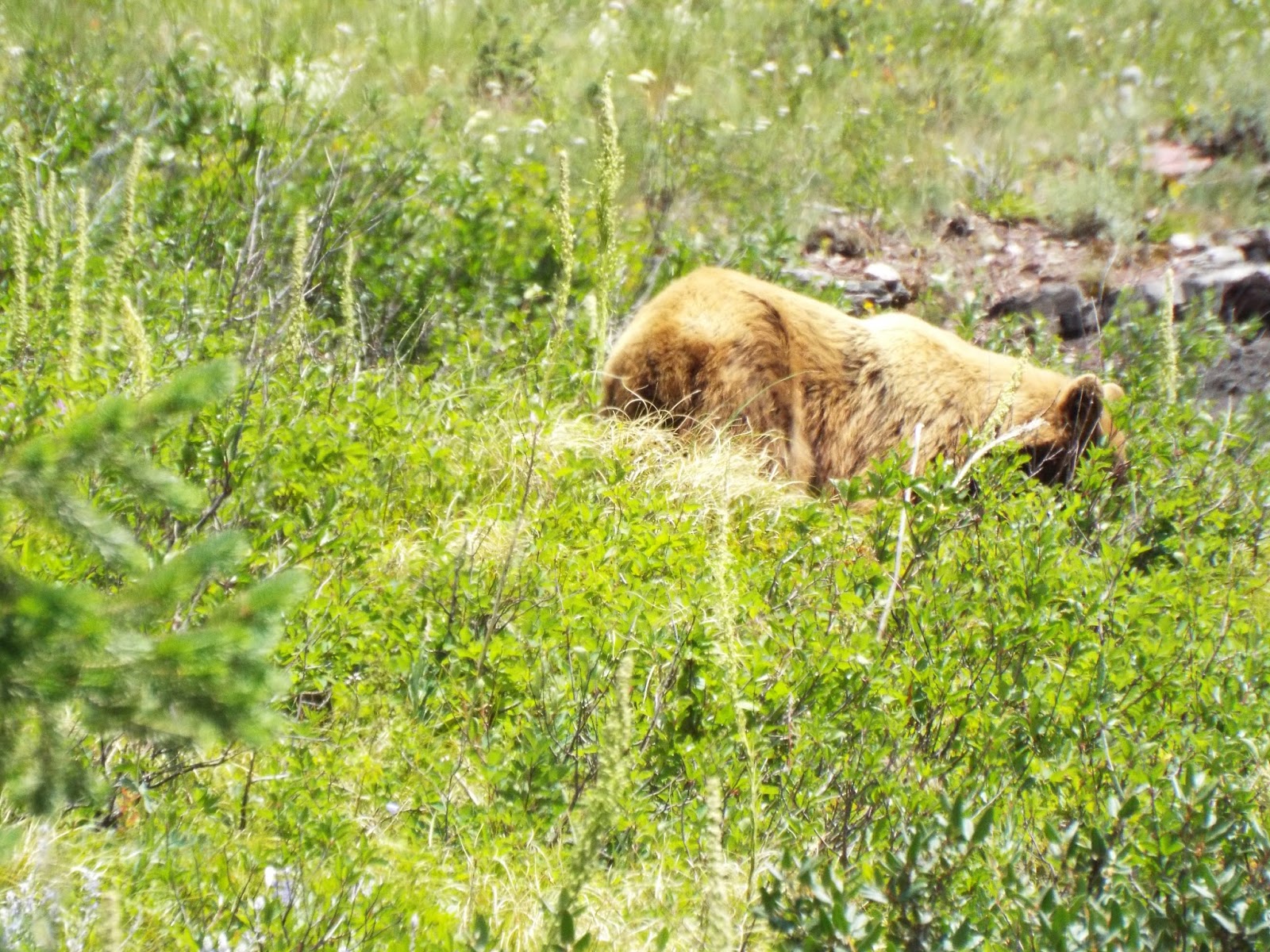
When we arrived on the scene about a mile and a half from camp the light cinnamon colored bear was 20-30 yards up the mountain from the trail. There were a number of hikers standing there watching it with the Ranger trying to get them to move along. We moved past the crowd and up the path a few yards we turned and watched.  The bear was ignoring the people. S/he had to know they were there. The Ranger thought it was a black bear. We had our doubts. You have to remember that Black bears - Ursus Americanus - can come in any color, just as can the Grizzly - Ursus Arctos Horribilis.  I don't like the Latin name for the Grizzly because it isn't a horrible animal, but I guess I have to live with it. To differentiate between the Black and the Grizzly there are six main points of difference - hump, ears, face, claws, paw print and coat.  The Grizzly has a hump on its shoulders from the massive muscle. Their ears are smaller and rather round, Their faces are dished. The Grizzly claws are as long as a human's fingers which gives it a different print, and its coat appears grizzled. Actually there are three names for the Grizzly - Silver point, Kodiak, and Grizzly. It gets the name Silver Point because the tips are actually a silvery white. That's what gives it the grizzled effect. In my own encounter with the two types of bear I find that the Black Bear appear to have just come from a groomer and the hair is all the same color. The Grizzly looks grizzled, almost unkempt and is usually multi-colored. The Grizzly also has a narrower rump with the Black Bear being more pear shaped. This particular bear was more grizzled and had small ears. There appeared to be a hump and it didn't have the nice wide rump of the Black Bear. Our money was on Grizzly.
Look west on the Ptarmigan toward the Ptarmigan Wall

It didn't really matter. Either way the bear was about 70-80 yards too close and the Ranger was undoubtedly concerned. Park rules are to stay 100 yards from a bear. A bear can run at 40 miles per hour. We have talked to Rangers who were chased by a Grizzly as they were riding their bicycles down a mountain. The Ranger said that the bear got so close to catching them that he could hear the bear's claws click on the asphalt. We were neither on duty nor in uniform, so we took some pictures, admired the bear for a moment and then moved on. We weren't worried about the Ranger. He probably went through that routine a dozen times a week.

Ptarmigan Falls
We turned our attention to the trail ahead that stretched out before us like a ribbon. There was very little elevation change in the next mile plus.  We were headed toward Ptarmigan Falls, hiking along between Mount Wilbur (9,321 feet high) and Mount Henkel (8,770 feet high) and ahead of us was the Ptarmigan Wall.  In the picture above, the peak in the distance slight left of center is Iceberg Peak and is 9,146 feet high. Our destination is the cirque lake right below that peak.

Ptarmigan Falls is where the Ptarmigan Trail parts company with the Iceberg Lake Trail.  It is just a bit over half way to Iceberg Lake. At this point we had hiked 2.7 miles and had another 2.1 miles to go.  If you take the Ptarmigan Trail you head almost due north in the valley between the Ptarmigan Wall and Crowfeet Mountains to Ptarmigan lake. It's a good elevation change in that 1.86 miles. You climb about 900 feet.  But that's nothing compared to climbing 575 feet up in 4,380 ft distance from Ptarmigan Lake to the tunnel. Once you have passed through the Ptarmigan Tunnel you are met with one of the most fantastic vistas in the park.  But our sights were on Iceberg Lake.
Mt Wilbur and the cirque around Iceberg Lake 

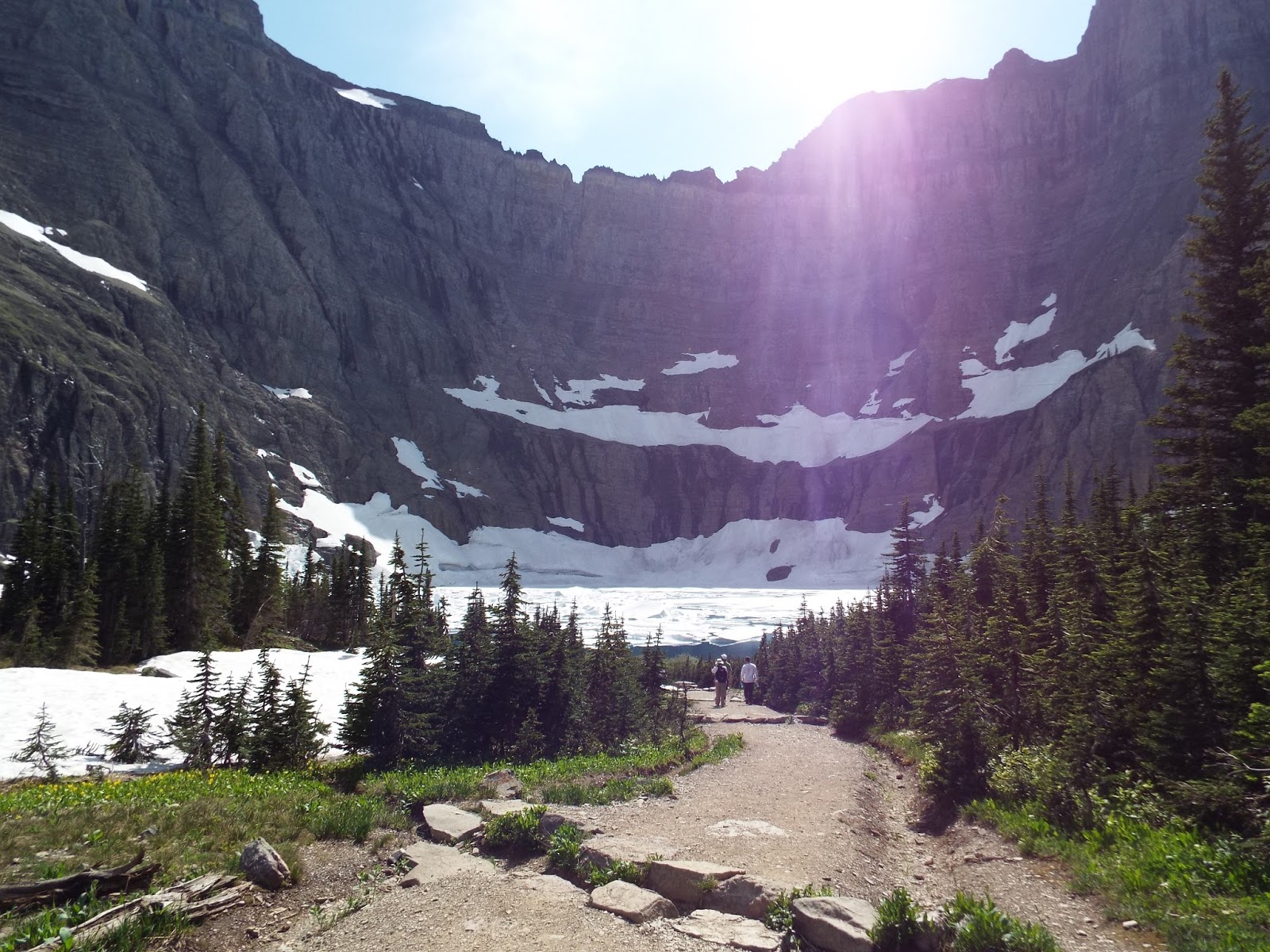
As we went our separate way from the Ptarmigan Trail, heading almost due west, we emerged out of the trees and in the distance we could make out the cirque in which lay Iceberg Lake. We stood for a moment in awe. That happens to us a lot when we're hiking through the Rocky Mountains. Below us was a deep valley about 500 feet to Iceberg Creek at the bottom. The trail would take us up another 400 feet and then go along the Ptarmigan Wall between the tree line and enormous scree field, crossing several snow fields.  It was still over two miles away but Pamela was determined to finish the course despite the arthritis pain in her knees.

Approaching Iceberg Lake
The reward was worth the effort. It was a perfect example of a cirque. The lake is the remains of a glacier. Even though it was the 21st of July the lake was still over 80% frozen with great chunks of ice, the icebergs, sticking up from the ice and snow covered lake. There were also icebergs floating in what little open water there was.

There must have been a dozen other hikers sitting around the lake taking in the beauty. It hadn't been a particularly hard hike but it had still been almost five miles of wilderness trail so the majority of hikers had taken off their boats and were lying on the large flat rocks that had been warmed by the sun.

Pamela and me just above Iceberg Lake
Even though we weren't in uniform our hats had the volunteer logo so people asked us all sorts of questions. Pamela enjoyed what she loves doing most; viz. telling visitors about the marvels around them. While she was explaining the geology of the area around us, one of the visitors tapped me on the shoulder.

Pointing to a dark spot on the side of an ice field about half way up to the 9,321 ft peak of Mt. Wilbur the visitor asked "is that a mountain goat?"

I got out my binoculars. "No," I shook my head, "it a crazy human trying to killing themselves." There on the steep ice field was a person without any climbing gear trying to make their way to Wilbur's eastern ridge.

We were distracted from watching the Mt Goat wanna-be by a family with three teenage children.
They were laughing and teasing each other as they removed their hiking boots and socks while still moving toward the water.  It seemed they had a challenge going on. Who could stay in the cold Iceberg Lake water the longest.  The winner stayed in the water just over a minute. But that prompted the rest of us to go wading.  After all how many people can say that they went wading in an iceberg filled glacial lake.  Of course none of us lasted more than a matter of seconds. Within 10-20 seconds your feet start going numb and it hurts. But everyone had a great time.


We stayed at the lake as long as we could but we  still had a 4.84 mile hike to get back to camp. Thankfully this close to the summer solstice it was quite light well into the evening.  On the solstice it really doesn't get totally dark.  But we did want to get back at a reasonable time. Feeling refreshed and very much alive we put our socks and boots back on, hefted our packs, and started back toward camp. On the way back we were treated to a sighting of a Ptargiman after whom the trail, lake and tunnel is named.  It sat unperturbed by our presence as we quietly passed.

As we approached Many Glacier several trails converge and we became part of a flow of tired, happy hikers returning after a day of adventure in the marvelous mountains of Glacier National Park all talking excitedly about their experience.

No matter how often we go out into the wilderness it is never old. Quite the contrary, each time is a greater adventure because our growing experience enables us to see more and more around us. This particular evening we splurged. Instead of cooking in Willy we went to the Italian restaurant at the Swiftcurrent Lodge that didn't have spaghetti. (That just makes me laugh every time I think about it.)  Returning home we succumb to the wonderful feelings of exhaustion and satisfaction. By 10 pm we were in bed knowing that we are among the luckiest people on earth for tomorrow we will do it again.


You ask me why I dwell in the green moun­tain;
I smile and make no reply for my heart is free of care.
As the peach-blossom flows down stream and is gone into the unknown,
I have a world apart that is not among men.       Li Bai (3) 


FOOTNOTES.
===================================
(1)  I have seen only one Moose in Glacier since this story and poor Pamela still hasn't seen a Moose at Glacier. To pour salt in an open would, we had a Moose Jam (where traffic is stopped and backed up because of people stopping to watch a Moose) less than a mile from where we lived and we missed it!
(2) A thrust is where a part of the earths mantle is broken by a fault and pushed or "thrust" up over the other side.
(3) LiBai  http://www.theclymb.com/stories/passions/mountaineer/5-great-poems-about-mountains/