Thursday, February 9, 2017

The Desert - symbol of strength, fortitude and survival

The desert - symbol of strength, fortitude and survival
I was rather set aback when a travel and nature blogger called the desert "dead." Nothing is further from the truth. The desert is filled with beautiful and resourceful life.

We are currently living in the desert four miles west-southwesst of Quartzsite, AZ.* We are on a flat plain a few hundred yards from the Dome Rock Mountains. Each day we spend some time just walking in the desert admiring the plant life and geology. Yesterday we went out for the sole purpose of identifying shrubs and trees right near where we're staying. We identified three different varieties of trees and four different shrubs. We had already identified six different cacti from the giant Saguaro to the tiny Hedgehog.

You must experience the desert to appreciate its grandeur. Its strength is beyond comprehension for most modern American city dwellers. The Sonoran Desert, in which we are living, gets a whopping 3-16 inches of rain a year. The ground is hard and rocky, covered with volcanic rocks, minerals and gemstones. If we tried to pick up and take all of the beautiful quartz that covers the ground around us, the truck wouldn't be able to move.

The Iconic Saguaro cactus (this one probably hundreds of
years old) along with the ubiquitous Ironstone tree.
The Saguaro cactus grows so slowly that a plant as tall as a man is at least 50-100 years old. The massive specimens around us are all well over 100 years old. The Ironwood tree is called the 'nurse plant' and is its own micro-environment. It is the epitome of strength, endurance and safe-haven. It can reduce temperatures under its boughs by 15 degrees which is important when temperatures can get to 122 degrees in the summer. It provides food which attracts insects and birds which attracts and provides food for predatory animals, and it is a haven for small animals and rodents. We have yet to see an Ironwood tree that did not have at least one burrow under its protection.

On one hike along a wash - a dry stream bed - I found three areas where the soil was damp even though it hasn't rained for weeks. Desert survival teaches that you can dig a hole in such areas and the hole will fill with water.

This is the story of plants and animals in the desert. They are survivors. They can thrive in what the rest of the world sees as adversity.

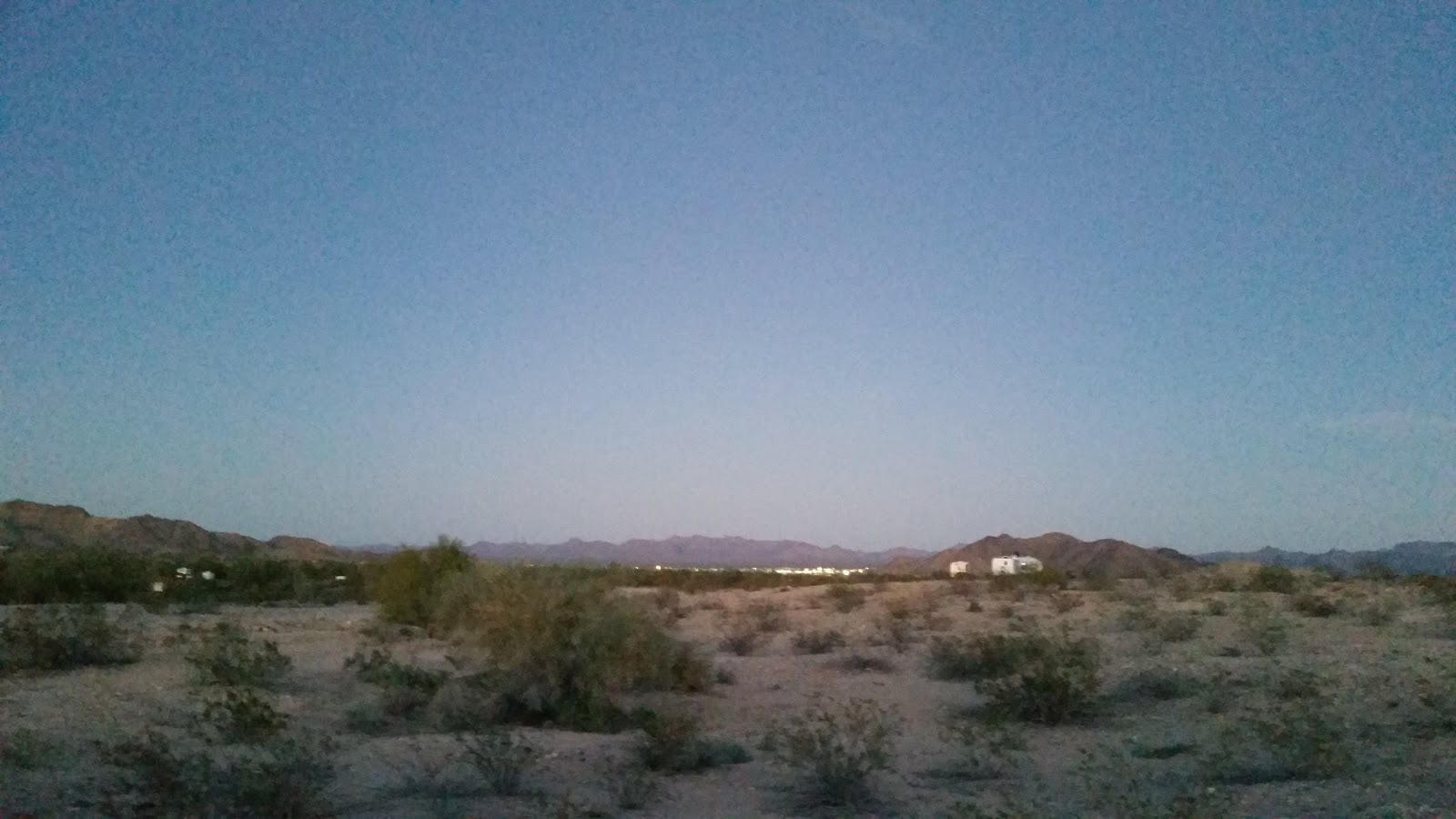
In light of the current political climate where anti-environment individuals and corporations have control of our government, I would suggest that the picture that opens this blog be a symbol of our determination to resist and survive. The tree in the foreground is Ironewood representing fortitude, survival and safe-haven. The mountains in the distance represent strength, resistance and longevity.

For those who love our disappearing natural areas and wilderness ... for those who know that our very survival depends upon how we treat Mother Earth ... I suggest that you post this picture someplace where you see it regular and put a caption on it "We will prevail".

Live in hope, dear friends.


=======

* NOTE. I say 'living' instead of 'camping' because we are full-timers who are always home with our 20 foot trailer named Nitsitapiisinni (Blackfeet for 'our way of life') never more than 18 feet behind us - the length of our Ram 1500 4x4. The young man in the tent, living out of a backpack, about 100+yards west of us is camping. 

Monday, February 6, 2017

Quartzsite, Arizona

Leather, Ice cream, Dry camping, dump & water
all in one business. Many shops are like that.
We arrived in the famous Quartzsite, Arizona around noon on Sunday, January 29th. It was packed with cars (mostly toads - vehicles towed behind a Class-A or Class-C RV), trucks (which were mostly tow vehicles), and recreational vehicles of every possible description. Two people had told us that we really needed to camp along Dome Rock Road. We registered with the BLM hosts and drove the length of Dome Rock Road, finally deciding upon a place right up against Sugarloaf Peak, an outstanding geologic feature in the Dome Rock Mountains. We just pulled off the road on the hard desert sand and found a spot. We set up and quickly headed off to explore Quartzsite.

We really hadn't tried to get here before their famous RV show closed. In fact, we weren't really sure that we wanted to get caught up in the chaos which the show creates for miles in all directions. Nevertheless we ended up going to the "big tent" - the focal point of the RV show which draws tens, maybe hundreds, of thousands of campers and RV enthusiasts to this tiny desert town every year. We pulled into the parking lot less than an hour before it closed. We just wanted to see it for ourselves. Inside we encountered a man selling solar panels for a deep discount so he didn't have to cart them home. We bought an 80 Watt portable solar panel for 45% less than the best price we could get on line.
Street vendors galore.  Just some along Main  St.

By Monday morning things were a lot different. So many people had left town that you could actually drive down the main street, but there were still RVs of every description no matter what direction you looked. It is almost like a permanent carnival. As I mentioned in my blog "Desert Living - a steep learning curve", the streets are lined with tent vendors, concessions sold out of the back of trucks and vans, store that sell everything and anything, at least four RV sales, four RV parts and service besides the sales companies, ten gas stations and two solar companies. One of the more unique businesses is called "The Pit Stop" where you can dispose of your trash, fill up with fresh water, dump you holding tanks, fill your tires and buy ice all in one place. Even as things have started to settle down after the RV show, there is always a line down the street for The Pit Stop. If you don't want to boondock in the desert,there are three RV campgrounds inside the city limits, plus all of the businesses you'd expect to find in an enormous town of 3,643 people.

Quiet Time - a stationary shop where we get
our mail delivered. 
I went to the Post Office to check on general delivery. I won't bore you with the details other than to say that one thing we have learned in our experience is that every town's post office is different and it is best to check it out before having your mail sent there. Larger areas and towns, like Quartzsite, which are inundated with campers are not as helpful as small towns. In Quartzsite General Delivery can be collected between 11am and 1pm. When 1pm arrives they close the door even if there are people waiting. I got there just before noon. Some people had been waiting 30 minutes and weren't even inside the door. As is typical of camper, travelers and full-timers - mostly geriatric nomads like us - everyone was talkative and happy to share. I learned about campgrounds, BLM areas, water, dump and a host of things including a small stationary store called Quiet Time that will let you use their address for your mail.

Herb's Hardware. People are friendly and it
has almost anything you could want. 
Herb's Hardware is one of the local businesses I've patronized several times. It is a True Value franchise unlike any you've ever seen. There is a line of outbuildings for wood and other items. The main store is a large metal building with big sliding doors on the side. It almost gives you a feeling of an open air shop. It was packed. Packed with people and products. I quickly learned that the easiest way to find something was to ask. They were happy to show me where to find what I wanted. Like everywhere else it was filled with old hippies and old cowboys. The rest were just old.

This is undoubtedly retirement central. We went grocery shopping at a Walmart in the nearby town of Parker. I swear that, pushing 71 years old, I was one of the younger ones there. Pamela is probably the age of their children.

The place where we did our laundry was so crowded that we had to wait for washers and dryers. BUT it was a hoot. Again, if you didn't have grey hair or bald, you were the odd one out. There were at least twelve vehicles in the parking lot - ranging from toads (cars that are pulled behind big Class-As) to the Class-As themselves. Of those 12 there were only 2 with a license plate from the same state. Guess what! That state was Montana. LOL. I talked to a couple from near Mt. St. Helen while I folded my clothes. I also talked to a fellow who lives half the year around Quartzsite and the other half in Oregon. People from around the country all enjoying life to the fullest.

Silly Al's - good pizza and good people
We had lunch today at Silly Al's. It's a beer and pizza joint that has live entertainment at night. It has great pizza, and we got a really good local beer called Mudshark. The place is so popular that we had to wait for a parking spot.

Silly Al's from the outside. Parking is always a problem.
As I mentioned, there are three RV parks within the Quartzsite city limits, but the majority of us stay on BLM land. (Bureau of Land Management) Most of the areas have a 14 day stay limit. But it is free. After 14 days you must go 20-25 miles before you can get a permit for another BLM area. One of the most common conversations with our new found geriatric nomad friends is the BLM areas discovered. "Oh, you're headed to Yuma. You need to try Palm Canyon Road." We look up all recommendations on Google Map/Satellite mode, so we can actually see the place, and decide if it rates a star on our map.

This is a trick we learned from a nomad friend, Brent MacAloney, who actually boondocks in a Prius. He writes a daily blog about his adventures. If you hold your finger on a spot on Google Map/Satellite mode for a moment it will show a drop-pin. You can save that drop-pin spot which leaves a star shinning on your map. We already have a number of stars on our map of southwestern Arizona.

This is where most of us stay ... camping on BLM land.
This is Dome Rock Road a short distance from our camp.
We are camped 6.6 miles west-southwest of Quartzsite. At this time of year there's nothing noticable around except Desert Broom, Saguaro cactus, Ferocactus, Cholla and a couple of plants I don't know yet. The locals say that the wildflower show will start in March. It is supposed to be magnificent and we don't want the heat to push us north until we get to see it. Pamela is sure that things seem to be a bit more green that when we arrived almost a week ago. The ground is littered with quartz and shale. There is still some gold mining going on in the area. I found a couple of old gold mines while hiking in the desert and some modern day prospectors. (Check out my blog "Quartz, Water and Prospecting".)
Gem World is an enormous rock & jewelry craft wholesaler.

Pamela checked out the local history. Quartzsite started out as a trading post and then became a fort for protection from local Native American tribes bent on sending the illegal aliens back east. Gold mining came later and was relatively successful. There are a number of very large rock and gem stores in Quartzsite, a gem show touted as the biggest in the world, as well as a four day Gold Show.

Inside Gem World
I'm sure you've all heard people say that because of the low humidity you don't notice the heat. If you're a skeptic, come find out for yourself. It is true. 80 degrees with 15-20% humidity here is more comfortable for us than 60-65 degrees with >80% humidity in the east.


Our routine has become to be awakened by the sunrise and decide whether or not we're going to get up or just lay in bed and enjoy. Either way, by 8:30 we have put out of solar panels and are collecting the sun's energy. It will take all day to refill our rather sizable capacity batteries. You can fill your days with activities organized by a local organization called QIA, roam through acres of tent vedors, hike the mountains or hunt for gold and gems, ride ATVs through the hills, or just sit and watch the world. Whatever you do, you'll enjoy your time at Quartzsite, Arizona.

A row of shops on Main Street by the Chamber
of Commerce Office. 


Quartzsite Outpost sells everything from used books
to surplus military vehicles. 


Sunday, February 5, 2017

The First Cloudy Day

Shut down our solar panels when we saw this coming. 
If you want to know the true meaning of anxiety, be a solar energy newbee - and I mean a seven day newbee - on the first cloudy day. If anxiety is rated on a a  scale of 1-10, I would probably be >10.

Well, maybe I exaggerate just a bit ... a big bit, but today didn't even start out particularly sunny. The sun was in and out, so I did find myself watching the read out jump around - 13.1, 14.2, 13.6, 14.5. These are the volts coming from our solar panels. We want a charge cycle to be around 14.7 and, when the batteries are charged, a maintenance cycle of 13.7.  I finally called it quits when Pamela returned from the store and pointed out some dark clouds just coming over the Dome Rock Mountains.

I don't know about the desert, but most places I know probably wouldn't even report a 1% chance of rain. They'd say "no chance". Most places I've been don't consider 20% much of a chance, but I couldn't help wondering. 1% is 100% greater chance that any other day we've been here, and the 2% forecast for the next hour is a 200% increase. Maybe I should pay attention. After all, the normal humidity is around 15-18%. The forecast for this afternoon was 24% humidity while the actual humidity report was a towel-wringing 35%. The clouds are not the usual nimbus one associates with rain, but I'm out of my element here. The temperature is falling rapidly. That, however, I've learned is typical when there is not direct sun. We can have a cool breeze all day even though it might be 80+ in the sun. The desert appears to hold absolutely no heat, unlike a city which might be 10 degrees warmer than the surrounding country because all the concrete and asphalt begins to give off the heat it absorbed.

Even as I sit here writing I look out our large back window and see the signs of nimbus. I look carefully for signs of rain on the mountains a few miles south of us. In the northern Rocky Mountains you can almost always see the rain line as it crests the mountain.

Of course I know that I won't have a blazing sun every day. The idea is to have enough energy stored in your batteries to get through cloudy and storm days. The question right now is 'do we have enough battery?' Yes, I know. The solar and RV rule is 'you can never have enough battery' but at this point we have as much as we can charge. It's not going to do you any good if you can't charge it.

Solar power is really becoming much more affordable. We are using portable solar panels because we don't want to drill holes in our roof (that can be disastrous on a trailer) and we don't want to have to have solar panels determine which direction we face Sinni. The portable are more expensive because each unit has its own regulator. We will probably look at more solar panels before more battery so we will charge what we have more efficiently. We've looked at the new lithium batteries. They cost $1,000 to $2,000 for 100 amp hours. We have 224 amp hours. The advantage, however, is that you can run a lithium battery down to nothing. Even our good AGM batteries should not be run down more than 50%. So a 100 amp hour lithium battery will last as long as a 200 amp hour AGM battery. Food for thought. They are also very light weight, so you can carry many more.

Most of the threatening sky is now to our east. Probably no rain for the desert here. I wander back to my volt meter. We have a comfortable 12.6 volts with the batteries off the chargers.


My anxiety level is down. Well, maybe it wasn't really all that high, but I have learned to trust my equipment. We had put a lot of time and energy into selecting it. Now I can go back to studying the lovely and interesting plants around us which we see getting greener by the day. Did you know that the tall iconic Saguaro cactus might be over 100 years old. All Saguaro are protected by law in Arizona. But I'll tell you more about that in another blog.  

This magnificent Saguaro cactus must be >40 feet high.
That would put it well over 100 years old. 


Friday, February 3, 2017

Quartz, water and prospecting

Dome Rock Mountains
Wandering the hills around Quartzsite, more specifically the Dome Rock Mountains around Sinni, was an enjoyable experience filled with new plants, surprising discoveries and a taste of the past.

Everything except area circled in red are campers!
And thousand have already left for the season!
We are camped 6.6 miles west south-west of Quartzsite at the base of Sugarloaf rock which is part of the Dome Rock Mountains. We are much lower than we were at Rock Hound State Park where we were camped at 4,600 ft. Here we are considerably higher than the town of Quartzsite but still only at an elevation of 1,257 ft. The lower formations of the Dome Rock Mountains, like Surgarloaf, rise to a maximum of 1,436 ft. with the highest peak in the range being <2,500 ft. I guess I've been influenced by Montana and the Rocky Mts where the Belton Hills are almost 6,000 feet high. Despite their low stature, they are formidable rock formations and quite beautiful.

Quartz outcropping
When you hike these hills you know why Quartzsite got its name. There are beautiful pieces of quartz crystal lying everywhere. I ran across what appeared to be an outcropping of quartz. It was a mounded area comprising mostly of quartz with several enormous bolders of solid quartz buried in the ground. I have no idea how far down they might go. Since there are several large rock and gem stores and traders in Quartzsite, I'd guess that this outcropping had been frequently visited.

Almost everything green is found in either a wash or some other depression. There is a depression near our camp that is filled with shrubs. When I went to explore it I found a large trough that had been dug out. I decided that it must be rock hounds looking for specimens to sell at their shops.

One of the "oasis" I discovered
I followed a wash - dry stream bed - northward. I was admiring the vegetation and taking pictures when I made a startling discover. It was wet! There has not been rain here for weeks yet there was mud. If, like you're taught in survival, I had dug a shallow hole I'm sure it would have filled with water. This was one of three such oases I encountered on my hike.

Gold mine entrance
As I came up out of the wash I saw what appeared to be fenced areas ahead of me. As I drew closer I could see that the three structures were cages made of heavy metal. The first cage covered what appeared to be a sink-hole. I wondered why the government would go to such extent to cover a sink-hole. Why not just put a fence around it and say 'stay out'. Upon closer inspection down the dark hole I could see timbers. These were the entrances to mines. I remembered that a local group called QIA has a Gold Show next week. I wondered if these were old gold mines and determined that I would check it out next time I was in town. Two of the three appeared to go almost straight down while the third had two entraces and a tunnel extending back into the mountain. The tunnel was only high enough for a large man to crawl through.

Another of the gold mines
I climbed one of the smaller formations. It offered a panoramic view. As with most of the rest of the area it is covered with quartz and shale. This peak offered a much closer look at the Dome Rock Mountains. Amazingly there were no signs of ATV on this feature. All the others have trails up and down the sides, except for this small mound on which I stood and the top hundred feet or so of Sugarloaf which would require a reasonably skilled rock climber to ascend. There were two cairns at the top of my mound, so I had to add my own.

My cairn 
As usual I had taken the hard way up because I wasn't really planning on climbing to the top. I had spotted this group of lovely Ferocactus. Actually much of the side of this feature was covered with Ferocactus. At this point I have identified three types of cacti - Saguaro, Ferocactus and the Cholla which is a part of the genus Cylindropuntia. I'm still working on learning the bushes and small trees. There was one plant, which I assume is in the cacti family, that I have been unable to identify. We'll be stopping at the local bookstore soon. If you know its name, please drop me a note.

On my way home I followed a draw that ran between Sugarloaf and the mound I had climbed. Again I saw lots of evidence of humans digging. A short distance before I arrived at the trail on which we are camped I saw a dig with buckets, shovels, and other tools. There was a small trailer and a truck camper parked just above the site. I asked a lady, who was sitting outside watching me, about the dig. She was reluctant to tell me why they were digging. A man came out. He said nothing. He just watched me. Finally the woman said they were digging for gold. I wished them luck and moved on thinking "I sure hope there isn't a rifle pointed at my back."

Unknown cactus - let me know if you know its name!
Looking at a topographic map later I found spots all across this area designated "prospector". Since I'm still here this morning, they were evidently not too threatened by my discovery of their dig. It was well hidden in the brush along the draw. That's the only reason I was there was to see the vegetation. From what I understand it is legal to prospect for gold on BLM land, but, if they think they have a good spot, I'm sure true modern-day prospectors don't like to share their location.

There is so much to see in the desert. We check each morning to make sure that some desert animal hasn't nested in the truck engine compartment. We keep a close eye on the dogs because the coyotes are known to be very stealthy and are quick to snatch and run. It gets hot during the day but the temperature drops quickly and suddenly as the sun begins to go down. A moonless night leaves you with a marvelous astronomic display. Even I can identify some of the constellations when it is this clear.


If you haven't camped in the desert. It is an experience you don't want to miss and BLM (Bureau of Land Management) land affords you that opportunity.

Saguaro cactus and tree in the Sonoma Desert


Thursday, February 2, 2017

Desert Living - A Steep Learning Curve


Sinni camped in the Sanoma Desert by Dome Rock
Pamela and I have over 40,000 miles of travel experience in the past three years but nothing prepared us for boondocking in the Sonoma Desert. No matter how much we read and no matter how many seasoned southwesterners we talked to, the learning curve for living here was almost perpendicular. There is water conservation, power, and waste disposal and dumping just to head the list.

Now that is neither a negative statement nor should it be a red flag to anyone considering coming to the desert. It is just a statement of fact. Like learning to walk, everyone must do it. Actually for us it has been an exciting and enjoyable time of discovery and learning.

We arrived in Quartzsite, AZ about noon on January 29th. I know it sounds impossible but Quartzsite was everything we expected and nothing like what we expected both at the same time. It was wall-to-wall street vendors, concession out of the back of a truck or camper, and grey hair as far as you could see. We expected that. It was the last day of the big RV show, which draws hundreds of thousands of people from all across the country.

Interstate-10, which passes through Quartzsite, looked like a caravan of trailers, Class-As and other forms of recreation vehicles going both east and west. We had a couple of people recommend that we boondock on the BLM land along Dome Rock Road. There is no cost but they do ask you to register. As the hosts said, "it is so we can show that the land is being used." No problem! Campers of every size and description were scattered across the desert.

Morning view out our big window (looking south)
If the first-timer or newbee isn't afraid to admit it, the learning curve is truthfully almost perpendicular. I'm not afraid to admit this. Despite all our experience almost everything was new. On the way here I kept thinking 'oh, you just pull into the desert and find a place to stop.' It's got to be easier than camping in the wilderness, which is our normal. As you sign in with the BLM area host and look around at the arid and almost hostile land, you begin to worry about finding a place to camp. Perhaps it is that easy the second and subsequent times, but the first time you worry about access, position, shade (or lack thereof), sharp rocks, solar cell placement, and a number of other issues. There's no way the most articulate of seasonsed desert camper can explain these things. The best they can do is warn you not to get into a draw because the ground is soft and not camp too close to others. Having been through our first time, I can understand why it is a matter of experience. Actually except for getting stuck in a draw, being swept away by a flash flood or sliding down the side of a mountain because you got too close to the edge, you're probably not going to do anything that will kill or serious injure you. A bad choice will probably be no more than minor discomfort or the use of more energy. Energy and water are your life here.

Our neighbors
I used the word 'hostile' above, but I only used it because, at that moment in time, that's the way it appeared. We soon learned that the desert isn't hostile. It is a unique environment that only frightens us because of our naivette. I would imagine that first-timers to our beloved mountain wilderness would find our home, in which we find such peace and security, equally hostile.

We have 40 gallons of fresh water with us. We have found that being conservative with it isn't as difficult as one might think. When we wash or hands or wash dishes we keep that water. In stead of letting it go into the 'grey water' holding tank we use it to flush the toilet. At Quartzsite there are a number of water vendors. There is everything from machines which will dispense water into a portable container to a place called "The Pit Stop" where you refill your fresh water tank. It does cost, but having lived overseas where water was a precious commody, I don't find it exhorbitant. We also wipe out our dishes before washing to reduce the amount of water required for cleaning them.

Disposal of trash and sewage is more of a problem because there are not dumpsters and dump stations around the corner. Some BLM land permits you to dig a hole and bury sewage and grey water but even there you must be very mindful of your holes relationship to possible water sources. Never burn trash or bury it. Trash needs to be bagged and carried out. That's the rule in mountain wilderness as well. Carry in - Pack out. This problem is not unique to the desert but one more thing with which you must contend. Our solution is that we're going to move when our black-water (sewage) tank gets full. We'll go to The Pit Stop, dump, load up with water and head off to a new and exciting location.

Two 80 watt solar panels.
When you're boondocking in the desert you are totally dependent upon the batteries you are able to carry and the means you have to recharge those batteries. Our neighbors tried to run more than their batteries were able to handle and didn't have the ability to recharge and they ended up frying their batteries. They have a big fifth-wheel which takes a lot of energy just sitting there. Sinni is not only extremely efficient but, because of our small size, not trying to use A/C, satellite, etc., our power demands are minimal. When I was calculating our minimum battery needs I calculated 1amp for each light. We have all LED so the

man at the solar store just laughed. "You probably don't use 1amp for all those." You really need to find people who know batteries and/or solar energy, depending upon your need. If you still use a gasoline generator that is a whole different world. We had purposely waited to update our battery and solar system until we got here because we knew there would be more knowledge of battery and solar for RVs here than anywhere else.

Here again our learning curve was almost perpendicular. I didn't even know enough to get into trouble. But several hours of study and lots of listening to people who know has changed that. You get to the point that you can calculate the required amp hours in you head when you know the 110 wattage of the device you want to run. Ao(12V) = Whr/12. Of course it is also important to know (V110)A = W and that to calculate how big of an inverter you need you want to know that the size of the inverter is the sum of the devices in watts plus 50%. I quickly learned that you can't have too many volt meters nor can you have too much battery nor can you have too many solar panels. You get as much as your pocket book can handle and your rig is able to carry. Our current demand is around 55 amps if we turn everything on at the same time. Our battery array is two 6 volt, 224 amp hour batteries connected in series to provide 12 volts of 224 amps.

Living in the desert does carry with it a steep learning curve but it is worth the effort. Every day we are learning, seeing and experiencing new and exciting things from the rock to the plants to the weather.


Friday, January 27, 2017

Because It's There

I always thought the response "because it's there" was a crazy answer to the question "why did you climb the mountain?" But over the past five years I have come to understand "Because it's there" just acknowledges that something has challenged you and, no matter how crazy it seems, you have to do it.  I ran solo across Badlands National Park. I also ran the 45 mile Eagle Rock Loop in Arkansas solo in 15 straight hours. I went scuba diving in a 500' deep lake fed by glaciers and snow melt where the water temperature at the surface on July 5th was 40 degrees.  All my life I had found it necessary to "play it safe" because I had a family to consider. That ended when my children all had their own families and I was on my own. Today Pamela and I travel the west, volunteer at national parks, and pack all the life we can into every day. You only go around once. No returns for the I-wish-I-hads. 

Bright red is my route up. Burgundy is my route down with fewer cacti.
Today I was just out looking for some gemstones on the side of the mountain. I kept getting attracted to natural features further and further up the mountain. Before I knew it I was standing at the top of one of the peaks. Granted that the climb was just a wee bit over 1,000 ft above the campground, and my friends who are real mountain climbers wouldn't consider this more than a stroll, I don't think it was bad for an arthritic old man. I ended up taking the hard way up because I wasn't really planning to go to the summit. I wasn't as worried about falling as I was of hitting all the cacti on the way down, so I took a much longer route down that had less cacti.  When I got close to the top it became a matter of "because it's there." 

 The picture above makes it look like a gentle grade on even terrain.  As you can see from the two pictures to the left, that isn't exactly true. I was off trail and had to contend with all sorts of obstacles.


The picture to the right is of my final ascent to the saddle which was just before the rock-climb to the summit.  I did not go back this way. LOL.

To the left is a selfie as I was just below the summit. I didn't try to get a picture right at the top because it was pretty windy and I didn't want my hat to beat me back to the bottom.

The picture to the right is the last 20-30 yards climbing over large boulders. It wasn't quite as bad as it looks. They were large.


Another selfie near the summit. I picked this one because you can see the valley below. The valley is about 4200 ft elevation. The campground where I started is 4600 ft. The summit is 5,680 ft. 


The mountain is one enormous gemstone. I saw obsidian outcropping the size of a pickup and walls of Jasper. The park lets you take stones but there is a weight limit. I see why.  


To the left are some stones with great examples of Jasper  and stratification. The picture to the right is an outcropping of obsidian. This isn't the biggest, but the one I encountered that was the size of a pickup was toward the top of the mountain and I rather had my hands full.  


Sunday, January 22, 2017

The Walk

The ground is firm under my feet as I walk the well used trail through the woods. The loblolly pines have made a fine mat of needles on the forest floor around me. Their reddish brown bark hangs like scales while their tufts of branches and long dark green needles are high above my head. But I can tell when the canopy is thin without looking up. Wherever the canopy is a bit thin there is a small cluster of seedlings all vying for that bit of sunlight.

There were supposed to be animals in the bayou. Everything from bear to alligators. I didn't see any. There was lots of hunting. I wondered if they were in hiding. Animals are smart, you know. When you visit a large national park where they're not allowed to be hunted they don't run and hide. You get to live together in peace. That's not true elsewhere.

I know that killing another animal for food is part of the cycle of life. I am well aware that if the carnivore predators disappear the herbivore ungulates overgraze and you end up with an environmental mess. Human created such a disaster by purposely killing off all the wolves in Yellowstone. It reversed and balance was regained when the wolves were returned. I happen to be a omnivore, like kiááyo - the bear, but I have a distinct advantage. I have all sorts of food sources and options, and I have the ability to make a conscious decision not to kill other sentient beings.

Stopping on a small rise above a campground I see the signs in the earth. Deer tracks. It had been raining for a couple of days so the tracks were very distinct even though some of them were hidden in the grass and pine needles. It looked as if the deer had stayed looking down at the campers stamping her or his feet. Were they upset or frustrated by the human presence. No matter. The tracks turned and led off in another direction. I didn't follow.

I can't help but think of how humans will purposely kill an animal for no reason other than "sport" or to purposely exterminate the species. Then we act like we have been burdened by the responsibility to "thin the herd" of ungulates to "maintain balance." If we had stayed out of it in the first place and only hunted to put food on our tables, we wouldn't have created the problem.

As I stop to admire a small pond I try to redirect my thinking. It is hard. I get so angry with my species. We have such potential and we blew it! We've become an insidious invasive species yet we're so arrogant that we think we're saviors. I look around. I fantasize about having so much money that I can buy up vast tracts of land to save them from my own kind. But the fantasy is short lived. The signs of death are all around me . . . the rusted fence running through thick forest . . . high fences topped with razor wire surrounding an open area filled with piles of gravel and equipment . . . slabs of concrete dumped . . . once clean water polluted and stagnant. And we haven't even gotten near the urban sprawl where lots are almost an acre, trees are cut, the environment ignored to make space for a gigantic houses built for two. Two?!

I hang my head and move farther into the forest. I can't stand straight. The sense of despair is too great. I love to admire all that is around me as I walk or run through the woods, but right now I keep my eyes to the ground because I can't bear to look at what my species has done. The shame is almost overbearing. I want to escape from reality but I know that no matter how far into the forest I go I will still be the same. I can not escape myself.


I stand on a ridge looking out over beautiful trees and meadows. I see the birds. I smell the nature. I beg forgiveness but to no avail. This marvelous sight may well be gone before my name is forgotten, and I am helpless to stop it, but I share in the blame because no matter what I do the reality is that I am a homo sapien - a human - an interfectorem terrram, . . . . . . . . . . . . . . . an earth-killer.