Friday, January 16, 2015

NO ONE LIVES FOREVER ... BUT WE TRY

No one lives forever. There is no doubt that it often appears that we expect to, and there is definitely no effort lost in living as long as possible. The day before he died, my Father very stoically told his attending physician that he'd had enough. Up to that point, however, he had done everything the physicians said to stay alive.

Actually part of that effort is a bit ironic. My Father had been a smoker since high school. He went from smoking a pipe, which he claimed he didn't inhale, to being a moderately heavy cigarette smoker. He learned to smoke cigarettes in the US Army. We all did. In my Dad's day they got Lucky Strikes or Camels in their C-rations. When I was in we got Winstons or Salems in our C-rations. I quit smoking in 1977. I tried never to be the overwhelming crusader that many ex-smokers become. I tried always to remember how hard it was to quit. It took me a year in the day when we didn't have patches and gums. I did it by using extremely small amounts of snuff - so small you couldn't see it and I didn't have to spit - and reducing that until I could go without. I remember reading that nicotine is the most addictive drug in the world and that if, after many years, I were to smoke one cigarette I'd be as addicted as the day I quit. I don't know if that's factual in any way, but I sure wouldn't argue with it or be willing to test it. ( If you're the technical type I would recommend an article by Katherine C. Goedeke and Stephen T. Tiffany that was first published in the Journal of Abnormal Psychology (J Abnorm Psycho. Nov 2008; 117(4): 896-909) entitled On the Nature of Nicotine Addiction: A Taxometric Analysis which you can read at http://www.ncbi.nlm.nih.gov/pmc/articles/PMC2876731.) From 1977 until around 2006 I would take any casual opening I could find to discourage my father smoking. Short digression: you need to know that my father was the consumate academic. Nevertheless he would insist that he wasn't addicted. Sure Dad. That's why, when everyone went back to Ireland for a visit, you flew on Aer Lingus instead of on US Air where we had enough traveler points for a free ticket. He thought that Aer Lingus still permitted smoking on their flights. Wow, was he angry when they turned out to be smoke free!

Nothing made an impact on my Father's smoking. He had COPD for many years. It actually traced back to lung damage just prior to landing on Omaha Beach on D-Day, but it was exacerbated by ... guess what ... smoking. My Father was a disabled veteran and so he saw the physicians at the VA frequently in the last 10 years or so of his life. When he was 83 years old and had smoked for 66 years of his life a VA physician said “Dr. Vance, if you don't stop smoking right now you're going to die.” He stopped right then and never put another cigarette in his mouth. He lived another seven years.

The thing about this story is that almost everyone would do the same in order to continue living. I spent almost my entire career working in health care institutions and I did have a couple of patients who were so determined to keep smoking that they actually smoked on the day they died ... died from lung cancer. But that was extremely rare. If we told a patient that if they continued smoking they would probably die within the year and if they stopped they might get another year or so of life, they would almost always quit smoking.

We all want to live. We all know a person who insisted upon chemotherapy or radiation right up to the end of life because they never stopped believing that they were going to live.

The Earth is dying. We know that in, hopefully, several billion years our sun will start changing into a giant red and the earth will be engulfed by the expanding star. Even if I won't be there to see it, I really would like to believe that the Earth will live out its full potential existence as a vibrant, living planet. Wouldn't you?

Now part of my desire that the Earth continue as a vibrant, living planet, not just exist as a dead rock, as long as possible is because I believe that I'm a part of the Earth. It's kind of a Buddhist version of conservation of mass and energy. Even if I'm not alive in the form of a human animal, I am still a part of the whole. As long as the earth lives, I live, even if I'm not experiencing what we call consciousness. (Then again, maybe I will. Who knows for sure?) Another way in which this immortality, for lack of a better term, is played out is in the lives of our progeny. While my physical remains join with the rest of the Earth, my progeny carry me in their genetic code. Rather neat! Modern science can trace one's roots back to early man through their DNA. That means that I'm going to hitch a ride forward. I really don't want to see the end of the world before it's time.

Now here's where the rubber hits the proverbial road. Most scientist believe that the human animal is like smoking . . . it's killing the Earth. I really hate to think of myself as being a part of a killer, but, then again, I have to face reality. We are raping the land. Look at the tremendous scars, many which can be seen from space, that we have left in our quest for wealth and comfort. It's rather scary!

                                                           http://imgfave.com/search/deterioration

We are causing the extinction of other species. I'm reminded of the quote “if the bee disappears from the surface of the earth, man would have no more than four years to live.” I tried to research the scientific evidence for this statement but kept running into the argument that it was not Albert Einstein who first said it. (Here's a site to get you started: http://quoteinvestigator.com/2013/08/27/einstein-bees/ ) I finally stopped because this blog isn't just about bees. Bees are an example. Bees are phenomenal pollinators. Even in 1907 the New York Department of Agriculture had estimated that more than 100,000 variety of plants would cease to exist without bees. We are killing off species of insects and animals that help our food grow so we then think that we just need to add a chemical to the soil or change the plant DNA, and end up poisoning ourselves. We almost lost the symbol of our great country, the Bald Eagle, with our use of the chemical pesticide DDT, and we wouldn't have been far behind. The human animal really doesn't do very well at thinking things through, does it? Even what we like to call a “lesser animal”, while persuing food, will reach a point that it will stop. It realizes that stopping might mean being hungry but it will still be alive to hunt another day.

We are poisoning the air, the land and the water. This is the only air and water we have. We can't send out for more. Aquafina doesn't come from off planet. 

Professor Pamela Smith, professor of biology at Madisonville Community College, had a 200 level scientific inquiry class do a study which they ended up presenting at a multi-college science conference. They took soil from places near their homes and noted if the soil was from land that had not been disturbed by coal mining, soil that was from land that had been mined before the reclamation law, or soil from land that had been mined after the law. They attempted to grow radishes in each soil. The radish is know to be a very easy plant to grow. The first time they watered their plants they noticed that water just ran off the mined soil. Even the soil from land that had been mined after the reclamation law could not sustain life. Professor Smith knew what was going to happen but she wanted her students to test for themselves.  What made the biggest impact was that the soils were collected from right by where they lived. 

If we pollute or poison the water in this lake we will poison all of the western coast of the United States.
                                                         www.wikimedia.com

If we pollute or poison the water in this lake, we will poison the water in Hudson Bay through which passes almost all of the water for eastern Canada and northeastern US.

                                                         www.wikimedia.com

If we poison or pollute the water in this lake, we will poison the waters of the Missouri and Mississippi Rivers flowing through the heartland of America.

These are all pictures of lakes in Glacier National Park, the point called The Triple Divide Peak. Check out this map of the North America water effected by the Triple Divide Peak alone.

I don't know about you, but I find this scary stuff!  I'm certainly terrified. Aren't you?  And I haven't even gotten to global warming, fracking, tar sands oil, drilling in the Artic, etc.  

BUT there will be those who insist that earth goes through changes and cycles, etc., and we are to expect such things as global warming, etc., never mind the damage which is undeniably human. To this I must say 'yes, some of the changes we see around us may come from natural causes,' even if you don't want to accept what we can document we're doing to the planet.  

Here is where I go back to my original point . . .  what won't we do to stay alive?  Are we not willing to afford our only home the same care?   The nearest confirmed potentially inhabitable planet is 13 light years away.  Who's going to hop over there to confirm whether it really is inhabitable? 

My next point is . . . what does it cost to take care of our world?  Does it hurt us to do simple everyday things to contribute to Earth's life as opposed to contributing to its demise? Logic, mathematics and computer algorithms can easily demonstrate that a great number of people doing or refraining from doing very simple, daily, low or no cost activities can make tremendous differences in the life of our Earth and the quality of life for those of us living here. 


The beauty of nature . . . the miracle of life


I was wondering whether this qualifies as a blog, so I went to http://dictionary.reference.com/browse/blog and found this definition: "Contemporary definitions for blog. Expand. noun. an online diary; a personal chronological log of thoughts published on a Web page; also called Weblog, Web log. Examples. Typically updated daily, blogs often reflect the personality of the author." 

From that definition I guess this picture qualifies as a blog. It is published on a web page and it does reflect my personality. What is the old adage "a picture is worth a thousand words."   You know me. I had to check out my sources.  From a brief Google it seems that most sources agree to credit an American advertiser, Frederick Barnard, in the early 20th century, who was promoting picture advertising in trolley cars.  Some how that mental image just doesn't do the saying any justice.  But that doesn't make it any less true.  I could go on for thousands and thousands of words trying to describe this scene without being able to truly convey the magnitude of its beauty.  The only thing better would be to be there and see for yourself.

As you admire this magnificent vista, and hopefully think about visiting us at Glacier National Park to enjoy it first hand, I would like to suggest that you consider this - - -  scientists confound our brains with all of the fine detail that goes into the existence of a habitable planet.  While it seems so massive and strong, it is, by comparison to much in the universe, quite fragile. Should we not do whatever we can to preserve it?  


Thursday, January 15, 2015

Do not seek the truth. Only cease to cherish opinions.

 There is a Zen saying “Do not seek the truth. Only cease to cherish opinions.”

That sounds easy, doesn't it? Consciously seeking the truth is a pain in the . . . well, suffice it to say it can be exceptionally frustrating. Just the other day I found myself in the middle of a discussion about Thomas Edison and Nikola Tesla. The FaceBook post that started it pointed out that Thomas Edison was rather aggressive in his competition with Tesla to the point of doing some rather unscrupulous things. That lead to someone saying that to bring it up now was mean, which lead to talking about our perception of truth. After a lengthy discussion someone rightly pointed out that there were only two people who know the truth, and they are both dead; viz. Edison and Tesla.

Later I wrote a blog about the Keystone pipeline project. In it I referred to the British periodical, The Guardian. And, before anyone points it out again, yes I know the Guardian's reputation. The blog had hardly been posted when my son sent a long note about the Guardian's reputation. In return I acknowledged that I was aware of their reputation but had good reason to refer to them. Looking back on the exchange, his “truth” about the Guardian sounded like it was taken straight from the Daily Mail, which is the Guardian's conservative counterpart and chief rival.

Shall we get into a discussion about 'what is truth?' It does seem that we're going to end up concluding that what generally passes for truth is nothing more than a well established opinion. You've all read the famous quote by Abraham Lincoln, “I would have written a shorter letter, but I did not have the time.” How clever I thought he was for that statement. Actually, he might really have said that, but if he did it was an undocumented quote. How often do we do the same thing? Unless one is writing a thesis or other academic work it is not uncommon to use someone else's clever combination of words. If Lincoln was actually just writing a letter it is unlikely he was even aware. Whoever heard of footnoting a letter? But the point of all this isn't to criticize Lincoln or anyone else. The point is that there are those of us who would share/declare the “fact”, the “truth”, that this statement was originally made by Abraham Lincoln, or maybe Henry Thoreau, or maybe Voltaire, or maybe Mark Twain, or maybe Albert Einstein, or maybe Oscar Wilde or maybe Thomas Jefferson. And for the sake of good academic behavior, I got that list from en.Wikiquote.org which led me to www.classy.dk. At en.Wikiquote.org I read that in his Provincial Letters: Letter XVI, written December 4th., 1656, Blaise Pascal made the statement “Je n'ai fait celle-ci plus longue que parce que je n'ai pas eu le loisir de la faire plus courte.” roughly translated, “I would have written a shorter letter, but I did not have the time.” Even though it does appear that Pascal was the first to turn this phrase, the only one who knows “the truth” is Blaise Pascal and he hasn't been seen around for a few years.

How many times have you heard, or perhaps even said something like 'the truth of the matter is that if you had done what I said this wouldn't have happened.' Generally it seems quite logical. In July of 2014, while working as a National Park Service volunteer, my lady and I encountered a couple standing much too close to a Black Bear in order to take the bear's picture. We attempted to politely tell them they were too close but they ignored us. The end result was that the bear turned and lunged at them. They began to run. We screamed at them to not run and put ourselves between the terrified visitors and the bear. 'The truth of the matter is that had they moved away from the bear this wouldn't have happened.' Even now I would hold that such a statement is valid and most likely accurate, but is it the 'truth'? Could the bear, who had already been annoyed by the visitors, not have lunged even if they had listened to us and started to move away? The results could have been the same. So, while historic experience and park rules confirm that they should not have been doing what they were, my statement of 'truth' was still, in fact, an opinion.

The three greatest users of truth are politicians, religions and advertising agencies. The three most likely to modify the truth or make it fit their position are politicians, religions and advertising agencies. This is an opinion, not truth, but its validity can be supported. Since it is further my opinion that the elected official is the walking, breathing definition of the adjective 'vacuous', and they are all certain that they are the holders of 'the truth', it seems to me that it is miraculous that our Congress has ever made anything work. But I won't go any further with that. I promise.

I do believe, however, that one can demonstrate that 'truth' has changed a great deal over the course of history. In the early days of the development of the automobile the truth was that you couldn't breathe if you went faster than 30 miles per hour. People have been put to death because they challenged 'the truth'. Even today there is a large group of people in the United States who call anyone who challenges their belief system evil and claim that we do not 'know the truth'. There are those of us who base our belief concerning the creation and development of the world on scientific discovery. There are those who say that we are wrong and going to burn in Hell because the 'truth' is written in their holy book. I believe that, if you could take a poll, you would find that the devout scientist is really hesitant to use the word 'truth'.

This has been far from an academic consideration of the meaning of truth. My college should take back my diploma if I were to claim that it were. But it does seem that we have raised the question as to whether 'truth', as commonly used, is little more than a well established and widely accepted opinion. If you like dealing with complex issues and arguments, check out Wikipedia's site on “truth”. It is quite extensive and has 81 footnotes and 60 references and seeking more.
But I have digressed from the Zen saying - “Do not seek the truth. Only cease to cherish opinions.” I apologize.

It is interesting, however, in light of the Zen saying, that I ended up with the hypothesis that what generally passes for truth is nothing more than a well established opinion. Of course, if I put it that way, then I'm going to have to define “what generally passes for truth”. But I'm not going to bore you with that. I bet you have a very good idea of what I mean. (sorry philosophers and academics!) While it may appear that I have painted myself into the proverbial corner, which is exactly what I was beginning to think, it does appear that this might be coming together.

Buddhism teaches that there are two truths - absolute and relative. Since there is no way that I can even begin to explain this teaching which has developed over 2,500 years and been filled with 2,500 years worth of debate, I'm going to commit the sin of over-simplification. The Shambhala Dictionary of Buddhism and Zen (Schreiber, Ehrhard, Diener, 1991) states that Paramartha-satya (ultimate truth) is “the absolute truth as opposed to the conventional truth or relative truth of the phenomenal world.” In other words we have a perception of what is true. That is conventional truth.

Quantum physics might actually help us here. I can say “the truth is this table is solid.” That would be accepted by everyone standing around my table. They would all shake their heads in agreement unless there's a quantum physics scientist in the group. She would probably say, “that's not true. The truth is . . . .” and then go on to explain how the table just appears solid. Conventional truth is that the table is solid. Absolute truth is the reality of quantum physics.

The marvelous Zen meditation master, Thich Nhat Hanh, in his book The Heart of the Buddha's Teaching (1998, Broadway Books, p. 130) explains the difference with an analogy of knowing Paris. If you've been to Paris, you have a concept of Paris but that isn't really Paris. It's a concept of Paris. Even if you've lived in Paris all your life, it is still a concept as opposed to the reality of Paris. Relative truth is our concept of of reality. Absolute/Ultimate truth is reality.  He concludes “Look deeply to try to overcome the gap between your concept of reality and reality itself.” To a meditation master like Thich Nhat Hanh the means to that end is meditation. I won't disagree with that but I'm going to take it in another direction and say that this is where we turn back to our Zen saying.

If we can assume that the saying is talking about relative truth and we have established that relative truth is, by a mundane westerner's definition, a well established opinion and by a Buddhist definition a concept of reality, then the saying is proposing or could be rewritten 'do not seek the well established opinion, the concept of reality. Only cease to cherish relative truth, the concept of reality.' If we give up opinion, our relative truths, our concepts of reality, what happens? According to teachers like Thich Nhat Hanh, through meditation we become enlightened. We encounter the ultimate truth.

But I know you're not going to let me get away with that, unless you are a Buddhist student. Since the vast majority of my readers at this point in my blogging career are westerners, you're going to insist upon an application. Very well.

Let's go back to my question 'if we give up opinion, our relative truths, our concepts of reality, what happens?' What is a western answer to that question? Would you not have an open mind? Either that or you've gone blank.

There is a great teaching story for this. There are several versions but the one I first read was about Nan-in, a Japanese Zen master during the Meiji era. There was an American university professor who was a “expert” in Zen. The professor traveled to Japan and sought an audience with the famous master, Nan-in. As was the custom, Nan-in served tea. He kept pouring tea into the professor's cup until it was overflowing and the professor could not keep quiet. “It's overfull!” exclaimed the professor. “It won't hold any more.” Nan-in looked at his visitor. “You are like this cup,” he said. “You are full of your own opinions and speculations. How can I show you Zen unless you first empty your cup?”

“Awe!” someone is going to say to me, “why didn't you just say that 1,814 words ago?!”

To which I would reply. “If you really wanted to know the meaning of the saying you needed to experience having your cup overflow.”  

If I may be so bold . . . . .


(picture from on-line open source. Zen saying. Many people will see "truth will set you free" as a  reference to the Christian New Testament John 8:32 credited to Jesus even though that was not the intent.) 

Wednesday, January 14, 2015

Keystone XL Pipeline

I had no plans to write a blog about the Keystone project, but since the Republican Party seems to think that they must revisit this issue in order to repair their fragile and broken ego, I need to add my two cents. Please excuse the sarcasm, but I believe my two cents is worth a lot more than anything the politicians have to offer.

I will be honest, I'm opposed to the Keystone project. Why? Firstly, the United States does not need this type of high-risk project. One only needs to take a look at the proposed map to see that the United States would be taking all the risk and TransCanada would get most of the money. You can't argue this since the pipeline will mostly be in the US and TransCanada is the seller. The last time I knew if you were the only one selling a product, in this case tar sands oil flowing through a pipeline, you would get all the money. Simple?    

Secondly, there were 14 accidents in the first year of the project. That's an easily confirmed fact. We don't need that!  We don't need one accident that has the potential of environmental devastation. We have shown that we are quite capable of creating our own environment disasters. We don't need help from our Canadian friends, thank you very much. This is going through some very delicate ecosystems. And whether you like it or not, we all survive because of healthy ecosystems. Because of our technological prowess humans have the ego the size of a football stadium with an atom size understanding. If we destroy the environment . . . I don't care how many cars it will power, how many homes it will heat, how many jobs it will provide . . . if we destroy the environment we will die. I don't know about you, but I'd like to live, and I'd like to know that my grandchildren's grandchildren have a chance.  

Even the US State Department said there would only be 5-6000 jobs during the construction stage. That sounds like a lot, but it really isn't.  The Obama administration calculates that there will be only 50-150 full-time jobs after construction. I have no idea how they calculated it. It sounds a bit low, but not absurdly unreasonable. Think of it. What would you need? A few inspectors and some repair and maintenance crews. It won't take many. Texas Gas Transmission LLC has 6,100 miles of pipelines from the Gulf of Mexico well into Indiana. It has a grand total of 678 employees. The Keystone pipeline would only be 2,000 miles of pipeline. A third the distance.  If there is a mile to employee ratio, the Keystone pipeline would only need 226 employees. But I know there is probably no such ratio. So even if the Obama Administration is off by 500+, that isn't many jobs.  Is it worth the risk?  Is it worth your life?  

Those of you who have followed me on FaceBook know that I always encourage people to check out the facts for themselves. Just because it's on the internet doesn't make it true. Just because some television or radio talk-show host says it, doesn't make it true.  Just because your preacher says it, doesn't make it true. The truth can be hard to glean.  My father was a history professor with a penchant for digging for facts. It rubbed off on me.  I spent my work career as a psychotherapist who loves research . . . digging for facts. When someone posts something on FaceBook I will go looking for collaboration and won't be happy unless I have at least five reliable and trustworthy sources. Don't let someone tell you what to think.  Very honestly, and historically verifiable, the big three offenders of outright lying in order to control people are politicians, religions and big business.  I encourage you . . . I beg you . . . to check things out for yourself.  Be careful of your sources.  

On this particular subject I'd recommend starting by checking out The Guardian's article. http://www.theguardian.com/environment/2014/jan/31/keystone-xl-oil-pipeline-everything-you-need-to-know.  The Guardian is an English periodical with an excellent reputation for being reliable, trustworthy and accurate. It is considered left and labor oriented but it has no vested or political interest in what happens in the US, so it's probably the most reliable source for unbiased information. Even they say we don't need the Keystone project because we're already "on track to becoming an energy superpower. Most of the tar sands oil would eventually be exported, though there are plans to develop new markets for tar sands crude in the north-east. Oil prices are down because there is a glut in getting product to refineries." But do give it a read.  There are other sources but always check them out for reliability, etc.  The facts are there but you have to be careful. 

I had no intention of going to this length, but it does seem that a wee bit of advice on gathering information, reliability, etc., is in order.  Even if you check out your sources and they are considered  reliable, trustworthy and accurate, they can inadvertently repeat false information. The Chicago Tribune is a highly respected newspaper.  In an effort to get a jump on the competition it accepted erroneous information and headlines read "Dewey defeats Truman."  But they were wrong!  This is why dedicated researchers look for multiple sources and then compare their results. 

This is where a technique which was originally used for ancient studies can be applied. I call it 'the rejection of the absurd'.  The best way to explain it is example. If you ask 100 people about me you are going to get a wide variety of answers but they will be clustered. If you happen to talk to someone who really hates me they might report "he's a waste of air". If my Mother were still alive, she'd probably tell you that I walk on water.The vast majority would be somewhere in the middle describing me as a balding, retired, tree-hugging, liberal, Buddhist, with a pony tail and ear-ring who loves to hike, bike, run, kayak and scuba dive. Who is most likely to correctly describe me?  Those clustered in the middle. Throw out the extremes.  Another example. Above I basically threw out both the Obama Administration's and Keystone backer's estimate of jobs. They were obviously the extremes. In that particular case I was familiar with Texas Gas Transmission (they own the property next to me) and checked out how many people they have to run their pipelines. 

Bottom line . . . . I don't think we want the Keystone project. It is too high risk with extremely limited returns. I don't know about you, but I don't want to risk my environment so that some Canadian (or American or anyone else) can get more wealthy.  I don't think we need the Keystone project. We have adequate oil and technology continues to find more and more ways to break our dependency on oil.  I really, really, really want you to throw off you political allegiance and think this through for yourself.  Don't just listen to birdbrained politicians who only worry about who's giving them money and how to stay in office or asinine TV/radio personalities who are just interested in ratings (which means money). Check it out for yourself. Don't let someone else do your thinking!!


Friday, January 9, 2015

Red River Gorge - Natural Bridge, Kentucky

I wonder what percentage of the population think that they have to travel to far away places to find marvelous and exciting things?  I'm not picking on people from Kentucky, but I'm using Kentucky because that's where we're going to be visiting in this blog. Nevertheless, I wonder how many Kentuckians know that they have one of the world's longest and largest cave complexes. (and it wasn't created by a coal company!) I wonder how many know that Kentucky has more than its fair share of a natural phenomena called a natural bridge.

In this post I want to take you to two of nature's beauty spots in Daniel Boone National Forest - Red River Gorge Geological Area and Natural Bridge State Park.


It all started the week of Thanksgiving, 2014.  Pamela and I had been trying for some time to get our children together for a Thanksgiving weekend.  At first we wanted to take them camping. Then we were willing to settle for a weekend anywhere.  Have you ever tried to get seven grown children, their spouses and their children together in one place?  Have you heard the saying "its like herding cats"?  We final admitted defeat.  We did have a lovely Thanksgiving with my daughter, Deirdre, and her husband, Henry, along with close friends from India, Plebita and Aseem, and their daughter. But we weren't going to waste a perfectly good, albeit cold, long weekend. Making our decision well in advance . . . . at least 48 hours (LOL) . . . . we uncovered Willy, who had already been winterized, and headed to eastern Kentucky.

We stayed at a campground called Lago Linda Hideaway about 15 miles south of Natural Bridge State Park.  It was only $20/night for a site with water and electricity. Well, the water was frozen, but that didn't bother us. The place was remote and beautiful.  We were probably the only people there who were not rock climbers. Until I talked to some of them I didn't realize that this area was a premier climbing area.


Now here's where I'm going to insert a Verizon ad.  We had suffered for most of 2014 with AT&T phones.  In Montana and the Rocky Mts. people around us with Verizon were sending photos and texts home while we couldn't get a signal with AT&T.  I had had that same experience in Shawnee National Wilderness and on my running trips to the Ozarks and Badlands.  I had taken a Verizon phone with me to the Badlands and had both Verizon and AT&T side-by-side. Verizon was the only one that would get a signal. In any case, I switched to Verizon as soon as we got home from Glacier and Pamela switched when her AT&T contract ran out in November. Here in Daniel Boone National Forest, 30 miles from the nearest cross-roads that had a name, we had a good signal.

Back to our story.  Lago Linda Hideaway is owned by a lovely lady named Linda. We had a very nice visit with her on Saturday morning (11/29). She is a widow running a hard business in an extremely remote part of eastern Kentucky, but she loves it.  She and her husband had purchased several hundred acres of forest.  He was a geologist. She is a business woman. She really enjoys the climbers who will flood a meadow behind the office with tents in the spring and early fall. She handles them like a mother, and they obviously respond.  Everything about her campground was nice. If you want to get away where you can see the stars at night, go camp at Lago Linda.
Red River Gorge Geological area has dozens of gorges, natural bridges and other magnificent natural phenomena. It was quite a bit colder than predicted.  Our first night there we actually turned on the furnace in Willy. (The first time we ever used it.) The temperature dropped into the high 20s. Thankfully we are seasoned trekkers and were prepared, as you can see from our picture. We decided to start with the Auxier Ridge Trail to Haystack Rock.  It was a 5-6 mile trek along a narrow ridge. At times you could literally stand there and look down into deep ravines on each side of you. It was a nice, well-marked trail.  Of course, there wasn't much chance of getting off the trail and lost. If you got off the trail the fall would be your greatest concern!  Pamela was a bit disappointed because she really wanted me to see the deep forest, but I assured her that I was adequately impressed and thoroughly enjoyed getting to see the great gorges.

We met several nice people on the trail. One was a family from Brazil who had recently moved to Kentucky. We took their picture and they took ours. Meeting people from around the world seems to be a habit of ours when we're in the wilderness (ref. my FB post of 1/8/2015).

Here goes a safety note: On almost every picture you see of us trekking you will notice the bright red straps of my backpack. You don't need to be many miles out in the wilderness to need help or get stranded. The backpack contains a large first-aide kit, full survival pack, a Resqlink device (GPS and satellite rescue communications), two compasses and topographic maps, and 4 liters of water. It weighs about 25 pounds, but I don't go trekking without it. In fact, it lives in the back seat of the truck.  Get out and enjoy the wilderness, but be safe.


 When we drove to the trailhead for the Auxier Ridge Trail the road crossed above this tunnel. You can't see the tunnel from the road or vise versa. Believe me, having seen it on my topo map, I tried.  At this point the tunnel is like the entrance to the geological area.

After hiking the Auxier Ridge Trail we had some lunch and took a road that went around the Red River Gorge area. Because it gets dark so soon in November and even sooner in the mountains in November, we didn't do any more long treks but stopped frequently to admire streams, outcroppings, etc. Our only exception was the 1.5 mile to Whistling Arch, one of the dozens of natural arches or bridges in the park.  If you have followed my blogs you will remember my visit to the natural bridge in western Kentucky during the spring of 2014. Kentucky seems to have more than their fair share of these marvelous and gorgeous natural phenomena. Lucky Kentucky.

On Sunday we decided that we wanted to hike up to the famous Natural Bridge before returning home. It was only about a 1.5 mile hike.  We decided to take the long way up, which requires more climbing but which goes by such natural marvels as the Balancing Stone (above).
I'm not generally one for stairs on trails. When I'm running they slow me down. When I'm trekking, they hurt my arthritis. However, in this case I was glad to make an exception. Otherwise we'd have had to get out the climbing gear. But it was well worth the effort.

 Above and below are pictures of the famous Natural Bridge, from which the park gets its name. These pictures do not do it justice but even in winter when the foliage is at a minimum there is no way to get a good picture of the entire expanse. You've just got to go see it for yourself.  Again the park service - in this case the Kentucky park service - has provided means for people with physical limitations to see this marvel of nature.

 Below are a couple of pictures of the marvelous rock formations we saw.  I actually have almost 100 pictures, but I thought you'd not want to look at all of them.   I'm not going to take the time to tell you the geological history of the area.  That's partially because I'm being lazy, but mostly because I want you to look it up for yourself so that you are enticed to go see first hand.
 If we didn't need to get Pamela home for school on Monday, we'd have spent all day on this 1.5 mile of trail studying and admiring these formations.
 Oh, I know people who follow me on FaceBook know, but I don't think I mentioned on my blog that Pamela is a biology professor. She is also a geology "nut" . . . . saying that in the best possible context. When we travel we have books for every State that tell the geological history and information about what we are seeing. I'm a topographic map "nut".  I always have both paper and electronic topographic maps with me which I have studied.
The Going-to-the-Sun Road in Glacier (ref. Glacier blog 1/8/15) is 50 miles long - about 30 miles from closure to closure (i.e. the gates they close when traffic is not allowed). We are probably the only people who have taken over 3 hours to drive from closure to closure.  We stopped at every pull-out on the road. Pamela would pull out her books and give me a lecture on the geology of the area and what we were seeing, and I would pull out my maps and identify all of the peaks and geological features. We're quite the pair and I'm sure people think we're a bit wacky. Maybe we are.  We're in love with nature and the wilderness. If we took that long in a truck, you can imagine how long we could have spent on this trail.  As it was, we didn't come off the trail until after noon but we were happy.

The moral of the story is, you don't have to go far from home to find, explore and admire the miracles and wonders of nature.  If you can get to southeastern Kentucky in a few hours, I would highly recommend Red River Gorge and Natural Bridge in the Daniel Boone National Forest even if you only have a weekend.  Obviously a longer stay is desirable, but if you're looking for a wonderful and exciting weekend - instead of sitting in front of the boob-tube - here's a great destination. There are comfortable accommodations at the State Park lodge if you don't want to camp.


Thursday, January 8, 2015

Glacier National Park, Montana . . . . a fabulous treasure

      I have been remiss in my posting to this blog.  I could blame it on feeling that no one really reads it or cares, but that's just an excuse. If even one person reads what I share, then I'm happy and hope that they take something away that they didn't have before -  a piece of knowledge or a sense of wonder at what we have on this earth. (Actually after I wrote that sentence I learned that there have been several hundred visits to my site. Happy!)

     As an attempt at making amends I'm going to share some of what I experienced since my last post.  I spent from early May to the end of July as a volunteer for the National Park Service at Glacier National Park in Montana. I have Pamela Smith to thank for that.  We met in December of 2013. We bought a vintage trailer in January 2014 that we named Willy. Willy is a sixteen foot 1985 Fleetwood Wilderness. He's a work in progress but we've made a lot of progress and are proud of him.

     In 2014 alone Pamela and I travelled 12,000 miles together, camped in the wilderness for over 120 days, rode our bicycles almost 300 miles, trekked almost 500 miles, kayaked over 30 miles and went scuba diving in the icy glacier waters of Lake McDonald, GNP, Montana as well as the warm waters of Panama Beach, FL. and quarries of western Kentucky.

     We spent our time at Glacier working as camp ground hosts for a small 25 site campground about 11 miles into the wilderness.  People see the word "park" and forget that it is really wilderness and should be respected as such.  While we are treated like park employees, it is embarrassing to call what we do "work".  Trailers and large campers are not permitted at Sprague Creek. Over 95% of our campers sleep in tents or hammocks strung between trees. Our job was to help them know how to live safely in the wilderness, find appropriate trails and activities, and respect the wildlife.  It was great fun. We did "work" an average of  9.5 hours a day, 7 days a week, but we had more than ample time for fun. We would open a gate and check on the campers early in the morning. By noon the campground was either full or we had things under control. From then until evening we could often play. In the evening we worked until about 9:30 and then retired early.


This is a picture of the view from our campsite. It was our inspiration each morning. I went scuba diving in this lake. It is 500 feet deep. Carved by a glacier it is fed by glaciers and melting snow. I waited until July 5th. to go diving - allowing the water to get as warm as it was going to get. Even then the water was only 40 degrees at the surface.  Thanks to Tammy Storm and Larry Babcock of Aquatech Diving in Evansville, IN. I had a safe and enjoyable dive.  Larry got me outfitted with the correct diving gear and Tammy taught me how to dive in high altitude and cold water.

It should also be noted that every drop of water that falls as snow or rain in Glacier has a direct effect on the water across continental North America. Glacier water is the original source for three systems. All of the water that flows down the west side of the Continental Divide goes into the Pacific Ocean somewhere along the Pacific coast. The water on the east side of the Continental Divide either goes north into Hudson Bay, and therefore effects everything in eastern North America as it makes it way to the Atlantic Ocean, or south to the Gulf of Mexico via the Missouri and Mississippi Rivers. This area is so sensitive that hundreds of scientist constantly monitor our waters and the lakes are carefully protected.

A picture of me as we trekked along the Avalanche Lake trail.  In May at Avalanche Lake one could hear 2-3 avalanches every hour. Generally you could not see them.  They were in the mountains far above us. Avalanche lake is only about 3,500 ft elevation. But it is a magnificent place.

Pamela had a lot to smile about in this picture. This was one of the first days we were back in her beloved Glacier and we were out trekking the wilderness. Nothing makes her happier.  Yes, that's snow in May even at only 3,500 feet elevation. We had a snow storm on June 17th that dropped 30" of snow on the Continental Divide above us. At the end of July, just before we left, we were still trekking over snow fields that were 5 feet deep.  It is said that Glacier has only two seasons - July and Winter.

The mountains of Glacier are actually the lowest in the Rocky Mountains, but they're high enough to be magnificent.  We lived at 3,200 ft. and played at 6-7,000 ft.  There are only about 1/2 dozen peaks above 10,000 feet in Glacier, but look at the next picture and tell me they aren't magnificent!


The Going-to-the-Sun Road was closed because of snow until July 2nd. but we were able to hike or bicycle the road up to where they were clearing snow . . . about 2 miles from the Continental Divide. Above is a picture that I captioned "The view from where we were forced to turn around". The reason we had to turn around was an avalanche  that had buried the road.  The road goes from 3,200 feet to 6,600 feet in 14 miles. Pretty steep. We rode up the road on our bikes about once a week until it opened to car traffic. The road had to be closed down again on September 9th because of snow. Like I said, . . . two season . . . . July and Winter.

This was our first Grizzly bear.  He was just a bit over 100 yards from us with a small lake between us. He looked at us a couple of times, but didn't seem interested.  We met another one on the east side of park and were much closer.  The bears at Glacier have not experienced human food and we work hard to keep it that way.  One of our main jobs was educating people about camping and hiking in bear country.  Even though there was evidence that a deer had been killed (probably by Mountain Lion) within 50 yards of Willy, we never had problems with bears or mountain lions in the campground.  The Mule deer, however, would wander through the camp each day.

Here is a Black Bear play-pen. These two were high up in the top of a tree. Mom was about half way down the tree taking a nap.

After our 'tour-of-duty' was over we enjoyed some time camping and hiking on the east side of the park.  It is very difference. The west side is lucious forest like the rest of the Pacific Northwest. The east side is rather stark and open, by comparison, like the great plains which come right up to the mountains.  Above is Iceberg Lake, about ten miles into the wilderness. It has icebergs in it the year around.  We waded in the water but our feet started going numb in less than a minute.

We made the trip to Glacier in 2 and a half days because they opened our campground early and we were rushing to get there. (Relax, I didn't drive fast with a vintage trailer in tow. We just drove for 14-16 hours each day.) We took two weeks coming home visiting 5 National Parks/Forests and camping at three of them.  Above we are camped at about 8,200 ft in Rocky Mountain National Park. Even though we had spent 10 weeks working and playing at high elevations, this was higher and took some adjusting.
 Here I am at 11,900 feet.  We hiked up about another 2-300 feet along a narrow ridge until we saw a thunderstorm coming.  Standing on a narrow ridge at 12,000+ feet with nothing higher than you isn't a good idea in a thunderstorm. We were about 4 miles from the truck and scurried back. Up here we got to enjoy the tundra. The tundra, despite is appearance, is quite delicate. A misplaced foot-fall can wipe out plant life that will take decades to replace.

From what we understand about 1/2 of all the workers in our nation's National Park Service are volunteers. That is certainly true at Glacier.  This is our group of campground hosts who work on the west side of the Continental Divide. Most of us are retired.  Within a week of this picture one of these couples were dropped by boat into the most remote spot in the Glacier wilderness. From there they hiked further into the wilderness for three days to small lakes where they counted Loons. They were totally on their own.

This is Avalanche Creek.  One of our favorites.  We told all visitors that they weren't allowed to go home until they had hike Avalanche Lake trail along this creek.  Unfortunately the number one cause of death at Glacier is drowning.  Despite what we tell visitors they get too close and end up falling in. If you fall in, you are dead.  The man with whom I went scuba diving at Glacier has the job of retrieving the bodies.

Here's a picture of Pamela riding up the Going-to-the-Sun Road. At this point we're about 10 miles from our starting point at the Avalanche campground (3,200 ft) and at an elevation of 5,200 feet. Around the corner just ahead there is a 1,400 vertical drop!   You don't want to miss that curve!

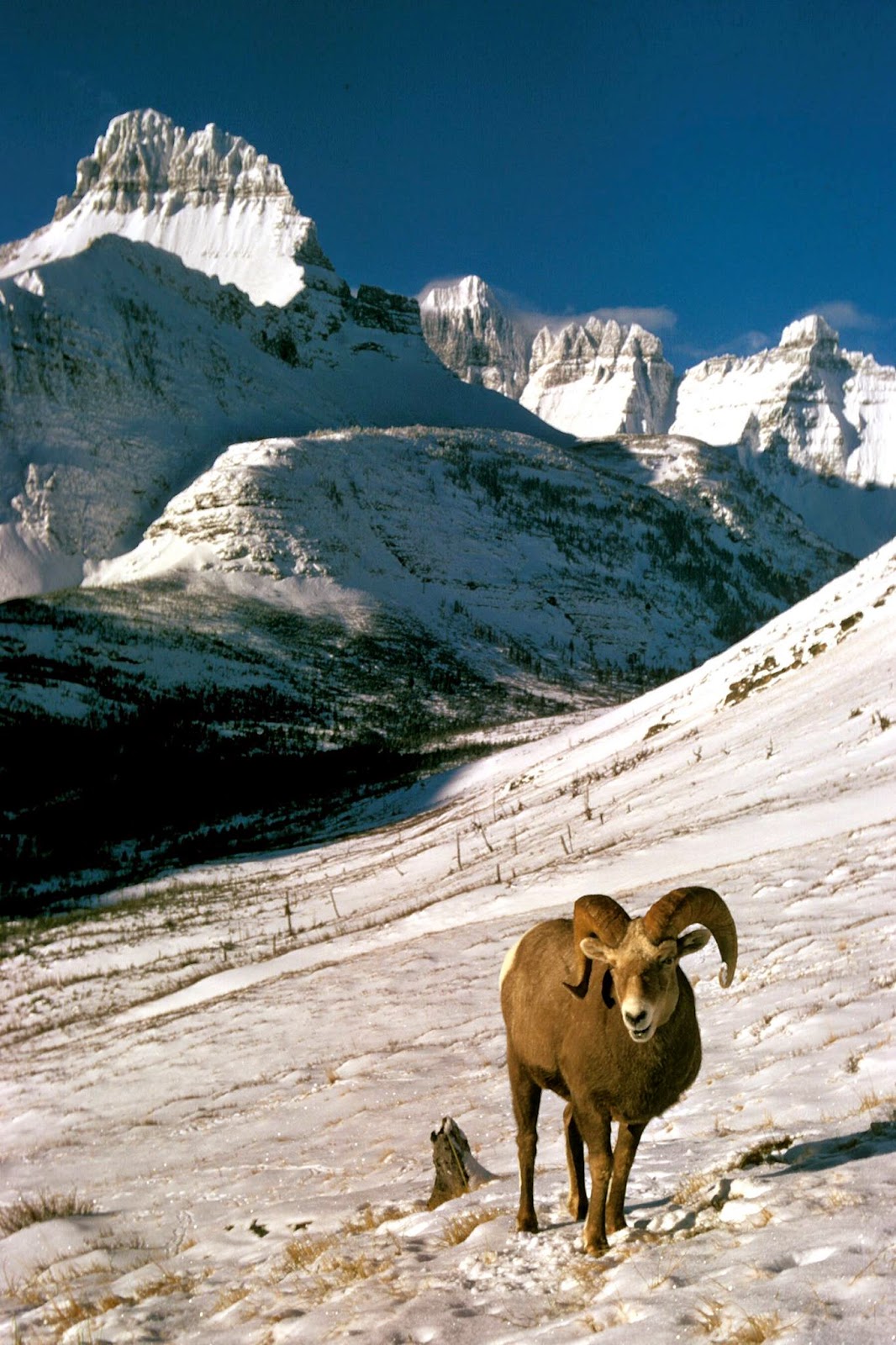
We crossed paths with Great Horn sheep, Mountain goats, Mule deer and many other animals. On one occasion we met some Mountain goats on a narrow, snow-covered trail with an 800 foot drop to the side. It didn't bother them. We pressed ourselves up against the mountain and they walked over our feet. It was definitely up-close-and-personal!

This is a picture on the east side of the park with our friend, Judy, from Cincinnati.  She was one of two women who made the trip to Glacier and tended a campground alone.  The other was our good friend, Jane, from Panama Beach. We had a great visit with Jane at St. Andrew State Park in Panama City in October. She too is a diver.  In the picture above we're on a guided trek. The ranger was extremely knowledgeable and has two books published. We are taking a break after about 5 miles out and a 2,000 foot climb. The two of them had me take over 100 pictures of wildflowers and plants. Pamela is planning to do a field guide for Glacier wildflowers.

This bear was actually closer than the picture shows.  We were going along the Going-to-the-Sun Road when we saw this bear running toward us at full speed. Despite our efforts, we can't get most visitors to spend $30 for bear-spray for their own protection. There were a number of visitors on the road but Pamela and I were the only two with bear-spray. We were suddenly everyone's best friends. The bear stopped running a hundred yards or so from us. All Glacier employees must attend "bear school". We were no exception and so we applied what we learned. But bears all have their own personalities and this one wasn't going to be put off. He kept walking toward us. The road is only 16 feet wide. The bear walked along on one side while we stood on the other with all of the visitors behind us.  He ambled off down the road and everyone was happy.  The visitors all had a great bear story to tell when they got home. Employees are asked to report any bear sightings.  Pamela and I turned in 15 reports (some of them reporting as many as 4 bears) in 10 weeks.  Glacier is definitely bear country.

There are not words that I can type or say, sounds that I can make or any means of communication that will express the feelings of wonder, awe, love and excitement I felt every moment I spent at Glacier and in the high Rockies. This is a marvelous part of the paradise which has been entrusted to us to care for and turn over to our children unblemished.  If you have not been to Glacier or the Rockies, it is a must do trip for you.  Even if you can't bike, hike, kayak or camp, your National Park Service has made sure that you can enjoy these marvelous places up close with many handicapped assessible areas. It is an experience that will leave you wanting to start sing "America the Beautiful".

P.S. I feel compelled to add that without your help . . . without your raising your voice and vote to  stop greedy developers and companies who don't care about environment or wilderness but only the bottom line and stockholder profits . . . without your involvement this too will pass. And wilderness is NOT a renewable resource. Once it's gone. It's gone. Join  Sierra Club, National Wildlife Federation or one of the great organizations who work everyday to protect this country for you and your posterity.


Friday, May 9, 2014

Conservation and old trailers

     I know there are a lot of arguments in support of our throw-away society.  Some are relatively compelling.  All of them are either economic or sociologic.  None of them considers the future or the waste of natural resources.  As compelling as they may be to our short-term, myopic future, I have a problem with them.  Basically they all seemed to be based upon the premise that the human animal is incapable of adapting and must have certain comforts which, when investigated, are comforts that a small percentage of humans enjoy and have enjoyed for a relatively short period of our history - less than a century.  I really believe that there is no evidence for either premise.  We could not have survived this long and become the dominant animal without the ability to adapt.  
     When I attended Trinity College, University of Dublin,  a high percentage of the students attended lectures and studied in buildings hundreds of years old. They were perfectly good buildings and their age in no way hindered the quality of TCD education.  "New Square", which is still a dominant part of the university, was built in 1491.  In contrast, there is a parcel of land in Evansville, IN that has had at least four brand new commercial buildling built on it since 1990. Each of the preceding buildings were razed. All of that debris had to go into a landfill.  
     I think of this every time I observe or participate in a group like Tin Can Tourists.  Tin Can Tourists was founded in 1919 as a vintage trailer club.  Our 30 year old Fleetwood Wilderness camper is a relative youngster at rallies. There are such clubs in the US that save all sorts of things - from buildings to old cars and toys. When we consider these clubs and their members there are two common reactions; viz. delight in whatever it is they are restoring and considering the members a strange group of people. I say 'thank goodness for the eclectics who march to the beat of a different drum.'  
     Clubs, organizations and societies that save and restore do so much more than preserve history. They also play an important part in the conservation of natural resources as well as teach others by example how to enjoy a richer and productive life. 
      No, I'm not exagerating.  Consider the vintage trailer enthusiast.  When you save an old trailer you are not only keeping it out of a landfill but youare reducing the resources used to build a new one. That act alone not only slows the demise of our natural resources but permits us to determine the best, most efficient use as well as greatest need for those resources. 
     But there is more than the argument for conservation and stewardship of our world.  Consider the joy that such activity brings not only to the direct participants but to those who visit a rally and admire the fruit of their labors.  How many people have you seen attend a vintage trailer rally, antique car show, or visit a preserved building and not come away with a smile and light heart.  As a retired psychotherapist, I'd have to call such activities therapeutic. 
     Then you must consider the actual participant in the restoration.   The joy of discovery.  The knowledge gained and shared resulting from research into the history of the object.  The excitement of watching the project develop - sharing progress through pictures on social media such as Facebook. The person who finds that they can do something which they never thought possible, and the satisfaction and pride in using those skills.  Our Fleetwood Wilderness camper, which we call 'Willy', was destined for the junk yard. Three days from now it will become our home for 12 weeks as we volunteer in the wilderness of Glacier National Park.  
     Staying with example of the trailer, and remembering that this applies to many other things from toys to buildings, consider starting with this . . . .

and ending up with this . . .

Or starting with this . . . 

and ending up with this . . .

Collectors and others who restore and preserve things like cars, trailers, books, buildings, toys, skills, etc., etc., bring us not only a lot of joy but preserve our history and help us conserve natural resources so that our grandchildrens' grandchildren can enjoy what we so often take for granted.